
Voyager 1 crosses 16 billion-mile mark, becoming first human object one light-day from Earth
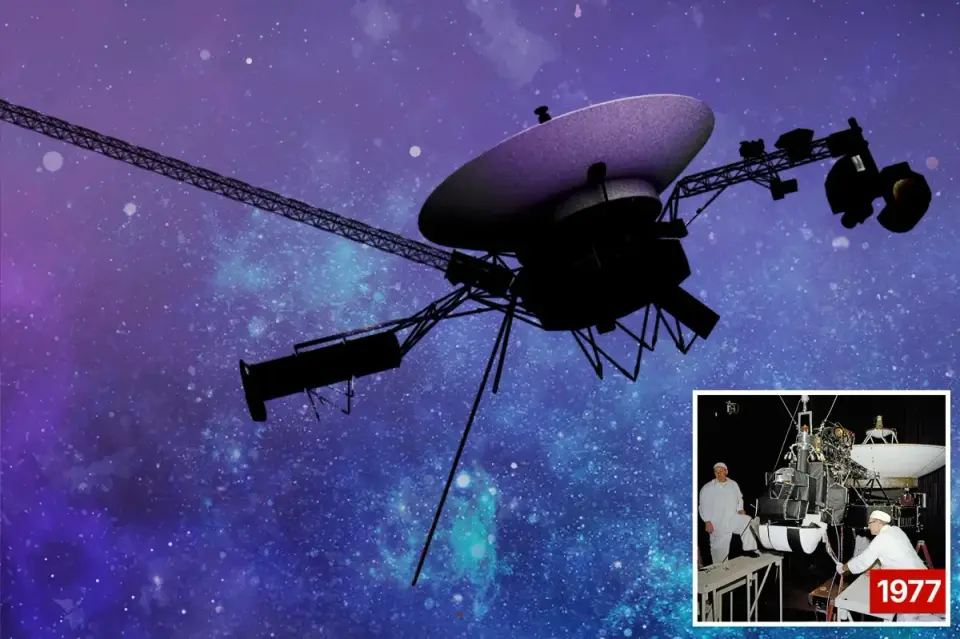
NASA’s Voyager 1 probe has reached a distance of one light-day from Earth, approximately 16 billion miles, making it the farthest human-made object in history. The milestone, confirmed by advance calculations, was achieved on November 18, 2026. While the probe continues to transmit scientific data on interstellar magnetic fields and plasma, its communication delay now extends to 48 hours for a round trip. Engineers have recently implemented power-saving measures to extend the mission’s life, though the spacecraft is nearing the end of its operational capability.
Key points
- Voyager 1, launched in 1977, crossed the one-light-day threshold on November 18, 2026, at 5:16 a.m. ET, a distance of roughly 16 billion miles.
- The probe is the most distant human-made object, surpassing Pioneer 10 in 1998, and is currently traveling at nearly 38,000 miles per hour.
- Communication with the spacecraft now requires a 24-hour delay for signals to reach it and another 24 hours for responses, creating a 48-hour round-trip time.
- NASA’s Jet Propulsion Laboratory scheduled a briefing on November 19 to discuss the milestone and confirm the probe’s status.
- Recent power-saving maneuvers, referred to as the 'Big Bang,' have extended the probe’s operational life by approximately two and a half years.
- Voyager 1 is currently transmitting data on interstellar magnetic fields, cosmic rays, and plasma waves, though only two of its ten original instruments remain active.
Background
Voyager 1 and its twin, Voyager 2, were launched in 1977 with a planned five-year mission to study Jupiter and Saturn. Both probes have operated for nearly 50 years, far exceeding their original design life. Voyager 1 entered interstellar space in 2012, while Voyager 2 followed in 2018. In late October 2026, Voyager 1 experienced a 48-hour communication outage, which resolved itself but highlighted the fragility of the aging spacecraft. NASA has been managing declining power levels from the probe’s radioisotope thermoelectric generators, which have dropped from 470 watts at launch to approximately 210 watts today.
How outlets are covering it
The New York Post and CNN emphasize the historic nature of the one-light-day milestone, highlighting it as an unprecedented achievement for human-made objects. The Atlantic frames the event as a symbolic reversal of Earth’s relationship with the cosmos, noting that for billions of years, matter only fell onto Earth, but now humanity has sent an object one light-day away. CNN provides detailed technical context on the 'Big Bang' power-saving maneuver and the recent communication outage, while the New York Post focuses on the scientific data being returned, such as the detection of interstellar gas vibrations. All sources agree on the probe’s distance and speed but differ in their emphasis: The Atlantic focuses on philosophical implications, CNN on engineering challenges, and the New York Post on scientific observations.
Why it matters
The one-light-day milestone underscores the longevity and resilience of Voyager 1, a spacecraft designed for a five-year mission that has operated for nearly 50 years. It highlights the challenges of deep-space exploration, including communication delays and power management, and sets the stage for the probe’s eventual end of mission. The data being returned by Voyager 1 provides unique insights into interstellar space that cannot be obtained from Earth-based telescopes, making the probe’s continued operation valuable for scientific research. The milestone also serves as a reminder of the fragility of the spacecraft, as engineers work to extend its life through innovative power-saving measures.
What to watch
NASA’s Jet Propulsion Laboratory will confirm the one-light-day milestone after receiving a signal from Voyager 1, which is expected within a day. The agency will continue to monitor the probe’s status and manage its power consumption to extend its operational life. Voyager 2 is expected to reach the one-light-day milestone in 2035, but it is unclear whether it will still be operational by then. NASA will continue to use the Deep Space Network to communicate with Voyager 1, though the 48-hour round-trip time will require careful planning for commands and data retrieval.
- NASA Voyager 1 probe believed to have accomplished 'astounding feat' in reaching milestone New York Post
- After 49 Years, Voyager 1 Is a Mind-Blowing One Light-Day From Earth The New York Times
- Voyager 1 is now a light-day from Earth. Here's what to know about NASA's longest-running mission PBS
- A New Milestone for Life on Earth The Atlantic
- Voyager 1, the farthest human-made object, is now one light-day from Earth CNN
Want the full story? Read the original reporting
Read on New York Post