
Webb Telescope Identifies 'Black Hole Star' in Early Universe
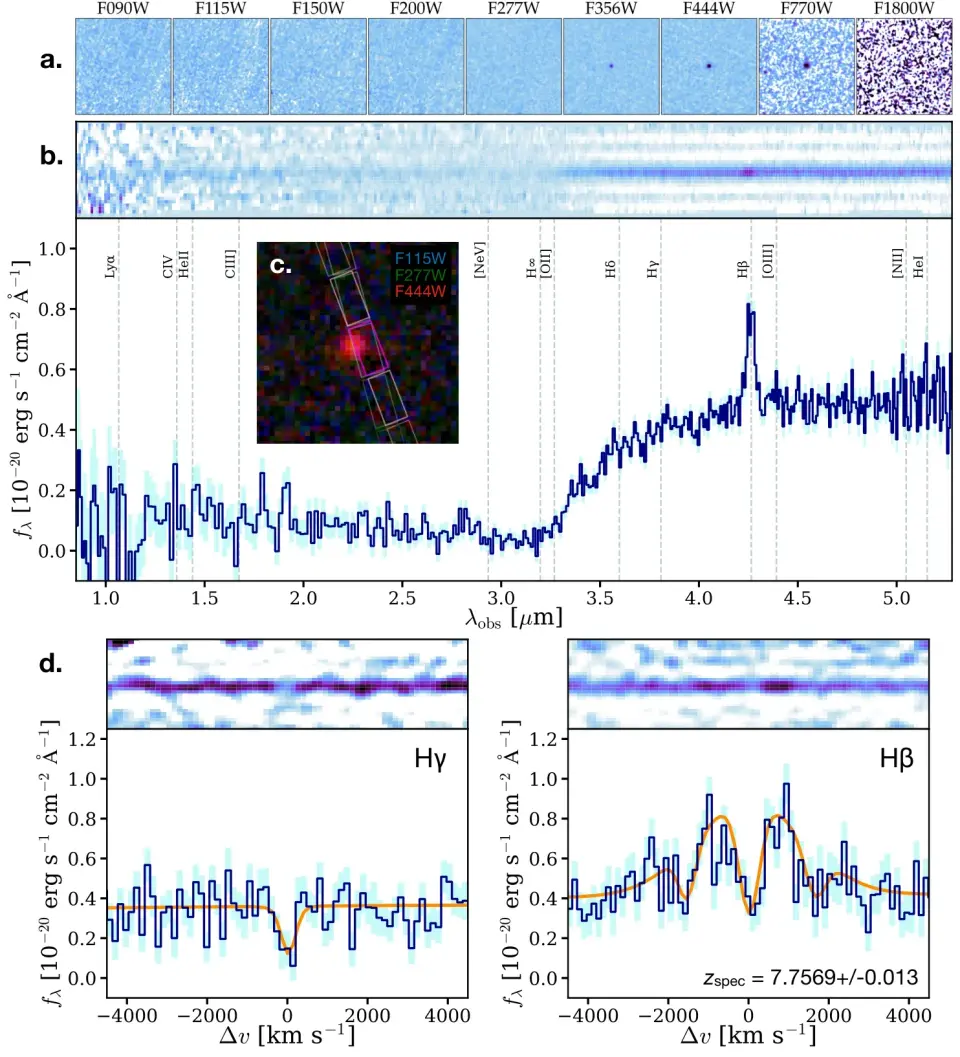
Astronomers have identified a unique object, MoM-BH*-1, existing 660 million years after the Big Bang, which appears star-like but emits energy equivalent to 100 billion Suns. The object is likely a black hole surrounded by dense gas, not a fusion-powered star.
Key points
- MoM-BH*-1 was detected by the James Webb Space Telescope in the PRIMER field, appearing as the reddest source in its region.
- The object exhibits a massive Balmer break, far exceeding limits for standard stellar populations, indicating dense gas absorption rather than dust.
- Its luminosity is too high for nuclear fusion, suggesting an accreting black hole as the power source.
- The gas envelope is nearly dust-free, with hydrogen densities around 10^11 particles per cubic centimeter.
- This discovery offers a potential explanation for 'little red dots' observed in the early universe.
Background
Previous observations by the James Webb Space Telescope identified numerous 'little red dots' in the early universe, which were initially thought to be compact galaxies or supermassive stars. Recent models suggested these could be active galactic nuclei obscured by dust or gas. The current finding builds on these earlier investigations into the nature of these enigmatic objects.
How outlets are covering it
Space Daily and Nature emphasize the object's anomalous Balmer break and the role of dense, dust-free gas in creating a star-like spectrum. Wired and Smithsonian highlight the 'black hole star' concept, noting that the object outshines its host galaxy, providing a pure view of the phenomenon. While some earlier models suggested dust or supermassive stars, the current consensus points to a gas-enshrouded black hole. The black hole mass is estimated between one million and ten million solar masses, though standard calibrations may overestimate this.
Why it matters
This discovery provides a potential mechanism for the rapid growth of supermassive black holes in the early universe. If 'little red dots' are indeed black hole stars, it could resolve the timing problem of how billion-solar-mass black holes formed within the first 700 million years after the Big Bang.
What to watch
Future observations will focus on time monitoring to detect variability consistent with an active black hole. Deeper spectra and longer-wavelength observations will test the predicted behavior of the gas cocoon. Researchers will also investigate whether this object represents a common phase in black hole growth.
- James Webb spotted a bizarre object just 660 million years after the Big Bang that looks like an enormous star but shines with roughly 100 billion Suns' worth of energy — because hidden inside its star-like cocoon is an accreting black hole, rather than a core Space Daily
- A gas-enshrouded and gas-reddened black hole at cosmic dawn Nature
- Astronomers Discover the Existence of a Black Hole Star WIRED
- How the universe got its spots The Economist
- Astronomers Peered at the Early Universe and May Have Discovered a New Kind of Celestial Object: Black Hole Stars Smithsonian Magazine
Want the full story? Read the original reporting
Read on Space Daily