
Falcon 9 Launch Creates 'Space Jellyfish' as Dragon Delivers Final Solar Arrays to ISS
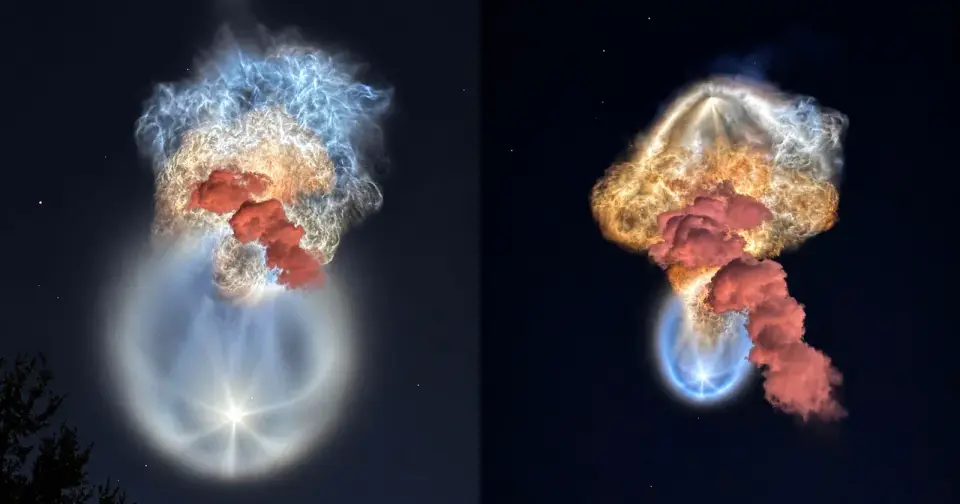
A pre-dawn SpaceX Falcon 9 launch on October 13, 2026, created a glowing 'space jellyfish' phenomenon visible across the US East Coast. The mission, the 35th Commercial Resupply Services (CRS) flight for NASA, delivered over 6,300 pounds of cargo to the International Space Station (ISS), including the final Roll-Out Solar Arrays (IROSAs). The Dragon spacecraft successfully docked with the ISS Harmony module on October 15, 2026, at 10:27 a.m. EDT, carrying scientific experiments for Expedition 75.
Key points
- The Falcon 9 rocket launched at 6:33 a.m. EDT on October 13 from Space Launch Complex 40 at Cape Canaveral Space Force Station in Florida.
- Sunlight illuminated the expanding exhaust plume in the upper atmosphere, creating a jellyfish-like shape visible to observers in Florida, Georgia, New York, and Virginia.
- The Dragon spacecraft carried approximately 6,300 pounds of supplies, equipment, and science investigations to the ISS.
- The cargo included the final set of International Space Station Roll-Out Solar Arrays (IROSAs), which are scheduled for installation later in the fall.
- The Dragon spacecraft docked with the ISS Harmony module on October 15 at 10:27 a.m. EDT and is scheduled to remain until mid-November before returning to Earth.
- The first-stage booster successfully landed at Landing Zone 40 after the launch.
Background
This launch is part of NASA's ongoing Commercial Resupply Services program, which has seen 35 missions to date. The 'space jellyfish' phenomenon has been documented in previous pre-dawn or sunset launches, where sunlight illuminates high-altitude rocket exhaust while the ground remains dark. Our archive notes that this specific mission was anticipated to deliver the final Roll-Out Solar Arrays, a key piece of hardware for the station's power system.
How outlets are covering it
PetaPixel and Space.com focused heavily on the visual spectacle of the 'space jellyfish' phenomenon, highlighting the aesthetic appeal of the rocket exhaust interacting with the upper atmosphere. NASA Science provided a technical timelapse video from Indian Harbour Beach, Florida, detailing the sequence of stage separation, boost-back, and landing. NASA's official statement emphasized the scientific payload, including experiments on artificial retinas, 3D heart tissue models, and brain organoids, alongside the delivery of the final IROSAs. All sources agree on the launch time, location, and the successful docking of the Dragon spacecraft.
Why it matters
The successful delivery of the final Roll-Out Solar Arrays is a significant milestone for the ISS, as these arrays will enhance the station's power generation capabilities. Additionally, the scientific experiments being conducted, such as those on artificial retinas and brain organoids, have the potential to advance medical treatments on Earth. The visual phenomenon also serves as a reminder of the intersection of spaceflight and public engagement, inspiring awe and interest in space exploration.
What to watch
The Dragon spacecraft is scheduled to remain at the ISS until mid-November 2026, after which it will depart and return to Earth, splashing down off the coast of California. The crew of Expedition 75 will begin unpacking the Dragon and activating new science experiments. Another SpaceX Falcon 9 launch is scheduled for October 19, 2026, at 6:30 a.m. from the same location, which may also produce a similar visual phenomenon.
- Photographers Capture ‘Space Jellyfish’ Left Behind by Rocket Plume PetaPixel
- APOD: 2026 October 16 – Chasing the International Space Station NASA Science (.gov)
- Cosmic 'jellyfish' wows skywatchers after SpaceX launch | Space photo of the day for Oct. 14, 2026 Space
- SpaceX Dragon Docks with Science, Supplies, and Roll-Out Solar Arrays NASA (.gov)
- SpaceX launches NASA science and cargo to the International Space Station Spaceflight Now
Want the full story? Read the original reporting
Read on PetaPixel