
Ukrainian Drone Campaign Drives Russian Refining to 24-Year Low
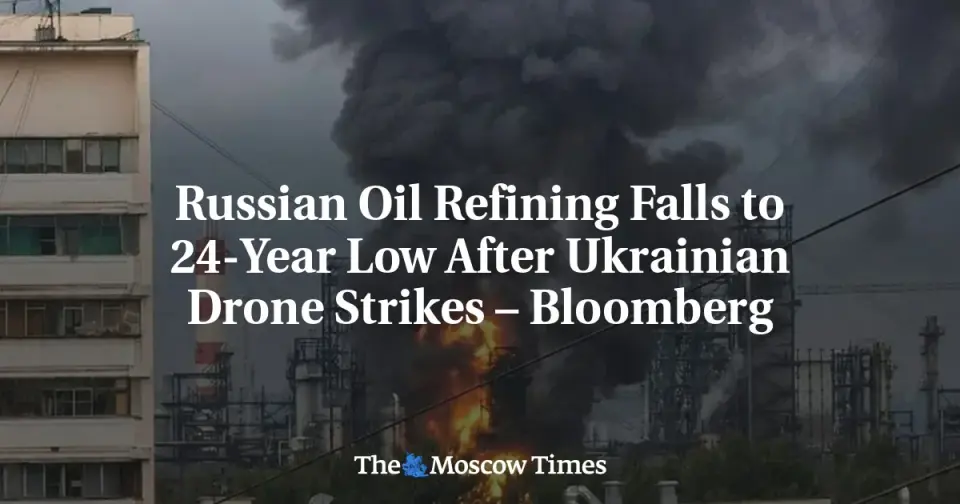
Russian oil refining output plummeted to its lowest level in over two decades in July 2026, processing only 3.6 million barrels per day. This sharp decline, roughly one-third below seasonal norms, was driven by an intensified Ukrainian drone campaign targeting refineries, tankers, and pipelines. While Moscow can redirect some crude to Baltic ports, analysts warn that limited pipeline and storage capacity prevents full compensation for the losses.
Key points
- July 2026 refining output hit 3.6 million barrels per day, the lowest since May 2002, according to EA Analytics data cited by Bloomberg.
- Ukrainian forces targeted 18 Russian refineries in July, including the Omsk refinery, located over 2,500 kilometers from the border.
- Bloomberg counted 30 attacks on oil infrastructure in July, the second-highest monthly total after 32 strikes in May.
- Strikes also hit five large tankers, five pieces of port infrastructure, and two pipelines, with loading suspended at the Caspian Pipeline Consortium terminal.
- Analysts note that while Russia can shift some volume to Baltic Sea terminals, spare capacity is insufficient to handle all diverted Black Sea volumes.
Background
This decline follows a sustained campaign of Ukrainian strikes on Russian energy infrastructure throughout 2026. Earlier in the year, Ukrainian drones hit oil terminals in St. Petersburg and refineries in Saratov and Tatarstan. In early August, strikes on the Bashneft complex in Ufa, Bashkortostan, further disrupted processing at facilities with a combined capacity of over 23 million tonnes annually. These events underscore a broader pattern of deep-range attacks aimed at degrading Russia's export revenue and military logistics.
How outlets are covering it
Bloomberg and The Moscow Times emphasize the statistical severity of the July drop, highlighting the 24-year low and the sheer volume of attacks. The Guardian and BBC focus on the operational details of recent strikes, such as the sinking of the sanctioned ship Yanina and the targeting of the Engels airfield, framing these as part of a strategy to cut off war funding. Ukrainian sources, including Ukrainska Pravda, confirm specific hits on the Saratov refinery and fuel depots, describing them as strategic facilities supporting the military-industrial complex. While Russian officials report high interception rates and civilian casualties, Western analysts like Jorge Leon of Rystad Energy argue that Russia's logistical constraints limit its ability to fully offset the damage through alternative routing.
Why it matters
The collapse in refining capacity threatens Russia's primary source of export revenue as the war enters its fifth year. If Ukraine continues to prioritize energy infrastructure, Moscow may face significant economic strain and reduced fuel availability for its military. The inability to fully compensate via Baltic ports suggests that the damage to Russia's oil sector is becoming structural rather than temporary.
What to watch
The trajectory of Russian oil exports will depend on Ukraine's drone availability and target selection. Analysts expect continued pressure on refineries and tankers, with potential further disruptions to the Caspian Pipeline Consortium. Russia may intensify air defense measures, but experts doubt this will provide complete protection against long-range strikes.
- Russian Oil Refining Falls to 24-Year Low After Ukrainian Drone Strikes – Bloomberg The Moscow Times
- Ukraine’s Shifting Strikes Deepen Uncertainty Around Russian Oil Bloomberg.com
- Ukraine says major Russian oil refinery and airfield hit, as Moscow reports eight deaths BBC
- Ukraine war briefing: Strikes on three Russian oil refineries and sanctioned ship The Guardian
- Ukraine's General Staff confirms strikes on Saratov oil refinery, Engels airfield and fuel depot Українська правда
Want the full story? Read the original reporting
Read on The Moscow Times