
Archaeologists Identify 11th-Century Abbot in Westminster’s Roman Sarcophagus
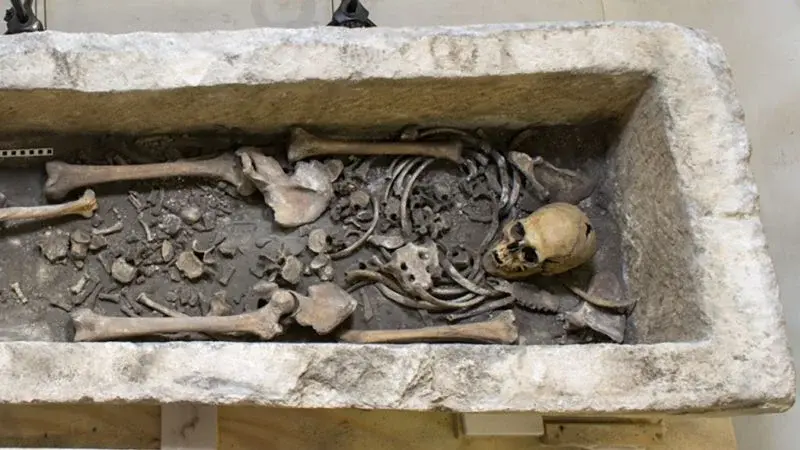
A new study resolves a 150-year mystery at Westminster Abbey by identifying the skeleton inside a Roman sarcophagus as likely belonging to an 11th-century abbot. Radiocarbon dating and skeletal analysis confirm the occupant died between 987 and 1052 CE, contradicting the Roman inscription on the coffin. The findings suggest the high-status monk was buried in a repurposed Roman tomb, a practice considered prestigious in the late Anglo-Saxon period.
Key points
- Warwick Rodwell’s study, published in the Journal of the British Archaeological Association, identifies the remains as likely belonging to Abbot Ælfwig or his successor Wulfnoth.
- Radiocarbon dating places the death of the individual between 987 and 1052 CE, while skeletal analysis indicates he was aged 35 to 49 at the time of death.
- The sarcophagus, originally inscribed for a 4th-century Roman named Valerius Amandinus, features a medieval cross carved onto its lid, indicating reuse.
- Conservation work in 2016 revealed that the skeleton was still inside the coffin, contradicting 19th-century reports that the bones had been lost or misplaced.
- The discovery of a lime residue suggests the body was first placed in a wooden coffin before being interred in the stone sarcophagus, a rare practice for high-status individuals.
Background
This story follows earlier coverage from October 2026, which first reported that Professor Rodwell had identified the remains as belonging to an 11th-century abbot. The current briefing expands on those initial reports by detailing the specific archaeological evidence, including the lime residue and the history of the coffin’s rediscovery in 1820 and 1869.
How outlets are covering it
While all sources agree on the identification of the occupant as a medieval abbot, they differ in emphasis. CNN and ZME Science highlight the 'mystery' aspect, focusing on the 150-year gap since the coffin’s discovery and the confusion caused by the 1820 excavation. The Jerusalem Post and Current Archaeology focus more on the technical details of the radiocarbon dating and the specific candidates, Ælfwig and Wulfnoth. ZME Science uniquely details the 1820 incident where workers broke the lid and disturbed the bones, a detail less emphasized in other outlets. All sources agree that the reuse of the Roman coffin was a sign of prestige, but ZME Science provides the most detailed account of the lime residue found inside the sarcophagus.
Why it matters
This discovery resolves a long-standing historical puzzle and provides new insights into burial practices in Anglo-Saxon England. It demonstrates how high-status individuals were buried in repurposed Roman monuments, reflecting the value placed on such artifacts. The findings also correct historical records that incorrectly stated the skeleton had been lost, highlighting the importance of re-examining historical artifacts with modern techniques.
What to watch
Further research may be conducted to determine whether the occupant was specifically Abbot Ælfwig or Wulfnoth, as current evidence does not definitively distinguish between the two. Additionally, scholars may investigate the broader practice of reusing Roman sarcophagi in medieval England to understand the cultural and religious motivations behind such burials.
- Mystery skeleton at Westminster Abbey was likely an abbot buried in a secondhand sarcophagus CNN
- Skeleton found in Roman sarcophagus at Westminster Abbey may have belonged to medieval monk The Jerusalem Post
- A Roman Coffin at Westminster Abbey Held the Wrong Body for More Than 1,000 Years ZME Science
- Recycled Roman sarcophagus reinvestigated at Westminster Abbey The Past website
- Archaeologists may have discovered identity of mystery skeleton in Westminster Abbey www.christiantoday.com
Want the full story? Read the original reporting
Read on CNN