
Dogs Mimic Infant Language Processing by Tracking Consonants in Speech
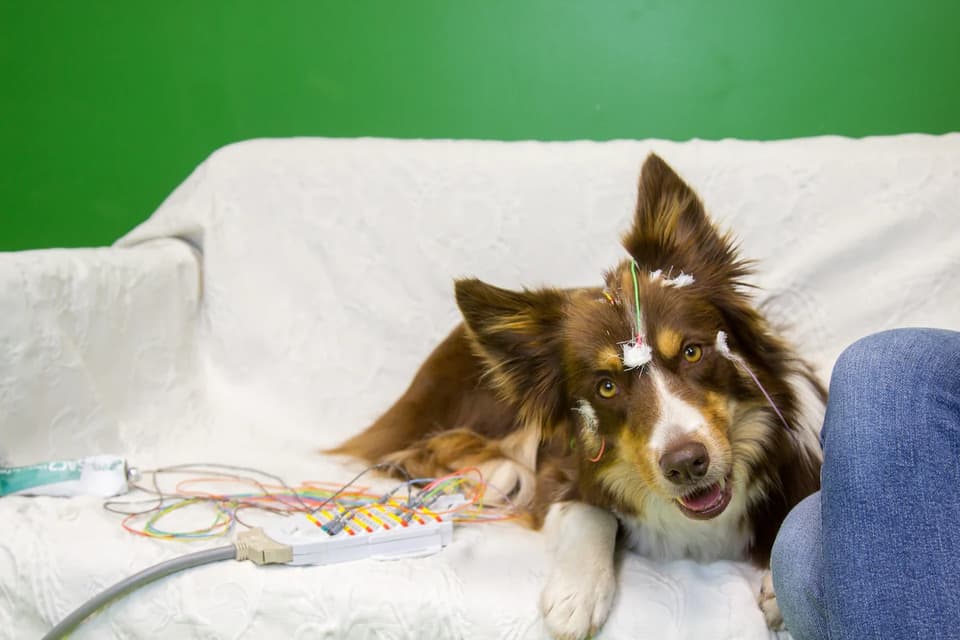
A new study from Hungary reveals that dogs use consonant patterns to segment words in human speech, mirroring the cognitive strategy used by human infants. Brain activity data shows dogs prioritize consonants over vowels to detect word boundaries, suggesting that living in a speech-rich environment has shaped their neural pathways.
Key points
- Researchers at Eötvös Loránd University found that dogs rely on consonant bias to identify word boundaries in continuous speech, similar to human infants.
- The study used EEG measurements on 20 dogs and 20 humans, showing dogs' brain activity synchronized 42% more strongly with consonant-based rhythms than vowel-based ones.
- The findings suggest that domestication and exposure to human speech have reshaped dogs' cognitive processing, though the effect may vary across languages.
- Experts note that while the study proves dogs detect statistical patterns in consonants, it does not confirm they understand semantic meaning, only word segmentation.
Background
Previous research has established that dogs respond to human speech and tone, but this study provides the first evidence that their brains actively process speech structure. Earlier coverage in our archive highlighted that dogs track consonants in human speech, mirroring infant language processing, confirming that living in a speech-rich environment shapes their neural pathways. This builds on prior findings that dogs care about how humans speak, not just what they say.
How outlets are covering it
The Washington Post emphasizes the parallel between dogs and human infants, framing the discovery as a surprising cognitive similarity. The Independent highlights the practical implication that dogs may respond better to names with more consonants. New Scientist provides technical detail on the EEG methodology and notes that the consonant bias may be specific to languages like Hungarian, where consonants are more informative for word boundaries. All sources agree that the study demonstrates a neural synchronization effect, but New Scientist cautions that the results may not generalize to all languages or dog populations.
Why it matters
This research deepens our understanding of how domestication shapes animal cognition, showing that dogs have adapted their brains to process human speech. It suggests that the bond between humans and dogs is not just emotional but neurologically embedded, with dogs evolving to decode human communication in ways that mirror early human language development. This could inform future studies on animal communication and the impact of human-environment interactions on cognitive evolution.
What to watch
Researchers plan to test whether dogs not exposed to human speech, such as wolves, lack this consonant bias, which would confirm the role of domestication. Future studies may explore how different languages affect dogs' speech processing, particularly in tonal languages where consonants may be less informative. The findings could also guide pet owners in choosing names or commands that are easier for dogs to process, potentially improving communication between humans and their pets.
- Dogs use a surprising method to understand human language, new study suggests The Washington Post
- Scientists reveal how dogs decode what humans are saying The Independent
- Dog brains track consonant patterns in speech, a first outside humans Phys.org
- Dogs pay more attention to consonants than vowels when we speak New Scientist
- Dogs listen to speech in a way that resembles human babies Earth.com
Want the full story? Read the original reporting
Read on The Washington Post