
Kagan and Soai Win 2026 Chemistry Nobel for Solving Molecular Handedness Mystery
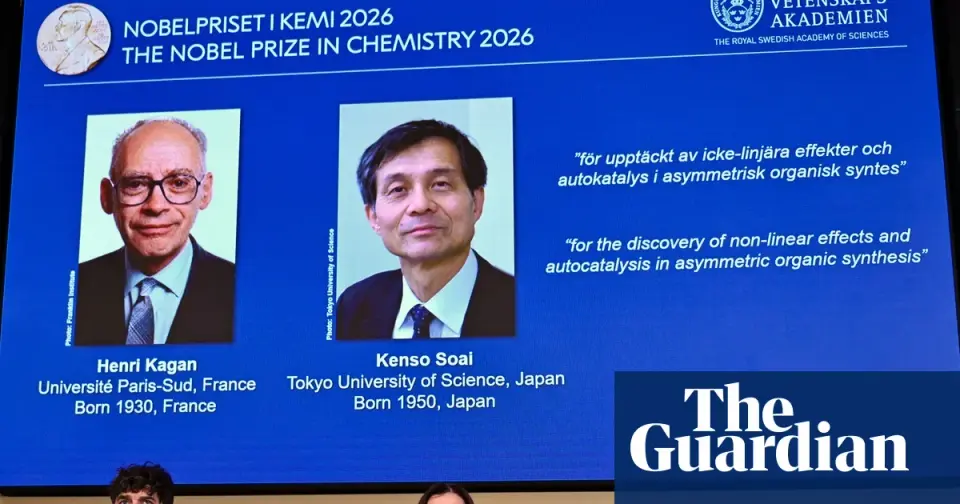
Henri B. Kagan and Kensō Soai have been awarded the 2026 Nobel Prize in Chemistry for their discoveries regarding nonlinear effects and autocatalysis in asymmetric organic synthesis. Their work explains how chemical reactions can produce an overwhelming excess of one mirror-image form of a molecule, a phenomenon known as homochirality. This breakthrough resolves a century-old mystery about the molecular origins of life and has revolutionized pharmaceutical development by allowing chemists to selectively synthesize specific molecular forms, thereby avoiding harmful side effects associated with their mirror-image counterparts.
Key points
- The Royal Swedish Academy of Sciences announced the winners on Wednesday in Stockholm, awarding each scientist 12 million Swedish kronor (approx. £900,000).
- Kagan’s 1986 discovery showed that a small imbalance in catalysts could create a greater excess of one mirror-image product, while Soai’s 2003 work demonstrated autocatalysis, where molecules catalyze their own production to achieve near-exclusive homochirality.
- The prize recognizes work that explains why life is 'homochiral,' using L-amino acids and D-sugars, despite laboratory reactions typically producing equal quantities of both forms.
- These discoveries have practical applications in medicine, as mirror-image molecules (enantiomers) can have vastly different biological effects, as seen in the thalidomide tragedy where one form caused birth defects.
- According to The Conversation, the ability to select specific molecular forms is crucial for drug safety, as one isomer may be therapeutic while its mirror image may be toxic.
Background
This award follows the 2026 Nobel Prize in Literature, awarded to Anne Carson, and continues the tradition of recognizing foundational scientific breakthroughs. The concept of chirality has been a subject of scientific inquiry for over a century, with previous archive coverage noting the long-standing puzzle of how life’s molecular 'handedness' emerged from symmetric chemical processes. The 2026 prize highlights the transition from theoretical understanding to practical application in asymmetric synthesis.
How outlets are covering it
The Guardian and The New York Times emphasize the historical significance of the discovery in solving the mystery of homochirality and its implications for the origins of life. The Conversation focuses on the practical pharmaceutical applications, detailing how the ability to synthesize specific isomers prevents the administration of harmful mirror-image drugs, citing the thalidomide case and recent research on resveratrol. Houston Public Media provides a behind-the-scenes perspective, noting that former Nobel Committee member Pernilla Wittung-Stafshede knew the winners before the public announcement, highlighting the secretive and long-term nature of the selection process.
Why it matters
The work of Kagan and Soai has fundamentally reshaped the field of organic chemistry, providing the tools to steer chemical reactions toward specific molecular configurations. This is critical for the pharmaceutical industry, where the 'wrong' mirror image of a drug can be ineffective or dangerous. By understanding how chirality is created and amplified, scientists can now design safer, more effective medicines and gain deeper insights into the biochemical foundations of life itself.
What to watch
The winners will receive their awards in December. The insights from Kagan and Soai’s work are expected to continue influencing the development of new catalysts and drug designs across various industries, further refining the ability to produce single-enantiomer compounds for medical and industrial use.
- Nobel prize in chemistry awarded for work on mirror-image molecules The Guardian
- Nobel Prize in Chemistry Is Awarded to Henri Kagan and Kenso Soai The New York Times
- Many drugs have mirror chemical structures, one helpful and the other harmful – a Nobel-winning discovery allows chemists to make either on demand The Conversation
- A Nobel for illuminating life’s asymmetry The Economist
- This Rice University professor has helped pick more than a dozen Nobel Prize winners Houston Public Media
Want the full story? Read the original reporting
Read on The Guardian