
New Fossils Show Homo erectus Survived in Chinese Rainforests Until 184,000 Years Ago
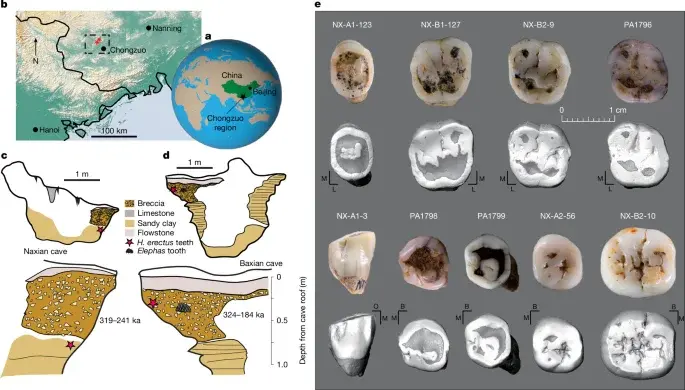
Researchers identified nine hominin teeth in two caves in southern China, dating them to 324,000–184,000 years ago. Eight teeth belong to Homo erectus, proving the species survived in mainland East Asia much longer than previously thought. Isotope analysis indicates they thrived in dense rainforests, challenging the idea that only modern humans could adapt to such environments. A ninth tooth remains unidentified but may belong to a Denisovan or hybrid lineage.
Key points
- Nine hominin teeth were discovered in Baxian and Naxian caves in Guangxi, China, dated to 324,000–184,000 years ago.
- Eight teeth are confirmed as Homo erectus through morphological and proteomic analysis, extending the species' known timeline in mainland Asia by up to 200,000 years.
- Isotope analysis of tooth enamel shows Homo erectus lived in dense rainforests, contradicting the belief that they were limited to open woodlands.
- A ninth tooth (PA1796) does not match Homo erectus, Neanderthal, or modern human profiles, suggesting it may belong to a Denisovan or an unknown lineage.
- The findings imply Homo erectus was more behaviorally flexible and mobile than previously assumed, potentially traveling up to 250 km.
Background
Homo erectus is the longest-surviving human relative, existing for nearly 2 million years before going extinct around 108,000 years ago in Indonesia. Previous fossil evidence from mainland China dated to approximately 400,000 years ago, leading scientists to believe the species vanished from the region as environments shifted to rainforests. This new discovery fills a significant gap in the geographical and chronological distribution of Homo erectus in East Asia, overlapping with the presence of Denisovans (Homo longi) in the region during the late Middle Pleistocene.
How outlets are covering it
Nature and National Geographic emphasize the proteomic and morphological evidence confirming the Homo erectus identity, highlighting the species' unexpected adaptability to rainforests. CNN and ABC News focus on the behavioral implications, such as long-distance mobility and ecological flexibility, which challenge previous assumptions about the species' limitations. While all sources agree on the dating and location, there is debate regarding the ninth tooth; some researchers suggest it may be a Denisovan or hybrid, while others note the lack of definitive molecular data for Denisovans makes classification difficult. The discovery also raises questions about why only Homo sapiens survived, as other hominins may have possessed similar adaptive skills.
Why it matters
This discovery reshapes the timeline of human evolution in Asia, showing that Homo erectus coexisted with Denisovans and potentially early Homo sapiens in the same region. It challenges the narrative that modern humans were uniquely capable of surviving in challenging environments like rainforests, suggesting that other hominins may have possessed similar adaptive skills. Understanding the extinction of Homo erectus may provide insights into the impacts of climate change and competition on human evolution.
What to watch
Researchers plan to analyze more fossils from the region to determine the identity of the ninth tooth and to understand the interactions between Homo erectus, Denisovans, and early Homo sapiens. Further studies will focus on the genetic and proteomic data to clarify the evolutionary relationships between these hominin populations and to determine if the ninth tooth represents a new species or a hybrid lineage.
- Evidence for late Middle Pleistocene Homo erectus in mainland East Asia Nature
- Cave discovery in China reveals surprising survival skills of Homo erectus CNN
- Archaic human species Homo erectus mastered the rainforest in China Reuters
- Fossil teeth discovery supports multiple human species lived in rainforests ABC News & Headlines – Australian Broadcasting Corporation
- Homo Erectus May Have Survived in China 200,000 Years Longer Than We Thought National Geographic
Want the full story? Read the original reporting
Read on Nature