
Japan's MMX Launches to Return First Samples from Mars' Moon Phobos
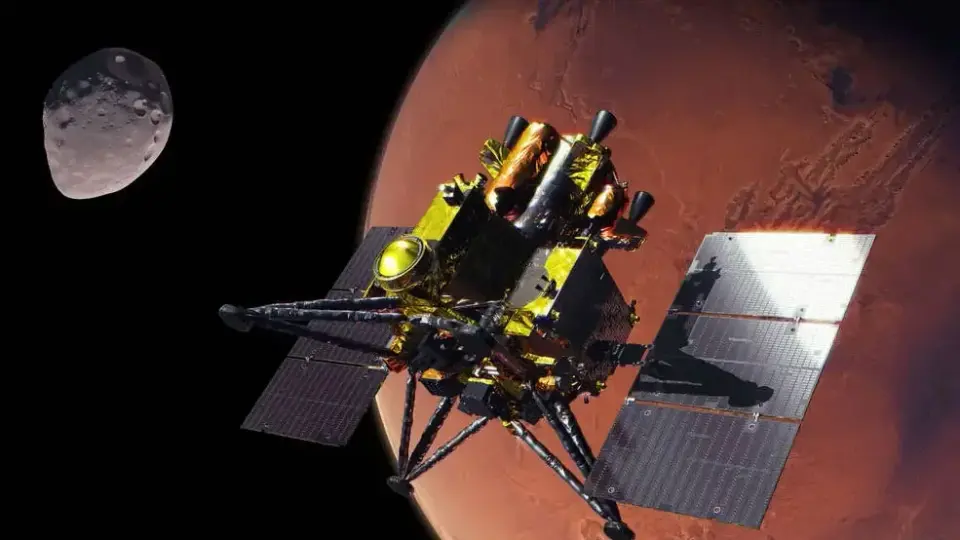
Japan's JAXA has launched the Martian Moons eXploration (MMX) mission, the first spacecraft designed to travel to Mars, land on its moon Phobos, and return samples to Earth. Launching on an H3 rocket from Tanegashima, the mission aims to resolve the origin of Mars' moons by analyzing soil composition. The spacecraft will spend three years at Mars, deploy a rover, and collect at least 10 grams of material before returning to Earth in 2031.
Key points
- MMX launched on October 19, 2026, from Tanegashima Space Center on an H3 rocket.
- The mission is the first to attempt a sample return from a moon other than Earth's.
- It will land on Phobos to collect at least 10 grams of soil using a nitrogen-gas sampler.
- Samples are scheduled to land in Australia in 2031 before being shared with international partners.
- The mission aims to determine if Mars' moons are captured asteroids or debris from a giant impact.
Background
Previous coverage established that MMX is a joint international effort led by JAXA, with significant contributions from NASA, ESA, CNES, and DLR. Earlier reports confirmed the launch schedule and the scientific goal of analyzing Phobos to understand the formation of the Martian system. This briefing synthesizes the launch event and the detailed mission mechanics reported by multiple outlets.
How outlets are covering it
Space.com emphasizes the technical complexity of the three-module spacecraft and the international collaboration, noting Mitsubishi Electric's role in construction. Mashable highlights the scientific stakes, quoting NASA's Tom Statler on the historic nature of the return and detailing the 'Megane' instrument's role in measuring gamma rays and neutrons. AP News provides a concise overview of the mission's timeline and objectives. All sources agree on the launch date and the 2031 return target, but differ in emphasis: Space.com focuses on the engineering, while Mashable focuses on the geological implications for understanding Earth and Mars history.
Why it matters
This mission represents a critical step in planetary science, potentially resolving the long-standing debate about the origin of Mars' moons. The successful return of samples could provide insights into the early solar system and inform future robotic and human missions to Mars. It also demonstrates the capability of international space agencies to collaborate on complex sample-return missions beyond Earth's orbit.
What to watch
The spacecraft will travel to Mars over the next 10 months, arriving in August 2027. It will then spend three years studying Phobos and Deimos, deploying a rover and collecting samples. The return capsule is scheduled to land in Australia in 2031, after which the samples will be transported to Japan for analysis and distribution to partner agencies.
- Returning the first samples from a Martian moon: Inside the science of Japan's bold MMX mission to Mars Space
- Japan to launch spacecraft on a mission to get samples from a Martian moon AP News
- Japan to launch historic round-trip mission to Mars moon Japan Today
- JAXA's Martian Moons Exploration mission launch: how to watch live Mashable
- The New Phobos Martian Moon Rover That Weighs In At Only 15 Grams Hackaday
Want the full story? Read the original reporting
Read on Space