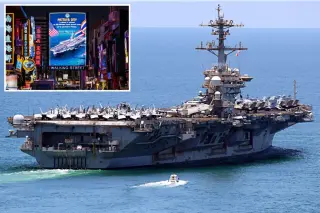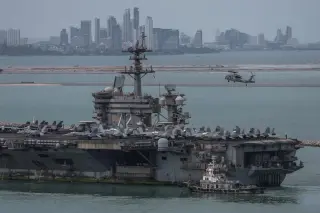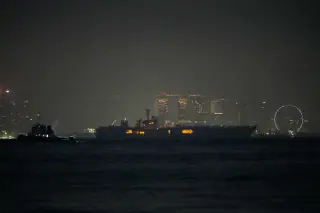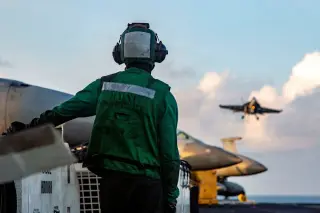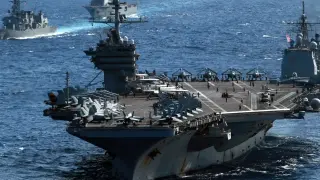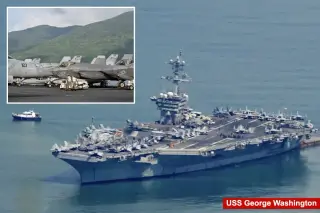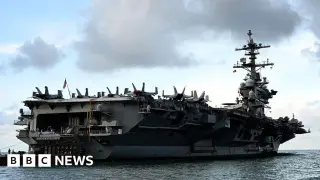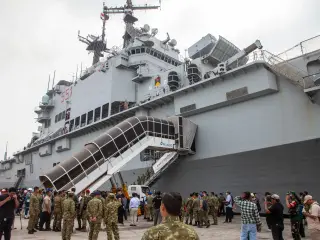
The U.S. Navy’s oldest active aircraft carrier is making its final overseas port call as it nears retirement, reflecting on decades of service while the service plans for its replacement and continued carrier operations.
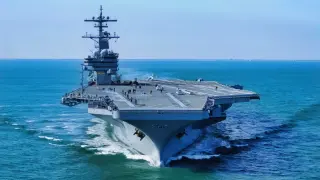
The USS Gerald R. Ford, the Navy’s newest nuclear-powered aircraft carrier, has returned to its home port after extensive sea trials and testing, signaling its readiness for deployment and marking a milestone in the service’s carrier program.
The USS Gerald R. Ford is ending a record-long period at sea and departing Naval Station Norfolk as the Navy wraps up the carrier's unusually lengthy deployment.
The USS George H.W. Bush and its carrier strike group arrived in waters near Iran, joining two other U.S. carriers and expanding American military options as President Trump presses Tehran to curb its nuclear program, reopen the Strait of Hormuz, and push toward an end to weeks of regional conflict.
A small Piper prop plane, flown by Sam Rutherford and co-pilot Shannon Wong, was buzzed by US Navy F/A-18s over the Arabian Sea near Oman while en route to India. With radio contact initially failing, the carrier’s jets pressed for a 15-degree course change. Rutherford balanced fuel and safety as two fighters circled the single-engine plane for about 30 minutes before easing off once they were clear of the carrier USS Abraham Lincoln and the route. The incident underscored ongoing Middle East tensions; CNN reported no comment from Central Command.
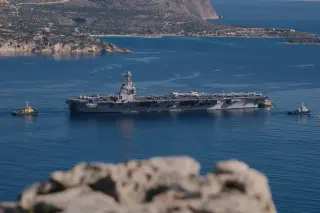
A fire aboard the USS Gerald R. Ford injures sailors and destroys about 100 berths, prompting a planned voyage to Crete for repairs on a nearly year-long deployment in the Red Sea, while ongoing toilet-clog problems and morale strains dominate discussions about the carrier’s readiness; officials and media say the ship may be relieved by another carrier as regional tensions with Iran persist.
The Houthis’ Red Sea drone and missile campaign forced the U.S. Navy to expend hundreds of high-cost interceptors (SM-2/3/6), sometimes up to $4 million each, in a long-running, asymmetrical battle that exposed vulnerabilities and served as a critical warm-up for potential high-end conflicts with Iran or China. The piece notes fatigue and ammunition depth as the Navy learns to counter drones, missiles, and unmanned surface craft, while warning that a broader war could require deploying another carrier strike group.
French President Emmanuel Macron ordered the nuclear-powered aircraft carrier Charles de Gaulle to move from the Baltic to the Mediterranean to protect allied assets amid the war in the Middle East, with Rafale fighters, air-defense systems, and drones deployed and French forces reporting self-defense drone shootdowns. He linked the move to recent strikes and stressed that actions should stay within international law, while calling for diplomacy and caution against escalation, as France reiterates support for its partners in the region.
China's Fujian aircraft carrier, the largest non-nuclear warship, debuts with an advanced electromagnetic catapult but a tight flight-deck layout may bottleneck launch-and-recovery and cap sortie-generation at about 60% of a U.S. Nimitz-class, signaling a transitional design ahead of nuclear-powered future carriers.
The USS Gerald R. Ford and its Carrier Strike Group have shifted from the Caribbean to the Middle East to bolster U.S. naval presence; if Ford remains deployed past mid-April, it could surpass the 294-day post-Vietnam record set by USS Abraham Lincoln in 2020 and approach 300 days, reflecting ongoing demand for extended carrier deployments amid maintenance delays and regional needs.
President Trump said that a change in power in Iran would be 'the best thing that could happen' as he confirms the deployment of a second aircraft carrier to the Middle East to pressure Tehran on its nuclear program and regional influence; the Ford will join the Lincoln group, doubling carrier assets in the region, while indirect talks with Iran via Oman continue amid Gulf-state warnings and ongoing Iranian protests.
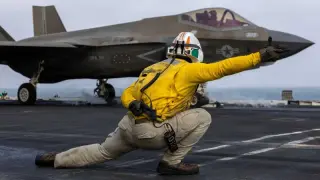
The U.S. military says an Iranian Shahed-139 drone aggressively closed in on the USS Abraham Lincoln in the Arabian Sea and was shot down by an F-35C in self-defense to protect the carrier and crew; no US military injuries or equipment damage were reported, as diplomatic talks with Iran on nuclear issues continue in the background.
With the USS Nimitz nearing the end of its planned life, the U.S. Navy must choose between a costly, full life-extension that requires significant shipyard work (including reactor/refueling and structural repairs) or a lighter modernization that buys time but cannot replicate Ford-class capabilities. The decision hinges on industrial capacity, carrier availability, and the ongoing ramp-up of Ford-class production; some argue for a bridging extension to maintain presence, while others warn of the high cost and opportunity losses from tying up shipyards and delaying other readiness priorities.
France announced plans to build a new nuclear-powered aircraft carrier capable of carrying 30 fighter jets and 2,000 sailors, expected to be ready by 2038, as part of a broader military modernization effort supported by increased defense spending under President Macron.
French President Emmanuel Macron announced plans to build a new, larger nuclear-powered aircraft carrier, the PANG, to replace the Charles de Gaulle by 2038, aiming to strengthen France's maritime power amid global tensions.