Tag

Ants

All articles tagged with #ants

Social-Parasite Ant Produces All-Queen Offspring
science12 days ago

Social-Parasite Ant Produces All-Queen Offspring

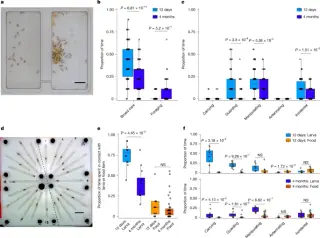
Temnothorax kinomurai invades nests of its relative T. makora, replacing the host queen while workers continue tending the nest; the parasite’s queens reproduce parthenogenetically, producing only queen offspring in both lab (six colonies yielding 43 offspring) and field (seven successful invasions yielding 57 offspring). The study, published in Current Biology on Feb 23, 2026, notes the all-queen strategy is rare and geographically limited to nine locations in Japan.

Backyard Discovery Suggests Ants Disperse Oak Galls, Not Just Seeds
science20 days ago

Backyard Discovery Suggests Ants Disperse Oak Galls, Not Just Seeds

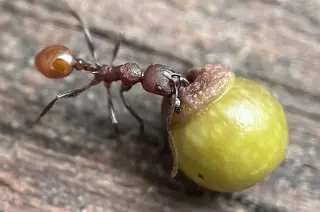
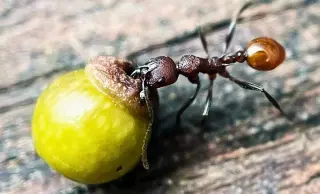
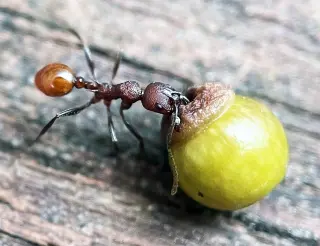
Penn State and SUNY researchers, sparked by an 8-year-old’s backyard observation, report that oak galls formed by gall wasps can be collected and carried by ants just like seeds. The study reveals a three-way interaction among ants, oaks, and wasps, with the kapéllo cap on galls releasing free fatty acids similar to seed elaiosomes, attracting ants to disperse the galls. This finding broadens our understanding of forest biodiversity and overlooked ecological interactions.

Backyard Clue Reveals Wasps Hijacking Ants to Move Oak Galls
science22 days ago

Backyard Clue Reveals Wasps Hijacking Ants to Move Oak Galls

An 8-year-old’s backyard find of oak galls revealed a new twist on seed dispersal: the galls produce a detachable cap, called kapéllo, that emits fatty-acid signals identical to plant elaiosomes, luring ants to carry the galls underground where the wasp larvae are protected; researchers say this convergent evolution shows ants, wasps, and oaks have a hidden, ecosystem-wide interaction with potential implications for nutrient and pathogen movement in forests.

Backyard discovery rewrites biology: ants, wasps, and oaks reveal a hidden alliance
science23 days ago

Backyard discovery rewrites biology: ants, wasps, and oaks reveal a hidden alliance

Eight-year-old Hugo Deans spotted BB-sized galls near an ant nest in his backyard, prompting researchers to test whether ants disperse galls the way they disperse seeds. Field and lab experiments showed ants are drawn to the galls' kapéllo caps, which carry fatty acids similar to seed elaiosomes, revealing a three-way interaction among oaks, cynipid wasps, and ants. The result suggests ants can transport galls, highlighting a nuanced signaling network in nature and potentially upending textbook views of plant–insect relationships and forest dynamics.

Tiny Ants, Big Ants: A Surprising Mutual Grooming Bond in Arizona
science1 month ago

Tiny Ants, Big Ants: A Surprising Mutual Grooming Bond in Arizona

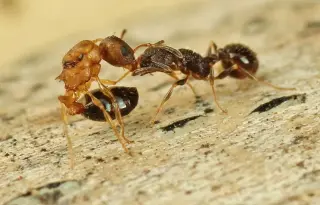
Researchers in southeastern Arizona documented an unprecedented interaction where small cone ants climb onto much larger harvester ants to lick and nibble their bodies, including inside open jaws. The grooming may benefit both species—cone ants could feed on tiny particles removed, while harvester ants gain cleaning in hard-to-reach areas. This first-recorded behavior, likened to cleaner fish in the ocean, was observed by Mark Moffett and described in Ecology and Evolution, highlighting how much remains to be learned from natural interactions.

Kenya jails Chinese national for smuggling live ants to China
africa1 month ago

Kenya jails Chinese national for smuggling live ants to China

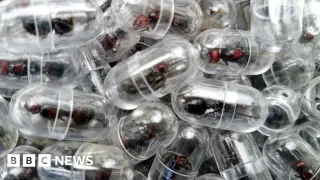
A Chinese national, Zhang Kequn, was sentenced to one year in prison and fined 1 million Kenyan shillings for attempting to smuggle over 2,000 live queen garden ants out of Kenya to China; he pleaded guilty after initially denying the charges, as authorities warn of rising wildlife trafficking and the high value of the ants (about $220 each), with repatriation to his home country after serving the sentence and a possible appeal.

Kenya jails Chinese national for smuggling 2,200 live ants
world1 month ago

Kenya jails Chinese national for smuggling 2,200 live ants

A Kenyan court fined 1 million shillings and sentenced Chinese national Zhang Kequn to 12 months in jail after he was caught at Nairobi’s airport attempting to smuggle about 2,200 live garden ants in his luggage; a co-defendant, Charles Mwangi, is accused of supplying the ants. Wildlife officials say ant trafficking is rising and penalties are used as a deterrent against biopiracy, with several similar cases having occurred in the past.

Kenya detains Chinese national over plan to smuggle 2,248 queen garden ants
africa2 months ago

Kenya detains Chinese national over plan to smuggle 2,248 queen garden ants

A Chinese national, Zhang Kequn, was arrested at Nairobi's Jomo Kenyatta International Airport for attempting to smuggle about 2,248 live queen garden ants (1,948 in test tubes and 300 hidden in tissue rolls) to China, signaling ties to a broader ant‑trafficking network. The ants, protected under biodiversity treaties, are regulated trade; prosecutors asked to forensically examine his devices as investigations widen and more arrests are anticipated. A similar high‑profile case last year underscored the seriousness of wildlife trafficking in Kenya.

The living trap: how ants and fungus rig a plant to catch prey
science4 months ago

The living trap: how ants and fungus rig a plant to catch prey

Researchers describe a three-way symbiosis in the Amazon between the shrub Hirtella physophora, the ant Allomerus decemarticulatus, and a cultivated fungus. The ants fashion a trap by cutting plant hairs and using fungal adhesive to build a stem platform with pores, where they ambush prey much larger than themselves; crickets are overcome and consumed. The plant gains defense and sugar rewards; the ants get prey, and the fungus feeds on waste, making a rare win-win-win interaction.

Sick Ants Self-Sacrifice to Protect Colony, Study Finds
science5 months ago

Sick Ants Self-Sacrifice to Protect Colony, Study Finds

A new study reveals that sick young ants release a smell signaling worker ants to destroy them to protect the colony, a self-sacrificial act not performed by queen ants due to their stronger immune systems. This behavior highlights the colony's collective effort to prevent disease spread, with sick worker ants leaving the nest and infected pupae being sacrificed through chemical signals, ensuring the survival of the colony's genes.