Nio’s July deliveries rise 71% YoY to 35,934, but fall short of June
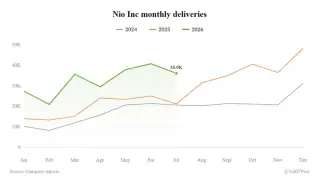
Nio delivered 35,934 vehicles in July, up 71% year over year but down from June, signaling strong annual growth with a seasonal month-to-month dip.
All articles tagged with #deliveries

Nio delivered 35,934 vehicles in July, up 71% year over year but down from June, signaling strong annual growth with a seasonal month-to-month dip.

Rivian reduced its 2026 spending and narrowed its expected losses while keeping the 65,000–70,000 vehicle delivery target. In Q2, revenue rose to $1.66 billion with an adjusted loss per share of 47 cents and a gross profit of $179 million, as its software and services segment posted a profit and the R2 midsize SUV began deliveries. The company aims for profitability on a per‑unit basis with the R2 but will need more scale than 160,000 annual R2 units to achieve it. Cash stood at about $5.3 billion, with expected $1 billion in non-recourse VW debt financing and $250 million in equity from Uber this year.

Tesla posted a 25% YoY increase in Q2 deliveries and topped $100B in trailing revenue, with revenue of $28.24B and EPS of $0.33 (miss vs. 0.51 expected), while signaling large capex and AI investments amid supply-chain bottlenecks and Optimus robot scaling, triggering a sharp selloff that erased about $214B in market value and sending TSLA down roughly 14.5% after earnings; analysts have mixed price targets as the company doubles down on its AI/robotics pivot.

Tesla shares fell about 10% after Q2 2026 earnings missed estimates (adjusted EPS $0.33 vs $0.50, EBITDA $3.2B vs $4B), even as revenue rose to $28.24B on a record 480,126 vehicle deliveries. Operating income dropped 57% to $398M and free cash flow turned negative by $1.09B, though management kept capex guidance above $25B for 2026. Tesla’s FSD subscriptions climbed 56% to 1.48 million with Robotaxi expanding to seven metro areas. Analysts trimmed price targets but largely maintained ratings; Rivian and Lucid slipped in sympathy, and the DRIV ETF weakened due to Tesla’s heavy weighting. Investors weigh autonomy milestones and margin pressures against the delivery momentum and topline growth.

Tesla’s Q2 2026 preview shows a company delivering a record 480,126 vehicles (up 25% YoY) with production of 451,758, meaning it moved more cars than it built and drew down inventory; energy storage deployment reached 13.5 GWh. Revenue is expected around $25.9–$26.4 billion and EPS about $0.53, but profitability hinges on automotive gross margin excluding regulatory credits, as fading credits and pricing discounts cloud margins. Investors are weighing whether the delivery surge translates into real profit, while bets on Robotaxi and Optimus continue to color the longer-term picture. Overall, the top line looks healthy, but margin clarity remains the key question for this quarter.

Tesla reported Q2 production of 451,758 and 480,126 deliveries, well above consensus (roughly 396k–408k from Bloomberg/IR/Goldman/Morgan Stanley), effectively clearing its earlier backlog and marking ~25% year‑over‑year growth. The strong print suggests robust demand and an unwind of vehicle inventory, with analysts lifting or reaffirming 2026 targets as a result. Geographic delivery details weren’t disclosed, but the beat reinforces a more positive near‑term narrative for Tesla’s auto business.

Rivian posted Q2 2026 production of 12,613 vehicles and deliveries of 12,194 (above its 9,000–11,000 forecast), and raised its full-year 2026 delivery guidance to 65,000–70,000 vehicles, signaling improved supply and stronger demand; Q2 results are due July 30 with an accompanying webcast.

Tesla posted Q2 2026 deliveries of 480,126 and production of 451,758, topping StreetAccount’s ~406k delivery forecast and Tesla’s own 406,024 consensus, a roughly 25% year-over-year rise and a 34% quarter-over-quarter jump. Model 3 and Model Y accounted for 467,762 deliveries (97%). The company is seeking a rebound amid competition and demand shifts, while energy storage deployments reached 13.5 GWh and SpaceX bought Megapacks to support xAI; results are due July 22 after the market close.

Tesla stock jumped about 8% in Monday trading—the strongest one-day gain in over a year—as investors bet the company could beat Q2 delivery estimates on stronger demand in Europe and China; Goldman Sachs lifted its forecast to 420,000 vehicles, with Barclays and Morgan Stanley also revising higher ahead of the July 2 delivery report. A Version 14 Lite Full Self-Driving update for older Hardware 3 cars and a broader tech rally provided support, while investors watch margins and progress on robotaxi/Optimus plans.

Tesla’s stock jumped after the NHTSA closed its engineering analysis into a power-steering issue on 2023 Model 3 and Model Y, following Tesla’s software recall; Wall Street lifted Q2 delivery estimates (Morgan Stanley ~413k, Barclays ~418k) amid a demand rebound in Europe and China, while Elon Musk signaled xAI’s Grok 4.5 is in private beta at Tesla and SpaceX, lending an AI-driven momentum to the rally.

Tesla's Q2 2026 analyst consensus projects 406,024 total deliveries, with the majority in Model 3/Y and about 12,978 in other vehicles (Cybertruck/S/X/Semi). Energy storage is expected at 13.8 GWh, up about 36% from Q1, aided by Megafactory Shanghai and upcoming U.S. production. Official delivery numbers are typically released in early July (around July 2), with full Q2 earnings following after market close on July 22.

Tesla’s Q2 2026 delivery consensus sits at 406,024 vehicles from 22 analysts, about 5.7% above Q2 2025, with 392,625 Model 3/Y and 12,978 from all other models. For the full year, deliveries are seen at roughly 1.65 million, essentially flat vs. 2025, while forecasts extend to 2030 with wide dispersion. Energy storage remains the brighter spot, projected at 13.8 GWh in Q2 and 57.9 GWh for 2026, climbing in later years. The piece notes Tesla’s IR consensus is used to set a low bar ahead of quarters, amid competition from BYD and reliance on China for volume.

Xiaomi’s EV division reported a Q1 operating loss of 3.1 billion yuan ($460 million) despite a 6.57% YoY rise in deliveries to 80,856 units, hit by Spring Festival drag and a mid-cycle SU7 facelift. EV revenue reached about 19 billion yuan with a 20.1% gross margin for the innovative segment; the company reaffirmed a 2026 delivery target of 550,000 units and plans for overseas expansion in 2027, including Europe as the first stop.
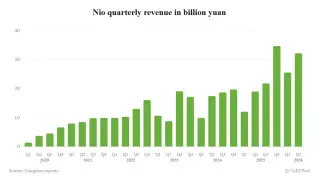
NIO posted RMB25.5B in total revenues for Q1 2026 and delivered 83,465 vehicles (up 98.3% YoY), with vehicle margin at 18.8% and gross margin at 19.0%; GAAP net loss was RMB332.1M, while cash and equivalents stood at RMB48.2B. The company expects Q2 deliveries of 110k–115k and total revenues of RMB32.8–34.4B as it advances launches across its NIO, ONVO, and FIREFLY brands, including the ES9 and ONVO L80.

Lucid Group said it will take steps to better align its production with customer demand and reduce an elevated EV inventory, with no plan to idle its Arizona plant and no firm recantation of prior guidance to produce 25,000–27,000 units. In Q1 2026, the company produced 5,500 vehicles but delivered 3,093, and it cited a supplier issue affecting Gravity deliveries, as it seeks to convert excess inventory into revenue through disciplined cost control and improved delivery cadence, following a quarterly results miss relative to expectations.