A color-enhancement technique originally developed by NASA’s Jet Propulsion Laboratory to analyze Martian surfaces has been adapted by archaeologist Jon Harman to reveal faded ancient rock art on Earth. Known as decorrelation stretch, the method expands color ranges to highlight subtle details, leading to discoveries in Mexico, Cambodia, Egypt, and Norway.
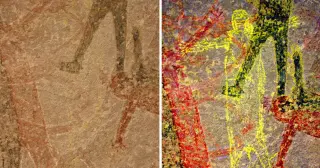
A decorrelation stretch technique originally developed by NASA’s Jet Propulsion Laboratory to enhance satellite images of Mars has been adapted to reveal faded ancient artwork on Earth. Jon Harman, a rock art enthusiast with a background in medical imaging and mathematics, created the Dstretch plug-in after seeing the technique’s effectiveness on Martian surface photos at a 2005 conference. By mapping original colors to an expanded range rather than simply increasing contrast, the algorithm uncovers details invisible to the naked eye. Harman first tested it on images from the Cave of San Borjitas in Baja California, Mexico, where it revealed a previously hidden yellow figure. The tool has since been adopted by archaeologists globally to document undocumented figures in Egypt, Canada, and Greece, and even to analyze tattoos on mummified remains. One major application occurred between 2010 and 2012, when Singaporean archaeologist Noel Hidalgo Tan used Dstretch to discover over 200 faded paintings at the Angkor Wat temple complex in Cambodia. The method preserves hue, saturation, and intensity while distributing pixels across all possible colors, making subtle variations in rock art visible. This cross-disciplinary application demonstrates how planetary science tools can solve terrestrial historical mysteries, bridging gaps between geology and archaeology through advanced digital imaging.