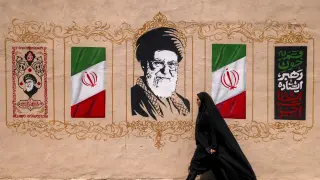
Iranian leaders are invoking historic battles and nationalist symbolism to frame any potential deal with the US as a David-versus-Goliath struggle, highlighting the 1982 Khorramshahr recapture and long resistance to deter aggression while Trump signals a possible agreement; Tehran’s messaging, reinforced by officials and the IRGC, contrasts with Washington’s aims for a long-term uranium enrichment pause and Hormuz reopening, as Israel largely stays silent.
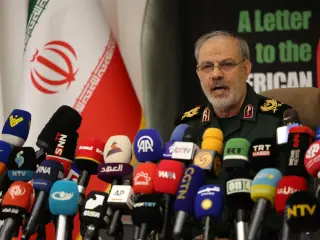
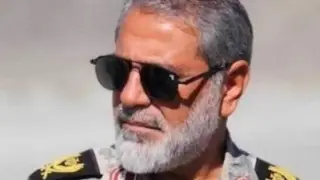
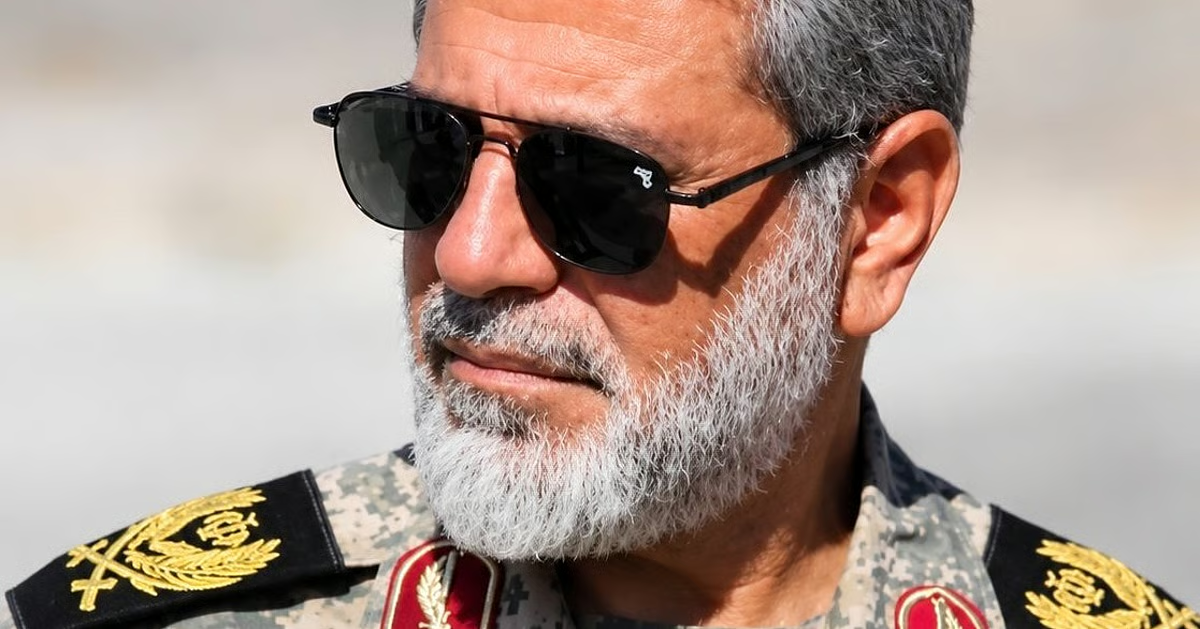
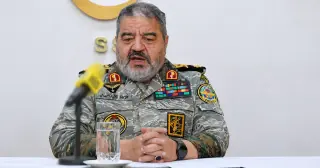
As negotiations over Iran’s war stall, Brig. Gen. Ahmad Vahidi—a hardline IRGC commander sanctioned by the US and wanted by Interpol—has emerged as a key behind-the-scenes player shaping Tehran’s next moves, signaling little appetite for compromise and complicating prospects for a deal with Washington while regional tensions and oil chokepoints mount.
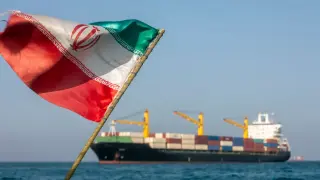
Iran is consolidating de facto control over the Strait of Hormuz by deploying a layered clearance system for passing vessels, including government-to-government deals, IRGC vetting, and sometimes fees for safe passage, with priority given to ships tied to Tehran’s allies; the Agios Fanourios I case shows delays and an IRGC inspection before authorization to continue, followed by US naval enforcement, and multiple Iranian agencies oversee the vetting through a new Persian Gulf Strait Authority—a norm that challenges international law and adds sanction-related risk while contributing to volatility in a global oil market that relies on Hormuz for roughly 20% of supply.
ISW/CTP warn that Iran is using the ceasefire to push bilateral transit agreements and hefty ‘security’ fees for vessels outside those deals to normalize control of the Strait of Hormuz, potentially restoring traffic to pre-war levels if successful. European post-war security deployments are unlikely to disrupt this scheme while the US continues port interdictions (including seizing the Skywave and redirecting the Celestial Sea). The IRGC threatens wider escalation, and Pakistan and Qatar are mediating between the US and Iran as Hezbollah engages in Lebanon; Iran’s internal dynamics show limited enrichment progress post-war damage. The overall picture suggests a gradual normalization of Hormuz transit that could undermine Western leverage to reopen the strait, though the outcome remains uncertain.
Iran’s Revolutionary Guard warned that renewed U.S. or Israeli attacks on Tehran would widen the conflict beyond the region, as mixed signals from Washington about a possible deal to end the war persist. The stalemate over control of the Strait of Hormuz continues to disrupt global oil shipments, while Trump oscillates between threats and diplomacy, keeping the broader crisis in flux.
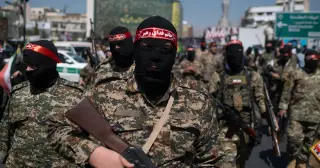
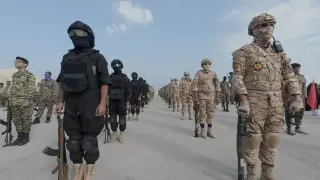
Iran’s state broadcaster IRIB has aired live weapons-training segments across channels, including demonstrations with assault rifles and other weapons, featuring civilians learning to fight perceived enemies. Separately, the IRGC has formally begun recruiting children as young as 12 for checkpoints and intelligence patrols, a move HRW condemns as a grave violation of children's rights and a potential war crime, amid ongoing regional tensions and recent civilian casualties at checkpoints.
Iranian authorities staged mass public weddings in Tehran for hundreds of couples who signed up for a state-backed “self-sacrifice” program to defend the Islamic Republic in the war with the United States and Israel, including about 110 couples at Imam Hossein Square; the ceremonies, broadcast on state TV, are part of a broader mobilization campaign.
A 32-year-old Iraqi militia commander linked to Kataib Hizballah and Iran's IRGC was arrested and charged by U.S. prosecutors with plotting more than a dozen terrorist attacks against Jewish targets and U.S./Israeli interests across Europe and North America, including synagogues in New York and Los Angeles; he allegedly directed plots, sought to hire operatives, and was extradited from Turkey after capture, while his defense calls the case political persecution.
US authorities charged Iraqi national Mohammad Baqer Saad Dawood al-Saadi with six terrorism-related counts for allegedly coordinating or aiding nearly 20 attacks across the US and Europe on behalf of Iran’s IRGC and Kata’ib Hezbollah, including a firebombing at a bank in Amsterdam and planned attacks against Jewish sites in New York and London; prosecutors say he worked with senior IRGC figures and posted propaganda before his Manhattan court appearance.
The Justice Department charged Mohammad Baqer Saad Dawood Al-Saadi, an Iraqi national and senior Kata’ib Hizballah operative tied to Iran’s IRGC, with six terrorism-related counts for directing and aiding attacks across Europe and the United States, including plots against U.S. targets and Jewish institutions. He was arrested overseas, transferred to U.S. custody, and faces significant prison time. The case, pursued by the FBI’s Joint Terrorism Task Force and DOJ components, underscores ongoing efforts to dismantle foreign terrorist organizations and their leaders.
Federal prosecutors say Mohammad Baqer Saad Dawood Al-Saadi, an Iraqi national and Kata'ib Hizballah commander, plotted to attack U.S. targets including a Manhattan synagogue, showing an undercover agent photos and maps and offering $10,000 in cryptocurrency for the operation; court documents include pictures of him with Qasem Soleimani. He was arrested in Turkey, handed to the FBI, and faces charges including conspiracy to provide material support to Iran’s IRGC and Kata'ib Hizballah, with a June 29 court date.
Kuwait says four IRGC members were captured after attempting to infiltrate Bubiyan Island, with two identified as Naval Colonels allegedly tasked with hostile operations that injured a Kuwaiti serviceman. Kuwait condemned the action, asserted its right to self-defense under the UN Charter, and said two more infiltrators escaped. Iran rejected the claims of planned hostility, saying the men entered Kuwaiti waters due to navigation disruption. The incident raises Gulf security concerns amid heightened regional tensions.
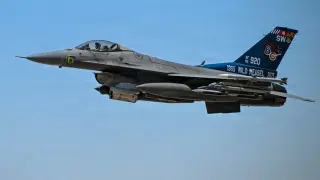
Iran is pressing for formal sovereignty over the Strait of Hormuz, framing control of the waterway as its primary deterrent and warning that recognition would disrupt global shipping. The ISW-CTP update cites preparatory moves suggesting a renewed confrontation, including an IRGC infiltration attempt on Bubiyan Island, Mahshahr Port drills, and Iranian aircraft repositioning to Pakistan/Afghanistan to shield assets. Negotiations, if resumed, reportedly hinge on five preconditions: a complete end to the war on all fronts, sanctions relief, unfrozen assets, compensation, and formal recognition of Hormuz rights. The United States and allies continue pressure to safeguard shipping, with covert strikes by the UAE and Saudi Arabia reportedly occurring against Iran, while Iran consolidates internal power around the IRGC. The report also notes Israel’s FPV drone countermeasures, Hezbollah activity near Lebanon, and Iraqi PMF efforts framed as sovereignty signaling, painting a volatile, pre-war landscape ahead of potential renewed conflict.
The Wall Street Journal reports the UAE secretly carried out a major attack on Iran during the ongoing conflict, including a strike on Lazan Island prior to a ceasefire, while Kuwait says four IRGC members were captured attempting to infiltrate Bubiyan Island—signs that the region could slide into a broader war if the ceasefire collapses and Iran retaliates, amid shifting Gulf alliances and ongoing US involvement.
Kuwait says four men linked to Iran's IRGC tried to infiltrate Bubiyan Island by sea, wounding a Kuwaiti soldier; three suspects were arrested while two escaped. Kuwait condemned the incursion as a flagrant sovereignty violation, summoned Iran’s ambassador, and stressed its right to self-defence under the UN Charter, amid a background of recent Iran-linked drone activity and strikes in the region.