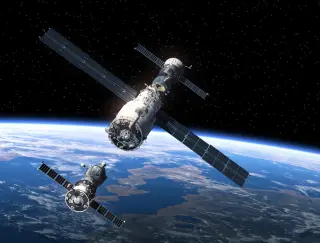
ISW says Russia’s Rassvet constellation, Russia’s Starlink-like broadband network, is stalling as July batch satellites remain well below the planned 550 km orbit—many at 300–400 km with some reentering—while only about a third of the 2026 launches have reached sustainable altitude, delaying continuous coverage and potentially increasing Moscow’s reliance on SpaceX amid rocket-availability and infrastructure-strike pressures.
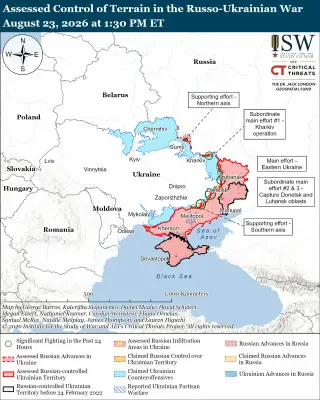
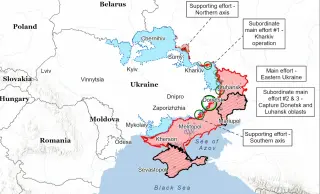
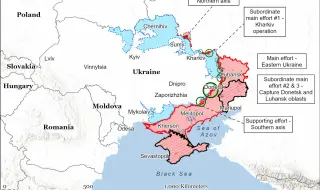
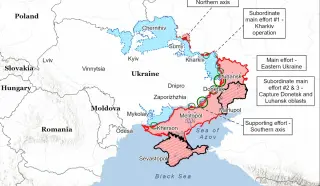
ISW’s August 2026 assessment finds Russia’s Ukraine campaign progressing only marginally, failing to achieve operational maneuver or rapidly collapse Ukrainian lines: about 90.35 km2 seized (2.91 km2/day) and 123.53 km2 including infiltrations (3.98 km2/day), with gains mainly in Donetsk’s Fortress Belt and Kostyantynivka not fully captured; Ukrainian counteroffensive expanded by at least 129.81 km2. Russian casualties for August reached roughly 42,000, reflecting a high price for limited gains and strain on manpower as Moscow contemplates mobilization. Russia’s tactics shift to jet-powered drones to maximize civilian harm; Putin expands security services and reshuffles law enforcement ahead of mobilization, while Ukraine reorganizes Donetsk defenses and continues long-range strikes on Russian assets. By Sept 1, neither side has achieved a decisive breakthrough.
Russia’s second batch of 16 Rassvet satellites failed to reach the planned 550 km orbit, with most staying at 300–400 km or decaying and at least two reportedly on a path to reentry, according to ISW. The setback undermines Moscow’s effort to field a Starlink-style network for Ukraine and highlights Russia’s limited launch capacity and the need for hundreds of satellites to achieve around-the-clock coverage; Ukrainian strikes on launch infrastructure could further delay progress, though even a partial constellation could still offer limited communications windows for Russian forces.
ISW reports Russian forces have advanced east of Slovyansk and are securing positions east and southeast of the city to set up frontal assaults toward Slovyansk and the Fortress Belt; Putin continues to push a rapid Donetsk Oblast takeover, likely underestimating battlefield realities. Zelensky reportedly presented a Ukraine-US-Europe proposal to end the war that would entail significant Ukrainian concessions, while Moscow remains unwilling to compromise on core demands. Ukraine is widening an intermediate-range strike campaign into occupied territory (including Crimea) to degrade Russia’s strike and air defenses, even as Russia escalates drone and air attacks; Ukrainian long-range strikes target Russian logistics and infrastructure, with Russia launching 127 drones overnight.
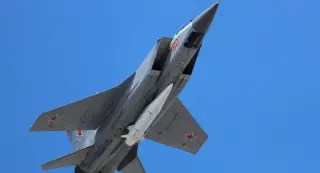
ISW analysts say Ukraine is now targeting Russian ballistic-missile launch facilities, focusing on deployment and training sites to counter a shortage of air and missile defenses, with the Aug. 15 strike on Savasleyka airbase illustrating the tactic.
ISW reports Ukrainian forces used a combined-arms approach with drones to secure elements of mechanized maneuver in the Oleksandrivka counteroffensive, while Russian MoD and milbloggers exaggerate gains in Oleksandrivka and Hulyaipole. Ukraine also struck a key enterprise tied to Russia’s battlefield satellite communications and appears to be targeting ballistic-missile launch infrastructure amid an interceptor shortage, as Russia launched about 152 long-range drones overnight on Aug. 14–15.
ISW reports that the Russian spring-summer 2026 offensive in Ukraine remains slow with no significant operational gains; July saw the highest casualty rate for 2026, while Moscow exaggerates progress. Russia continued large missile and drone strikes against Ukrainian energy infrastructure, even as Ukraine carried out long-range strikes against Russian oil and gasoline facilities; on August 1, neither side made confirmed advances.
ISW’s July 23, 2026 assessment finds no confirmed battlefield ground advances by Russian or Ukrainian forces on July 22–23. Ukrainian long-range strikes targeted Russian energy and logistics assets across multiple regions, causing fires at facilities in Ulyanovsk, Voronezh, and Bashkortostan and affecting operations at the Caspian Pipeline Consortium, with some impact on shipping in the Black Sea region. Russia conducted a broad drone/missile campaign against Ukraine, including Crimea-area energy targets. On the ground, Russian offensives in northern Sumy, Kharkiv, Oskil, Slovyansk, Pokrovsk, and Oleksandrivka directions did not gain territory, while Ukrainian forces continued counterattacks and drone-enabled reconnaissance. In the south, Russian attempts near Zaporizhzhia and Kherson yielded no progress; power outages persisted in occupied Kherson, and Ukrainian strikes continued against energy infrastructure in occupied Crimea. Belarus announced a fall conscription cycle; Zelensky reiterated willingness for peace talks with a possible trilateral meeting in Fall 2026, while Rubio rejected any Alaska Summit deal ending the war.
ISW says Putin used a staged July 3 meeting to push an exaggerated narrative of Russian gains (notably Kostyantynivka) with footage possibly AI-altered; there were no frontline advances on July 4. Ukraine continued long-range strikes against Russian oil/energy infrastructure, while Russia launched a limited salvo of Iskander-M and Kh-59 missiles plus 86 drones at Ukraine.
ISW says Putin used a staged July 3 meeting with senior Russian commanders to push exaggerated battlefield gains that clash with available evidence: 64 settlements and about 621.7 square kilometers seized or infiltrated in 2026 (20 settlements and ~30.4 sq km in June), far from the claimed numbers. Distances cited from key cities are not supported by geolocated evidence, and the seizure of Kostyantynivka remains unsubstantiated according to Ukrainian sources. ISW warns footage from the MoD and others may be AI‑generated to bolster a cognitive warfare narrative. Meanwhile Ukraine continues long‑range strikes into Russia with no confirmed front‑line advances on July 4, and Russia’s broader goals of a buffer zone and rapid Donetsk breakthrough remain unmet, with costly gains.
ISW analysis shows Russian territorial gains in Ukraine have collapsed this year, with front-line advances stalling and Ukraine's drone-enabled long-range strike campaign disrupting Russian logistics and fuel supplies; Kyiv reports heavy Russian casualties in June while pushing for limited gains, and Moscow signals openness to mediation but remains locked in combat as oil revenues fall and fuel shortages appear.
ISW says Russia is expanding and building bases along its northern NATO border to support potential future force projection after the Ukraine war ends, though near-term ground offensives remain unlikely as most combat power is still in Ukraine. Once constructed, the bases could shorten Moscow’s timetable to mass troops at NATO’s frontier, prompting NATO to maintain high readiness.
ISW warns Russia may launch an Oreshnik IRBM at Ukraine within 24–48 hours as Moscow shows military posturing on Russia Day while confronting battlefield setbacks. Despite Russian gains around Kostyantynivka, analysts say a rapid breakthrough is unlikely; Russia is reportedly building five long-range drone launch sites near Belarus to boost strikes. Ukrainian forces have advanced in the Kostyantynivka–Druzhkivka area and Oleksandrivka direction, while Russia attacked Ukrainian oil infrastructure and mounted a large night drone campaign (117 drones).
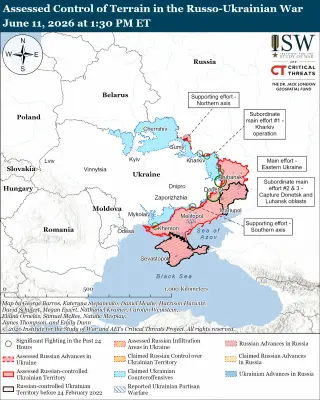
ISW’s June 11 assessment flags Ukrainian forces continuing to interdict bridges and ground-logistics links between occupied Kherson and Crimea, while Russian authorities in Sevastopol struggle with gasoline shortages likely tied to Ukrainian strikes on logistics and energy infrastructure. Ukraine is leveraging a drone advantage and expanding middle-range strikes, contributing to higher Russian battlefield casualties and weakening Moscow’s recruitment. Russia is building and expanding bases along its northern NATO border to bolster future force projection, though ISW judges near-term ground operations unlikely. Moscow’s MoD is accused of cognitive warfare to justify claims of progress; Ukrainian strikes against oil infrastructure persist, and Russia responded with Iskander missiles and drones. Ukrainian gains in the Oleksandrivka direction are noted, reflecting ongoing, multi-domain pressure on Russian forces.
Zelensky told The Guardian that Russia is losing the initiative on the battlefield with heavy casualties, but the front remains fluid and could shift day by day. He said Ukraine’s position has improved and cited Kyiv’s gains in 2026, while ISW has noted slow Russian advances and Ukrainian counteroffensives, and Zelensky expressed hope for negotiations to end the war.