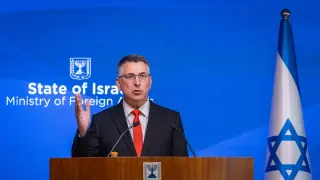
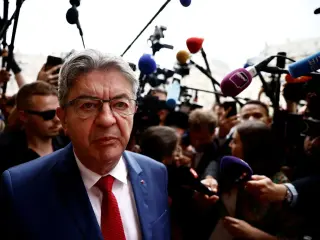
Israel has banned Jean-Luc Mélenchon and Mathilde Panot from entering the country, citing anti-Israel incitement. The move follows France’s refusal to admit West Bank settler leader Yossi Dagan. French officials condemned the ban as demagogic, while Israel framed it as a firm response to hostile rhetoric.
Jean-Luc Mélenchon has launched his fourth presidential campaign with a sweeping manifesto titled 'The Future Together,' aiming to replace the Fifth Republic constitution and withdraw France from NATO. Polling at 17.5–18%, he leads the left but trails far-right rival Marine Le Pen, who holds a significant advantage in head-to-head matchups. His platform includes lowering the voting age to 16, restoring retirement at 60, and raising the minimum wage to €1,700. While he has gained momentum by aligning with youth-led protests, critics warn his fiscal policies could destabilize markets and that his refusal to compromise hinders broad support. A runoff between Mélenchon and Le Pen could leave traditional center parties sidelined, potentially reshaping France’s geopolitical alignment and domestic stability.
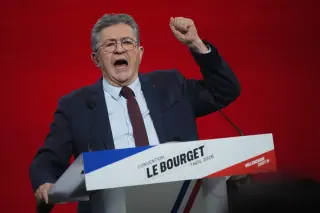
Jean-Luc Mélenchon launched his 2027 presidential campaign with a manifesto titled 'The Future Together' at a rally in Le Bourget, north of Paris. The 75-year-old leader of La France Insoumise (LFI) outlined a platform focused on nationalizing key industries, lowering the retirement age to 60, and phasing out nuclear energy. While polling at approximately 18% in the first round, he trails Marine Le Pen, who leads with 35-37%. The manifesto places the Israeli-Palestinian conflict at the center of foreign policy, proposing to suspend Israel’s EU association agreement, while offering vague positions on Ukraine and NATO. Critics, including Marine Le Pen and Édouard Philippe, have condemned the plan as fiscally irresponsible and anti-European, though Mélenchon cites recent protest movements as evidence of growing support for his radical agenda.
Jean-Luc Mélenchon has launched his 2027 presidential campaign with a manifesto titled 'The Future Together,' proposing sweeping economic and social reforms. Polling at approximately 18%, he leads the left but trails far-right rival Marine Le Pen, who holds a significant advantage in head-to-head matchups. His platform includes lowering the retirement age to 60, raising the minimum wage to €1,700, and withdrawing France from NATO. The candidate’s stance on Gaza, which he frames as a genocide, has alienated some left-wing allies, while his fiscal proposals face criticism for being uncosted and potentially destabilizing for France’s high debt levels.
French high school protests have escalated into nationwide unrest, with the government labeling the actions 'urban violence.' Prime Minister Sébastien Lecornu convened a crisis cabinet meeting as riots, arson, and blockades spread across major cities. The interior ministry reported nearly 3,000 student detentions since the protests began, with 1,949 arrests on Thursday alone. Grievances center on overcrowded classrooms, teacher shortages, and dilapidated facilities, exacerbated by recent budget cuts. While the government blames the radical left for inciting violence, opposition figures and some teachers criticize police brutality and support the students' demands for better resources.
A dozen deputies from La France Insoumise (LFI) defied a ban on a memorial rally for Adama Traoré in Paris, standing firm against the police prefecture's decision. The ban on the rally, which aimed to commemorate the death of Traoré who died shortly after being stopped by police in 2016, was criticized by LFI members as an infringement on democracy. The presidential camp accused LFI of trying to inflame tensions, while LFI leader Jean-Luc Mélenchon warned of a dangerous regression in France. Around thirty other demonstrations against police violence and for the preservation of public and individual freedoms are being organized across the country.