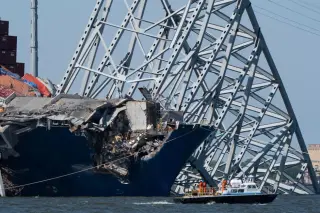
Maryland reached a settlement with the owner and operator of the container ship Dali over claims related to the 2024 collision that damaged the Francis Scott Key Bridge in Baltimore; terms of the agreement were not disclosed.
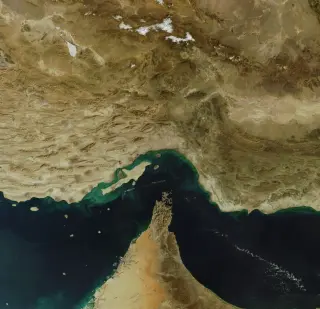
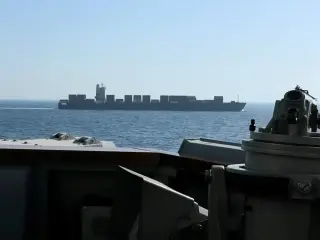
Confusion over the restart of traffic through the Strait of Hormuz after a US-Iran ceasefire deepens as Iran asserts unilateral control, proposes passage conditions and possible transit fees, and calls for ships to coordinate with its forces, while Gulf states and Oman insist on freedom of navigation under UNCLOS and warn against Iran's blocking measures amid reports of sea-mines and alternative routes.
Legal experts say the U.S. strike on Iran’s warship IRIS Dena did not violate international law, and two Iranian sailors were rescued by Sri Lanka’s navy after the incident.
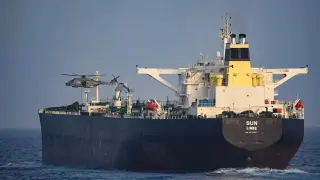
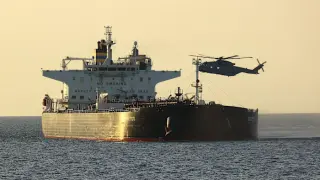
A Scottish court heard that the United States plans to remove the captain and first officer of the Russian-flag Marinera from UK waters imminently after the vessel was seized for sanctions violations. The judge granted a limited interim interdict to prevent removal while the case is considered, acknowledging the 1978 State Immunity Act. The Marinera has been in the Moray Firth under a US Coast Guard escort, with the US accusing the ship of sanctions-busting for Venezuela, Russia, and Iran. The hearing also touched on crew whereabouts and UK–US coordination during the seizure.
Lawyers for Natia Dzadzama, wife of Marinera captain Avtandil Kalandadze, filed for judicial review in Edinburgh, arguing the US-held captain has been unlawfully detained in Scotland since January after the tanker was seized in UK waters. An interim interdict restricts removal of the captain and crew from Scottish jurisdiction while a full hearing is anticipated.
The Trump administration conducted a military strike on a Venezuelan boat in the Caribbean, allegedly carrying drugs and linked to a terrorist organization, but the legality of the strike is questioned due to lack of transparency and potential violations of international law and maritime norms.
The Philippines has enacted the Maritime Zones Act and the Archipelagic Sea Lanes Act to clarify maritime routes, a move that has drawn criticism from China amid ongoing disputes in the South China Sea. These laws are expected to cause "stresses" for international shipping as vessels will need to adjust to the newly defined sea lanes. Philippine coastguard officials emphasize that the laws are not intended to expand territory but acknowledge the challenges they may pose to global shipping routes.
The owner of the container ship Dali, responsible for the collapse of Baltimore’s Francis Scott Key Bridge, has invoked a "general average" declaration, requiring cargo owners to share salvage costs. This comes as part of efforts to minimize financial responsibility in what could be one of the costliest maritime disasters. The ship remains stuck with bridge wreckage, and the declaration anticipates "extraordinary costs" for which contribution from all salvaged parties is expected. Investigations by the FBI and the National Transportation Safety Board are ongoing into the incident, which resulted in the deaths of six roadwork crew members.
Attorneys representing victims of the Baltimore bridge collapse are preparing to battle Grace Ocean Private Limited, the owner of the ship involved, as it seeks to limit its liability using historic maritime law, similar to the legal battle faced by businesses in the Pensacola area against Skanska USA. The Limitation Liability Act of 1851, used by the owner of the Titanic, is being invoked to restrict potential payouts, drawing criticism from attorneys. The legal maneuvering in Baltimore mirrors the experiences of businesses in Pensacola, where Skanska USA sought to limit liability and avoid economic damages caused by loose barges during Hurricane Sally.
The FBI has launched a criminal investigation into the collapse of the Francis Scott Key Bridge in Baltimore, focusing on the 985-foot container ship, the Dali, and potential violations of federal maritime law. The probe aims to determine if ship personnel were aware of any technical or operational issues before the ship left the Port of Baltimore. This investigation is separate from the National Transportation Safety Board's efforts to determine the cause of the collapse and evaluate safety measures.
Singaporean companies involved in the Baltimore bridge collapse have filed a petition to limit their liability to $43.6 million under an 1851 maritime law, citing the vessel's value and incurred expenses. The incident, which closed the Port of Baltimore, could result in insured losses of $2-4 billion, making it potentially the costliest marine loss in history. The legal process is expected to take years, with the focus on determining the cause of the catastrophe. The collapse has resulted in casualties, with families potentially seeking compensation under maritime law for wrongful death claims.
The owner and manager of the cargo ship involved in the Baltimore bridge collapse have filed a petition to limit their legal liability to roughly $43.6 million under U.S. maritime law. The estimated insured losses for the disaster could range from $2 billion to $4 billion, potentially making it the most expensive marine insured loss in history. The bridge collapse has resulted in fatalities, with four people still missing and presumed dead. The cost to rebuild the collapsed bridge is estimated to be at least $400 million, and families of the victims may seek compensation for wrongful death damages under maritime law.
The United States has signed an agreement with Palau that allows American ships to enforce maritime regulations in Palau's exclusive economic zone, without a Palauan officer present. The move comes as both the US and China seek to expand their influence in the Pacific, and follows pleas from Palau's president for US assistance in deterring China's "unwanted activities" in its coastal waters. The agreement aims to help Palau monitor its exclusive economic zone, combat illegal fishing, and deter uninvited vessels. Tensions have been rising in the Asia-Pacific region as China asserts its maritime claims and the US and its allies push back.
The United States has signed an agreement with Palau that allows American ships to enforce maritime regulations in Palau's exclusive economic zone without a Palauan officer present. The move comes as both the US and China vie for influence in the Pacific region. Palau's president had requested US assistance to deter China's "unwanted activities" in its coastal waters. The agreement aims to help Palau monitor its exclusive economic zone, combat illegal fishing, and deter unauthorized vessels. While the statement did not mention China, Palau's president previously accused China of conducting surveying activities in Palau waters. The US has been strengthening its partnerships in the Pacific, including similar agreements with the Federated States of Micronesia and Papua New Guinea.
Ukraine accuses Russia of threatening civilian vessels in the Black Sea and violating international maritime law. Russia recently quit a U.N.-brokered deal allowing Ukraine to safely export its grain via the Black Sea and warned that ships heading to Ukrainian seaports could be considered military targets. Ukraine's border guard service intercepted a warning from Russia to a civilian vessel, stating that transport of any cargo to Ukraine would be considered potential transportation of military cargo. Russia has not responded to the accusations.