Disney will unify its Disney+ and Hulu apps in December 2026, creating a single platform for content, live TV, and add-ons. While the Hulu app will eventually be phased out, its content remains accessible via Disney+. Pricing for the combined service is expected to mirror current bundle rates, with no immediate changes for standalone subscribers.
The Surface Transportation Board is reviewing the $85 billion merger between Union Pacific and Norfolk Southern, which would create the first transcontinental railroad. While Union Pacific argues the deal will lower costs by eliminating interchanges, opponents fear reduced competition and higher rates. Public comments were due Nov. 18, with a decision expected in 2027.
Bloomberg reports that Tesla and SpaceX are advancing merger negotiations, with a potential announcement as early as December 2026 or early 2027. The deal, which would be the largest ever, combines two companies valued at approximately $1.5 trillion and $1.9 trillion, respectively. No terms have been agreed, but analysts suggest a stock-for-stock exchange. A 15% premium would convert one Tesla share into 3.27 SpaceX shares, significantly increasing the value for Tesla holders due to SpaceX’s recent stock decline.
Skydance confirmed that a bundled subscription for HBO Max and Paramount+ will launch in early 2027. The move precedes the long-term goal of merging the two platforms into a single service. The company also detailed a plan to cut $6 billion in costs over three years through operational consolidation.
Fox Corp. completed its $22 billion acquisition of Roku on Friday, finishing the deal months ahead of the originally anticipated 2027 timeline. The transaction creates a new division, Fox Digital Platforms, which will unify Roku, Tubi, FOX One, and Red Seat Ventures. Fox expects to achieve $400 million in annual cost synergies within two years and anticipates the deal will boost free cash flow per share by the second full year post-closing. The merger positions Fox as a major player in free, ad-supported streaming and digital video advertising, leveraging Roku’s reach of over 100 million households.
CVS Health announced it will divide into two separate public companies by the first half of 2028. The split separates its retail pharmacy network from its insurance and pharmacy benefit manager units, effectively reversing the 2018 acquisition of Aetna. While the move follows a strategic review, it also responds to regulatory scrutiny of vertically integrated healthcare firms. Shares initially rose but later fell 12% in midday trading, despite the company reporting higher third-quarter earnings and raised guidance.
DoorDash has agreed to acquire Instacart for $17 billion, merging the two dominant US delivery platforms. The deal combines DoorDash’s food delivery network with Instacart’s grocery infrastructure, allowing users to access over 150,000 stores and consolidating subscription fees. While the acquisition aims to reduce costs and expand market reach, it faces scrutiny over rising delivery fees and labor practices.
EQT Corp. and Range Resources Corp. have agreed to merge in an all-stock transaction valued at $50 billion, creating the largest natural gas producer in the United States. The deal, expected to close in the first quarter of 2027, combines two major Appalachian operators to produce over 9 billion cubic feet of gas daily. Range shareholders will receive 0.987 EQT shares for each of their own, owning approximately 27% of the new entity. The merger aims to leverage long-term demand from data centers and power plants, with EQT retaining control and maintaining its headquarters in Canonsburg, Pennsylvania.
SpaceX reported strong third-quarter results, prompting Wall Street to evaluate a potential merger with Tesla. Analysts suggest the combined entity could become a dominant 'super company' in AI and robotics, with SpaceX projecting annual recurring revenue between $500 billion and $1 trillion by 2027.
Elon Musk has publicly endorsed a potential merger between Tesla and SpaceX, arguing that combining the two companies is essential for developing 'superintelligence' and integrating AI, robotics, and satellite infrastructure. While both companies' boards have formed special committees to evaluate the deal, the merger faces significant hurdles, including a 50% shareholder approval requirement and complex geopolitical risks. Prediction markets have seen odds of a merger before March 2027 jump to 56%, driven by analyst reports highlighting vertical integration benefits. The combined entity would be valued at approximately $3.5 trillion, though critics warn that merging two complex businesses does not eliminate execution risks.
U.S. stock markets closed mixed on Wednesday, with the S&P 500 rising 0.3% and the Nasdaq 100 slipping 0.1%, driven by strong earnings from Meta and Tesla. SpaceX shares jumped 8.5% in premarket trading after reporting third-quarter revenue of $14.6 billion, a 161% year-over-year increase, and net income of $4.4 billion. Elon Musk announced that boards of SpaceX and Tesla have formed committees to explore a potential merger, which he described as a move toward a 'superintelligence singularity.' SpaceX also forecast first-quarter 2027 revenue between $33 billion and $37 billion, significantly beating analyst estimates. The rally in tech stocks was supported by robust results from Meta, which cited successful AI investments, and Tesla, which saw shares rise 3.41% despite earlier concerns about capital spending cuts. The VIX volatility index rose 7.79% to 17.98, indicating increased market caution despite the gains in major tech indices.
Following the completion of the $111 billion merger between Paramount and Warner Bros. Discovery, the new entity Skydance has unified its gaming and experiences divisions. Tony Driscoll, previously president of Paramount Games Studio, will lead the combined unit. The move consolidates major intellectual properties, including DC Comics and Star Trek, under a single leadership structure to streamline development and global operations.
Paramount Skydance has completed its $110 billion acquisition of Warner Bros. Discovery, officially confirming that its three major streaming services—HBO Max, Paramount+, and Discovery+—will eventually unify into a single platform. Casey Bloys, the former head of HBO content, has signed a new five-year contract to lead this integration, bringing his core executive team with him. While the merger closes on October 6, 2026, specific timelines for the unification and the final brand name remain undisclosed. This move aims to consolidate over 200 million subscribers to compete with Netflix, though it may lead to higher prices and reduced content diversity for subscribers who prefer specific genres.
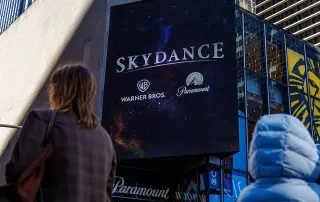
Paramount Skydance has officially completed its $110 billion acquisition of Warner Bros. Discovery, creating a new media entity named Skydance. The merger unites major film studios, news networks, and streaming platforms under the leadership of David Ellison, who will focus on strategy while former Mattel CEO Ynon Kreiz handles operations. The deal, which faced significant legal hurdles, is now subject to strict state-mandated production quotas and editorial independence safeguards.
US stock markets climbed to near-record levels on Monday, driven by major AI-related acquisitions and strong earnings expectations. The Nasdaq set a new all-time high, while the S&P 500 came within 0.3% of its record. Rising bond yields and inflation concerns remain key risks for the broader economy.