
Tag

Peptideins

All articles tagged with #peptideins

Dark Proteome Unveiled: 1,785 Tiny Proteins Emerge from Hidden Genome
science8 days ago

Dark Proteome Unveiled: 1,785 Tiny Proteins Emerge from Hidden Genome

An international study reveals that the human genome produces a large set of previously hidden tiny proteins, called peptideins, derived from non-canonical open reading frames. The team identified 1,785 microproteins across 95,520 experiments, expanding the known proteome and suggesting some peptideins may function like real proteins. Early findings include a peptidein linked to cancer survival, hinting at future therapeutic opportunities, though much remains to understand their roles. The work underscores that the dark genome is more biochemically active than previously thought and was published in Nature.
Proteome expanded by microproteins and a new peptidein category
biology20 days ago

Proteome expanded by microproteins and a new peptidein category

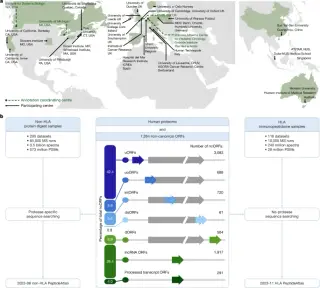
An international study standardizes evidence for thousands of non-canonical ORFs (ncORFs) and introduces the term peptidein for ncORF-encoded microproteins. Analyzing 7,264 ncORFs across 95,520 proteomics experiments, researchers find roughly 25% yield detectable peptides, and they develop an annotation framework using proteomics, immunopeptidomics, and Ribo-seq to classify ncORFs into protein or peptidein status. They also introduce ORBL and ORBLq to measure evolutionary constraint on ORFness, showing detected ncORFs often have higher constraint. The work identifies pan-essential ncORFs that meet criteria for potential protein-coding genes or peptideins and outlines a path to elevate ncORFs toward reference annotation, thereby broadening the recognized human proteome with implications for cancer biology and immunotherapy.

Dark proteins rebranded as peptideins to map hidden biology
science20 days ago

Dark proteins rebranded as peptideins to map hidden biology

Thousands of so-called dark proteins in the human genome have been reclassified as peptideins and added to major databases, but only 15 of 7,264 suspected sequences have robust experimental support; peptideins are short, often lack evolutionary relatives, and may be cellular by-products with unclear functions, though some are linked to diseases like childhood cancers. The effort aims to spur research into their roles and significance in biology.