Tag

Polygenic Risk Scores

All articles tagged with #polygenic risk scores

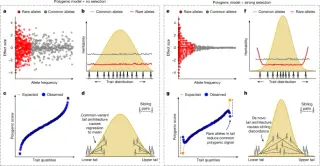
Tail-specific genetics: rare variants sculpt trait extremes under selection
science4 days ago

Tail-specific genetics: rare variants sculpt trait extremes under selection

A large study across 74 quantitative traits in UK Biobank and replication cohorts shows that while complex traits are broadly polygenic, the tails of their distributions are enriched for rare, large‑effect alleles. Using POPout and family‑based STANDout tests, researchers find widespread tail departures from common-variant expectations, replicated across ancestries and repeated measurements. Incorporating sequencing‑identified rare variants markedly reduces these tail deviations, indicating rare alleles drive trait extremes. Forward simulations support stabilizing selection as a mechanism, with lifetime reproductive success providing empirical support for selection. These results imply tail architecture is distinct from the population-wide polygenic pattern and have implications for rare-variant discovery and improving prediction of complex traits and diseases.

Silicon Valley's Quest to Create Super-Babies
science-and-technology10 months ago

Silicon Valley's Quest to Create Super-Babies

The article explores Silicon Valley's push towards genetically customizing babies through advanced embryo screening and polygenic risk scoring, raising ethical questions about eugenics, accessibility, and the accuracy of current genetic prediction methods, amid a broader cultural movement advocating for increased reproductive technology use to counteract declining birth rates.

"Improving Genetic Testing for Health Equity Across Diverse Populations"
health-and-medicine2 years ago

"Improving Genetic Testing for Health Equity Across Diverse Populations"

Researchers funded by the National Institutes of Health have improved genetic testing methods called polygenic risk scores to provide a more accurate assessment of disease risk across diverse populations. By recalibrating these tests using ancestrally diverse genomic data, the researchers aim to prevent health disparities caused by false results and inequitable genetic tools. The optimized scores, developed using data from the All of Us Research Program, have shown effectiveness across various ancestral backgrounds, representing a step towards routine use of polygenic risk scores in the clinic to benefit all people.