Live-cell imaging reveals nuclear pore barrier remains liquid, stabilized by importin-beta and glycosylation
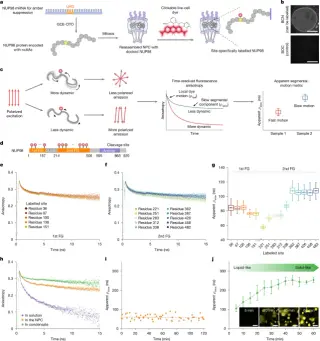
Researchers have resolved a long-standing debate about the physical state of the nuclear pore complex (NPC) barrier by demonstrating that its phenylalanine-glycine-rich nucleoporins (FG-NUPs) maintain liquid-like, nanosecond-scale segmental motion in living cells. Using site-specific labeling and time-resolved fluorescence anisotropy, the study shows that while isolated FG-NUPs in vitro transition from liquid to solid over time, cellular factors prevent this aging. Importin-beta and O-linked beta-N-acetylglucosamine (O-GlcNAc) modifications are identified as key regulators that stabilize this dynamic state. The findings indicate that importin-beta accumulates near the pore periphery while FG domains extend into the central channel, creating a radial organization that facilitates selective and rapid molecular transport between the nucleus and cytoplasm.