Midday Stock Movers Spotlight: MU, AZO, QCOM and OKLO Lead Trade
Micron Technology, AutoZone, Qualcomm, and Oklo were among the biggest midday movers, with Market Insider providing live updates as shares moved during the session.
All articles tagged with #qualcomm

Micron Technology, AutoZone, Qualcomm, and Oklo were among the biggest midday movers, with Market Insider providing live updates as shares moved during the session.

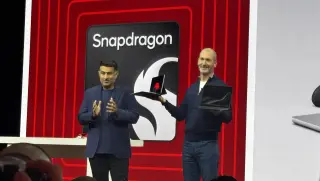
Qualcomm confirms its Snapdragon X laptop chip will power Google's new Googlebook, marking the first non-Windows device for the line. The Googlebook runs an Android-based Aluminium OS with Gemini features and on-device AI via the NPU, and will be offered by OEMs including Acer, ASUS, Dell, HP and Lenovo with Intel and MediaTek options and possible x86 support. Exact chip variant, pricing and ship date are not yet announced beyond a fall 2026 launch window; more details are expected at Google I/O.

Qualcomm officially confirms its Snapdragon-powered Googlebook will launch this fall, signaling a renewed push into premium Chromebooks. Initial devices are expected to use Snapdragon X Plus, with newer boards like Calypso under consideration, and Gemini Intelligence features shaping the performance and efficiency of the Googlebook lineup.

AI and chip stocks fell after U.S.-China talks did not address chip policy, keeping momentum weak for major chipmakers. The Nasdaq slid about 1.7% while the S&P 500 remained pressured; Nvidia and AMD declined on policy uncertainty, whereas Qualcomm and Cisco managed to rise despite the broad weakness.

Qualcomm shares fell about 10% as the broader semiconductor and AI complex declined on hot inflation data and geopolitical concerns, dragging most of the sector lower with Nvidia lingering as a notable exception.

U.S. equities rose Monday, led by semiconductor and memory-name gains (NVIDIA, Micron, Qualcomm) after an opening decline, with the S&P 500 and Nasdaq 100 rebounding as analysts lift 2026 targets on strong earnings, while investors shrug off U.S.-Iran tensions.
Trefis argues Qualcomm is transitioning from a handset component supplier to an edge‑AI compute platform, leveraging Snapdragon, automotive design-wins and on‑device inferencing. Despite near‑term headwinds like Apple’s modem shift and memory shortages, a growth path driven by AI, automotive, and on‑device compute could push the stock toward $340; with revenue seen rising to about $65B by 2029 and EPS near $17, a ~20x forward multiple implies the target, supported by strong cash flow and buybacks.

Qualcomm, reeling from its breakup with Apple, is pursuing a bold pivot into AI and data centers, building a broader silicon toolkit and AI accelerators while courting cloud-scale partnerships to replace shrinking iPhone component revenue. Although Qualcomm highlights growth in automotive tech and IoT, next-quarter revenue is expected to fall as Apple-related sales decline, and investors remain cautious amid fierce competition from Nvidia, AMD and others who already lead in the data-center AI space.

OpenAI is reportedly developing a smartphone where AI agents replace apps, with Qualcomm and MediaTek co-designing a custom processor and Luxshare exclusive manufacturing; analysts project 300-400 million annual shipments by 2028, a scale rivaling iPhone volumes. The concept envisions on-device lightweight tasks while heavy AI inference runs in the cloud, maintaining continuous real-time context. While the supply chain appears credible, OpenAI has never shipped hardware and past AI-device efforts have faltered, making the 2028 timeline speculative rather than confirmed.

Qualcomm shares rose about 13% in premarket trading after reports that the chipmaker is partnering with OpenAI to supply a smartphone processor, signaling potential AI-driven demand for its chips and a strategic boost for the company.
Qualcomm shares jumped about 13% in premarket trading after analyst notes suggested OpenAI is partnering with Qualcomm and MediaTek to develop AI-focused smartphone processors, with Luxshare as the exclusive system co-design/manufacturing partner and mass production targeted for 2028, signaling a potential long-term AI upgrade cycle for mobile chips.

Rumors suggest Samsung’s Galaxy S27 Ultra will continue to use Qualcomm’s Snapdragon chipset, potentially the Snapdragon 8 Elite Gen 6 Pro (SM8975), with Qualcomm hinting at an ongoing Snapdragon-powered legacy for Samsung flagships. Samsung isn’t revealing the S27 lineup until next year, leaving room for final chipset choices amid talk of a Snapdragon–Samsung partnership continuing for the top model.

Google’s March Android security update closes 129 vulnerabilities, several high severity, including a zero-day in Qualcomm graphics hardware (CVE-2026-21385) already seen in targeted attacks. Patches arrive in two levels (2026-03-01 and 2026-03-05); Pixel devices typically update first, while other OEMs and carriers may delay. Users should install the update promptly, keep Google Play Protect enabled, and practice standard defenses (avoid unknown apps, use strong device security) to mitigate risk from remote code execution and privilege-escalation flaws.

Qualcomm’s Arduino Ventuno Q fuses AI with robotics on a single board, pairing the Dragonwing IQ8 CPU/GPU with a dedicated STM32H5 MCU, 16GB RAM, 64GB eMMC, and an NVMe slot, plus Wi‑Fi 6 and 2.5Gb Ethernet. With Arduino App Lab offering offline pre‑trained models (vision, ASR, gestures, etc.), it targets edge AI robotics, autonomous sensing and education, and is slated to ship in Q2 2026 for under $300.

Qualcomm revealed Snapdragon Wear Elite, a 3nm AI-enabled wearable chip designed for pendants and pins that coexists with W5 Plus, featuring on‑device neural processing (two billion parameters, up to 10 tokens per second), improved power efficiency (GPS uses 40% less power), fast charging (about 50% in 10 minutes) and added satellite, 5G, UWB, Bluetooth 6.0, plus Linux support—signaling a push toward AI wearables and a broader ecosystem.