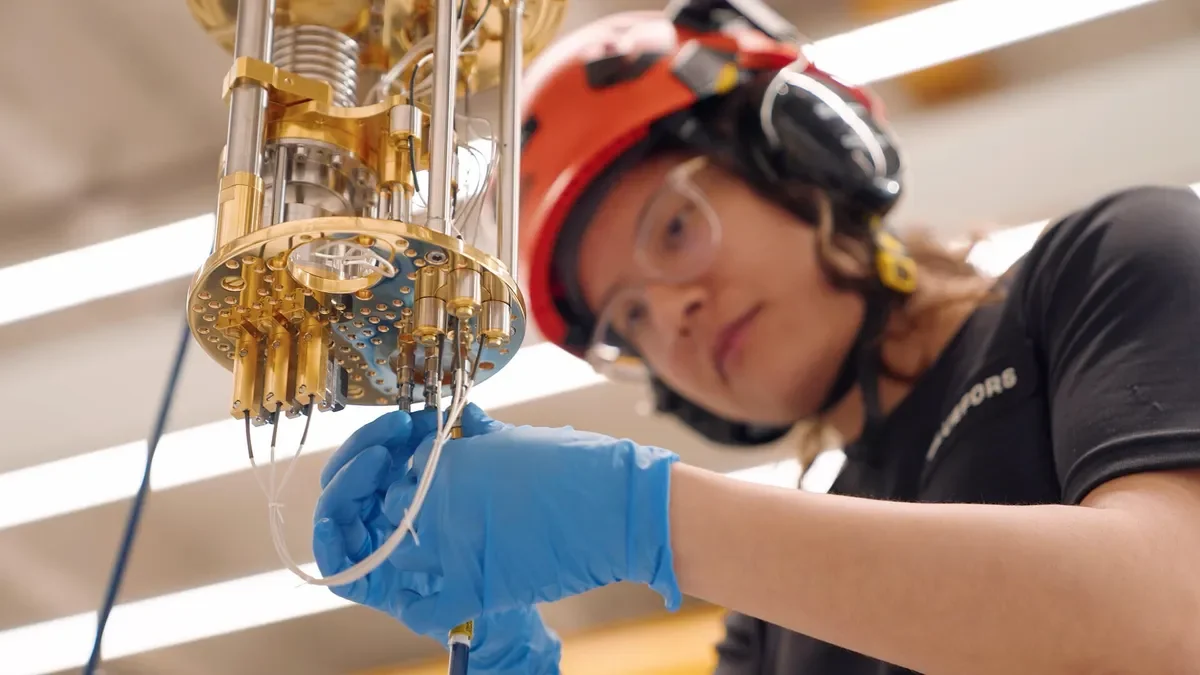
Quantum computers must be kept at temperatures near absolute zero to protect qubits from heat; a Bluefors dilution refrigerator cools the hardware to below one kelvin—colder than the Boomerang Nebula—highlighting how cryogenic cooling is essential to unlocking quantum computing.
NSF launches a $100 million National Quantum and Nanotechnology Infrastructure program to fund up to 16 open-access sites over five years to give researchers and startups access to chip fabrication, testing, and training tools; Delta Gold Technologies signs a multi‑year, up‑to‑$2.99 million gold‑based quantum IP deal with Penn State; Xanadu Quantum Technologies releases a method to cut quantum‑chemistry resource needs by more than an order of magnitude; Oxford Quantum Circuits demonstrates wafer‑scale packaging for 500+ qubits with strong fidelity, signaling progress toward larger machines; Infleqtion’s SPAC merger with Churchill Capital X secures over $550 million in gross proceeds, setting Infleqtion up to list on the NYSE as INFQ.
Scientists at Silicon Quantum Computing have developed the most accurate silicon-based quantum chip, achieving high fidelity rates up to 99.99% with a new architecture called 14/15, which is scalable and could lead to fault-tolerant quantum processors with millions of qubits, surpassing other tech giants like IBM and Google in certain benchmarks.
Scientists at Princeton have developed a new method for creating superconducting qubits using tantalum, significantly increasing their coherence time to 1.68 milliseconds, which is three times longer than current systems, potentially enabling more powerful quantum computing operations. However, challenges such as the scarcity of tantalum remain before these advancements can be widely implemented.
Google announced a breakthrough in quantum computing by developing an algorithm that outperforms supercomputers in a specific task, marking a significant milestone towards practical quantum applications, though widespread use is still years away due to hardware limitations.
A new qubit technology involves trapping lone electrons on the surface of liquid helium, leveraging old physics and the superfluid properties of helium to potentially scale quantum computers more efficiently. The system uses low temperatures and unique trapping methods to control electrons, offering a promising alternative in quantum tech development.
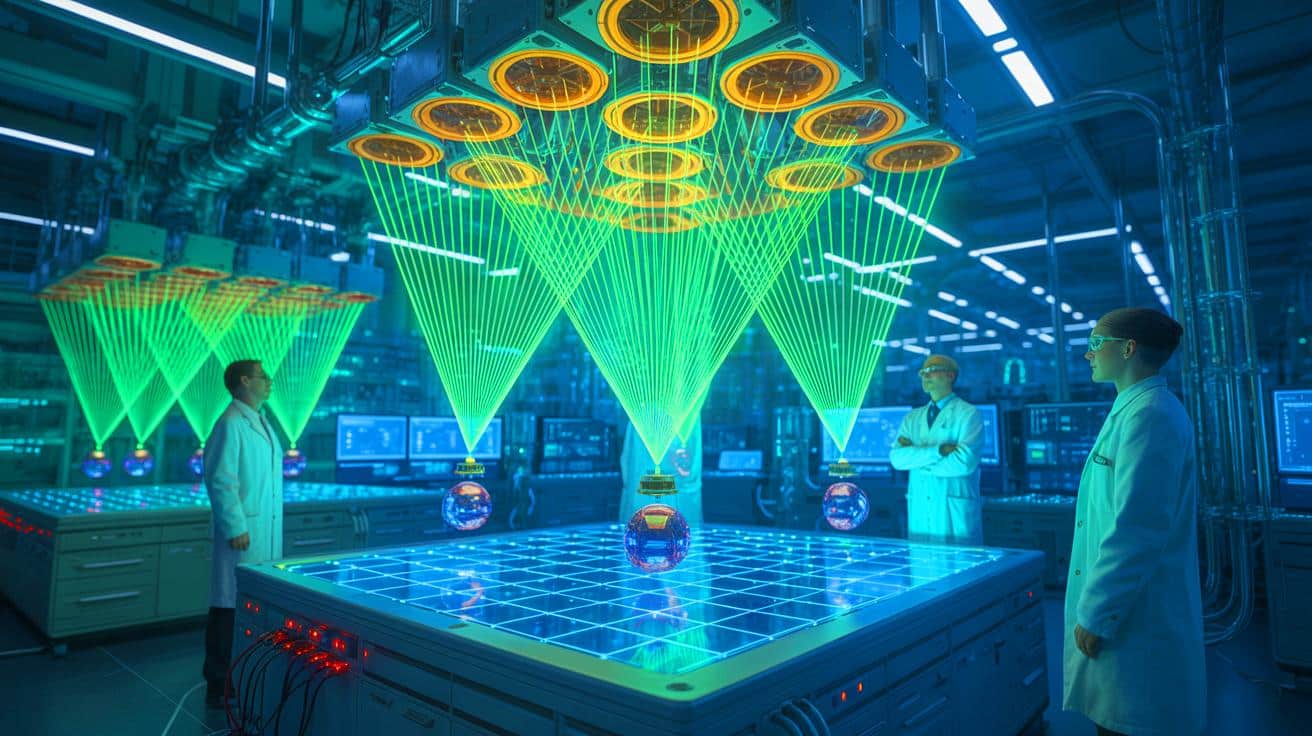
Scientists at Caltech have set a new record by synchronizing 6,100 neutral atom qubits in a quantum array that operates at room temperature, with extended superposition coherence of 12.6 seconds, marking a significant step toward scalable, fault-tolerant quantum computers capable of surpassing classical supercomputers.
Caltech physicists have created the largest array of neutral-atom qubits, consisting of 6,100 qubits with high accuracy and the ability to move atoms while preserving superposition, marking a significant step toward scalable quantum computers capable of complex computations and simulations.
Physicists used a scanning tunneling microscope to observe the real-time magnetic pulse of a titanium-49 atom's nucleus, revealing insights into nuclear spin relaxation and potential applications for quantum computing. They measured the atom's nuclear spin flip-flop every five seconds, providing an atomic-scale understanding of nuclear magnetic behavior relevant for developing qubit platforms.
Scientists at the University of Sydney have demonstrated a quantum logic gate using GKP error-correcting codes on a single atom, significantly reducing the number of physical qubits needed for quantum operations and advancing the development of scalable quantum computers.
Researchers at Caltech have demonstrated that quantum computers can generate randomness more efficiently using smaller qubit blocks, potentially enabling faster and more powerful quantum systems for various applications, while also raising fundamental questions about the limits of observing quantum phenomena.
Researchers at The University of Osaka have developed a new method called level-zero magic state distillation that significantly reduces the resources needed for high-fidelity magic states, overcoming noise challenges and accelerating the development of practical, large-scale quantum computers.
Scientists have developed a cryogenic control chip that can operate near absolute zero, enabling the placement of millions of qubits on a single quantum processor, marking a significant step toward practical and scalable quantum computers.
IBM plans to build the world's first fault-tolerant quantum computer, called Starling, by 2029, using new error-correction techniques that will enable scaling to 200 logical qubits (roughly 10,000 physical qubits), making quantum computers significantly more powerful and bringing them closer to practical utility.
Researchers have used a 56-qubit quantum computer to generate certifiably random bits, verified by classical supercomputers, marking a significant milestone in practical quantum computing and its applications in cryptography and secure communications.