Tag

Super Puff

All articles tagged with #super puff

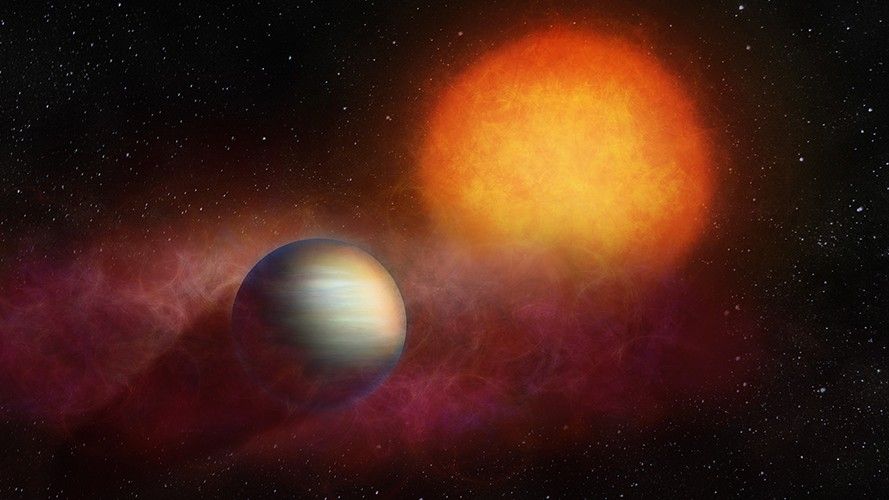
Cosmic cotton candy: two Jupiter-sized exoplanets revealed as featherweight 'super-puffs'
science1 day ago

Cosmic cotton candy: two Jupiter-sized exoplanets revealed as featherweight 'super-puffs'

Astronomers have identified two Jupiter-sized exoplanets, TOI-791 b and TOI-791 c, about 1,100 light-years away, that are ultralow-density 'super-puffs,' with densities far lower than Jupiter and likely hydrogen/helium atmospheres. Their puffiness, comparable to shaving foam or cotton candy, makes them some of the lightest known planets and challenges standard formation theories. Observations from Antarctica helped determine their densities, and their orbits may be in a mean-motion resonance, implying formation in gas-rich regions farther from their star.
Double Jupiter-Sized 'Super-Puff' Planets Dazzle with Cotton-Candy Densities
science12 days ago

Double Jupiter-Sized 'Super-Puff' Planets Dazzle with Cotton-Candy Densities

Astronomers have identified two Jupiter-sized exoplanets in the TOI-791 system—TOI-791b and TOI-791c—that are extraordinarily low-density, with densities of about 0.038 and 0.047 g/cm³, among the lowest for giant planets and even lower than cotton candy. Found by citizen scientists via the Planet Hunters TESS project, these planets orbit a dwarf star roughly 1,110 light-years away in a 5:3 resonance. Masses and densities were derived from global observations, including an Antarctic telescope, enabling the team to measure their diffuse nature. Further studies, including space-based observations with the James Webb Space Telescope, are planned to explore their atmospheres and formation history.

Haze Cloaks Kepler-51d, Complicating Its Atmosphere Study
science1 month ago

Haze Cloaks Kepler-51d, Complicating Its Atmosphere Study

New JWST observations of the low-density exoplanet Kepler-51d reveal an unusually thick haze that absorbs light and masks its atmospheric composition, leaving scientists puzzled about its formation and forcing them to consider whether rings or a unique haze layer explain the transit data; the planet, part of the Kepler-51 system known for three other super-puffs, may have formed farther from its star before migrating inward, challenging existing planetary-formation models.

science1 year ago

James Webb Uncovers Mysterious Super-Puff Exoplanet in Kepler-51

Astronomers using the James Webb Space Telescope have discovered a new planet, Kepler-51e, in the Kepler-51 system, known for its ultra-low-density 'super-puff' planets. This discovery, made through transit timing variations, adds complexity to the system and challenges existing planetary formation models. Kepler-51e's presence suggests more undiscovered planets may exist in the system, prompting further study of these unique exoplanets and their atmospheres.