First Magnetar Birth Seen in Chirping Supernova
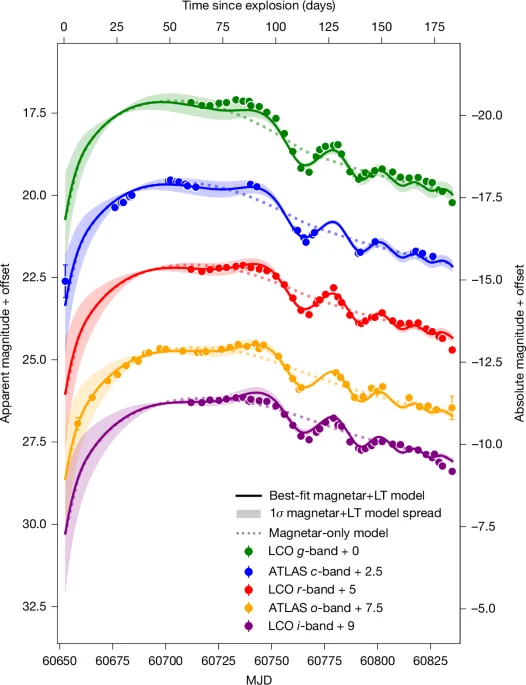
Astronomers monitored SN 2024afav for about 200 days and observed four distinct brightness bumps—the object's light curve chirp—best explained by a newborn magnetar with a tilted accretion disk that undergoes Lense-Thirring precession, a relativistic effect that modulates emitted light. This provides the first direct evidence that magnetars power some superluminous supernovae, supporting Dan Kasen's 2010 theory; the magnetar spins ~4.2 milliseconds with a magnetic field around 3×10^14 gauss. The discovery, published in Nature, confirms GR's role in a stellar explosion and suggests future surveys (e.g., Rubin Observatory) will uncover many more chirping events.