Tag

Tiling

All articles tagged with #tiling

Mathematicians finally discover the elusive 'Spectre' aperiodic tile.
science2 years ago

Mathematicians finally discover the elusive 'Spectre' aperiodic tile.

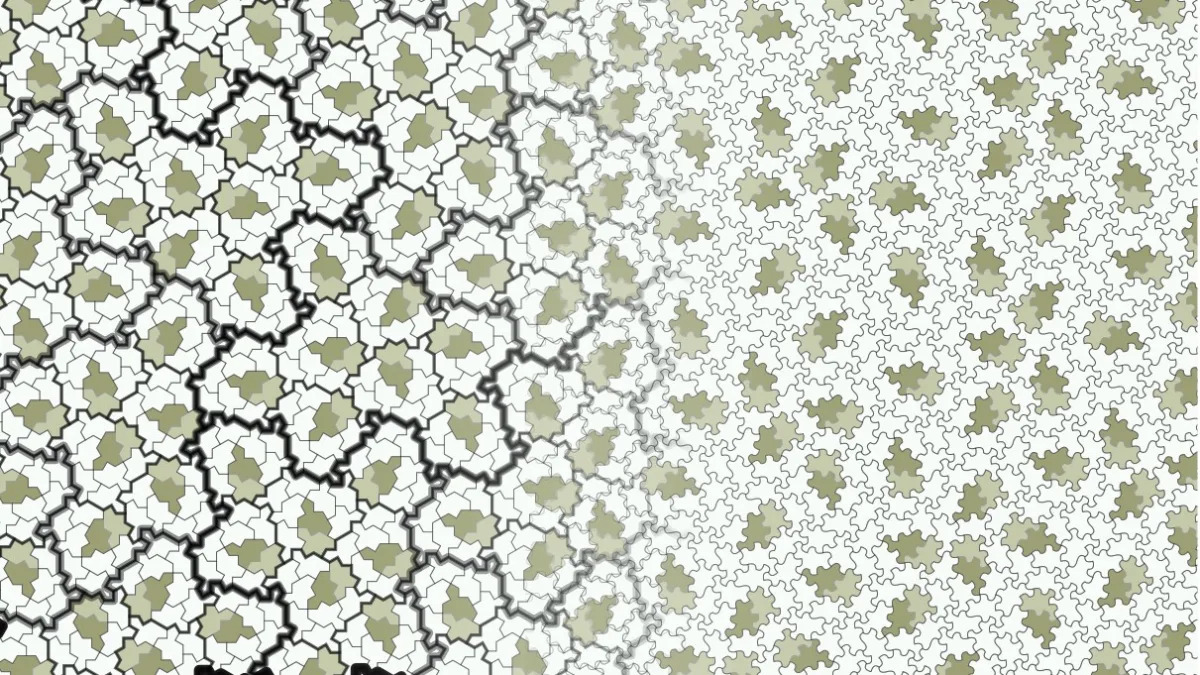
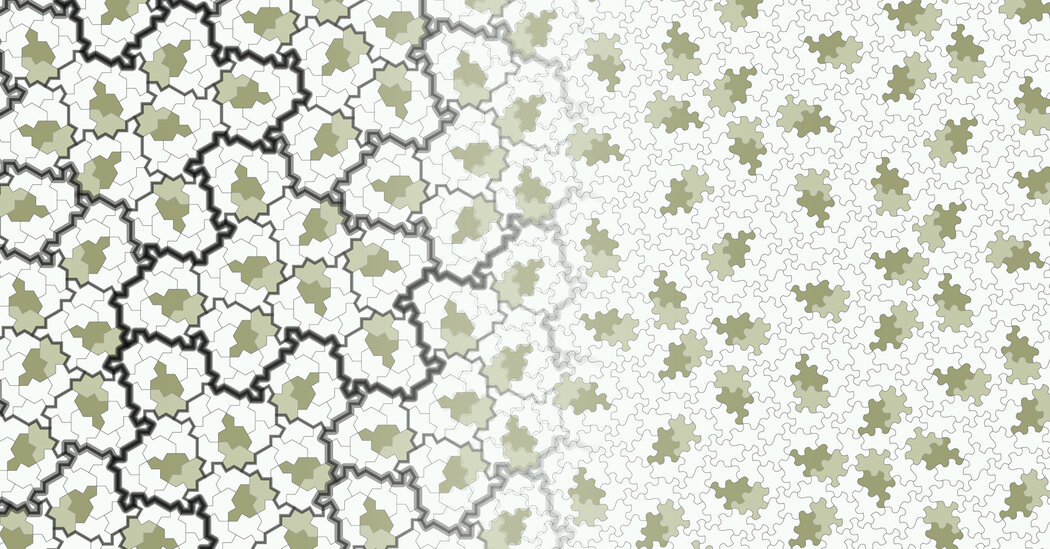
Mathematicians have discovered a 14-sided shape called the "Spectre" that can tile a surface without ever repeating or being flipped. The shape is the first example of an aperiodic monotile that tiles the plane without reflections. The discovery is the culmination of decades of hunting by mathematicians around the world, and it was made by a retired printing technician named David Smith. The team started with the original "hat" shape and added an extra side to it. That new shape still required its mirror image to fully tile, but the researchers discovered that by transforming the 14-sided shape's straight edges into curved ones, they could dispense with mirror images and work with just the one shape.
'Mathematicians discover elusive 'vampire Einstein' shape'
science2 years ago

'Mathematicians discover elusive 'vampire Einstein' shape'

Mathematicians have discovered a 14-sided shape called "Spectre" that can tile a surface without repeating or being flipped, making it the first example of an aperiodic monotile that tiles the plane without reflections. The shape was discovered by adding an extra side to the original "hat" shape and transforming its straight edges into curved ones. The discovery culminates decades of hunting by mathematicians around the world for a shape that could completely tile a surface without ever repeating.

Mathematicians Crack Decades-Long Tiling Puzzle with Upgraded Einstein Shape
science-and-technology2 years ago

Mathematicians Crack Decades-Long Tiling Puzzle with Upgraded Einstein Shape

Researchers have discovered a new-and-improved "einstein" - a single shape that tiles a plane, or an infinite two-dimensional flat surface, but only in a nonrepeating pattern. The new monotile discovery does not use reflections and is a close relative of the original "hat" einstein. The team produced a family of strong or "strictly chiral aperiodic monotiles" through a simple modification of the T(1,1) tile, named "Spectres," which only allow nonperiodic tilings, and without reflections.

Endless Non-Repeating Math.
mathematics2 years ago

Endless Non-Repeating Math.

Mathematicians have been searching for aperiodic tilings of the plane that cannot have translational symmetry. A breakthrough occurred in the 1970s with the discovery of the famous two-tile set called Penrose tiles. Recently, David Smith discovered the first known aperiodic monotile called the "hat," which was verified by researchers Craig Kaplan, Chaim Goodman-Strauss, and Joseph Samuel Myers. The hat tile comes together to form larger, regular structures, which can be used to understand how it tiles the plane.

Computer Scientist Solves Decades-Old Mathematical Mysteries
science-and-technology3 years ago

Computer Scientist Solves Decades-Old Mathematical Mysteries

Computer scientist Craig Kaplan, who had been searching for a shape that could fill an entire plane without forming regular patterns for decades, has finally found it with the help of a hobbyist named David Smith. The shape, called the 'hat', shattered records for both Heesch and isohedral numbers, proving itself to be an Einstein tile. Kaplan used computational methods to analyze the tiling properties of the hat, and the researchers used computation to construct a complete list of all possible neighborhoods to prove aperiodicity. While there is no immediate application identified to this tiling, new and interesting connections are expected to emerge as more researchers fiddle around with it.

New Shape Discovered Solves Longstanding Math Problem
mathematics3 years ago

New Shape Discovered Solves Longstanding Math Problem

After a decade of attempts, David Smith, a shape hobbyist, has discovered an "einstein," an aperiodic monotile that tiles a plane in a nonrepeating pattern. Smith's einstein, called "the hat," is a polykite made of eight kites. The paper, co-authored by Smith and three others, provides two proofs of the hat's aperiodicity, one of which uses a new technique. The hat's discovery opens up new possibilities for materials with this type of internal structure.

Mathematicians Discover Mesmerizing Shape with Non-Repeating Pattern.
science-and-technology3 years ago

Mathematicians Discover Mesmerizing Shape with Non-Repeating Pattern.

Mathematicians have discovered a new 13-sided shape called "the hat" that can be tiled across a plane to create patterns that never repeat, making it an aperiodic monotile. The hat was identified by a non-professional mathematician and "shape hobbyist" David Smith from the UK. The team has also introduced a new method for proving the existence of future einsteins, where various permutations of the shape are combined to help establish that they can continue on forever without becoming symmetrical in their patterns. The discovery of the hat opens up all kinds of avenues to explore, not least whether or not there is a finite number of aperiodic monotiles out there, waiting to be found.

Mathematical mystery solved by elusive 'Einstein'.
mathematics3 years ago

Mathematical mystery solved by elusive 'Einstein'.

After a decade of attempts, a self-described shape hobbyist from England, David Smith, has discovered an "einstein," an aperiodic monotile that tiles a plane in a nonrepeating pattern. Smith's discovery, called "the hat," was confirmed in a new paper by Smith and three co-authors with mathematical and computational expertise. The paper provides two proofs, one of which offers a new tool for proving aperiodicity. The hat is a polykite made of eight kites and is part of an entire family of related einsteins, including a second one discovered by Smith called "the turtle."

Mathematicians Unveil New 13-Sided Shape with Unique Tiling Properties
science-and-technology3 years ago

Mathematicians Unveil New 13-Sided Shape with Unique Tiling Properties

A team of mathematicians from various universities has discovered a 2D geometric shape called "the hat" that does not repeat itself when tiled. The shape has 13 sides and was discovered by paring down possibilities using a computer and studying the resulting smaller sets by hand. The researchers suggest that the most likely application of the hat is in the arts.