Tag

Unified Memory

All articles tagged with #unified memory

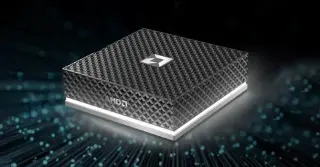
AMD Ryzen AI Halo Review: 128GB Unified Memory and Local AI Playbooks
hardware2 hours ago

AMD Ryzen AI Halo Review: 128GB Unified Memory and Local AI Playbooks

TechPowerUp reviews the AMD Ryzen AI Halo, a mini-PC featuring 128GB of unified memory and a robust software stack for local AI. The system includes pre-installed models and 'Playbooks' for tasks like image generation and coding, with up to 96GB allocatable as VRAM. While TechRadar notes a $3,999 price point for similar configurations, Camera Jabber highlights a Chinese competitor, the Thunderobot Station, priced at roughly £2,800. The Halo aims to reduce setup friction for developers by providing a ready-to-use environment for large language models and AI agents without cloud dependency.


Nvidia RTX Spark Launches: A New Arm-Based Windows Platform for Local AI
technology4 days ago

Nvidia RTX Spark Launches: A New Arm-Based Windows Platform for Local AI

Nvidia and Microsoft launched the RTX Spark platform on October 16, 2026, introducing a new class of Windows laptops built on Arm architecture. The N1X superchip combines a Grace CPU, Blackwell GPU, and up to 128GB of unified memory to enable local AI inference and agentic workflows without cloud dependency. While the hardware offers workstation-grade power in a portable form factor, early reviews highlight significant trade-offs in gaming performance, battery life, and software stability compared to x86 and Apple silicon competitors.

Lucebox Zero 495 Launches: AMD's Flagship AI Workstation Hits Market with 224GB Memory
technology14 days ago

Lucebox Zero 495 Launches: AMD's Flagship AI Workstation Hits Market with 224GB Memory

Lucebox has released the Zero 495, a high-performance local AI workstation featuring the AMD Ryzen AI MAX+ 495 processor. The system offers 128GB or 192GB of unified memory and includes a Radeon AI PRO R9700 GPU, boosting total memory to 224GB. Priced at $5,999 for the initial 200 units, it targets users seeking offline AI capabilities without cloud dependency.

ACEMAGIC F9A Mini Workstation Targets Local AI with 192GB Memory and Ryzen AI MAX+ 495
technology1 month ago

ACEMAGIC F9A Mini Workstation Targets Local AI with 192GB Memory and Ryzen AI MAX+ 495

ACEMAGIC has unveiled the F9A, a compact mini-workstation designed for local AI inference, featuring AMD’s Ryzen AI MAX+ 395 and upcoming 495 chips. The system supports up to 192GB of unified memory, enabling the execution of large language models without cloud dependency. While the 395 variant launches in September with 128GB of RAM, the 495 model offers 60% greater model capacity. Pricing is expected to exceed $5,000 for the top-tier configuration, positioning it against competitors like NVIDIA’s DGX Spark.

ASUS ProArt P14 Launches with RTX Spark, Joining Sold-Out Wave of NVIDIA's New ARM Laptops
technology1 month ago

ASUS ProArt P14 Launches with RTX Spark, Joining Sold-Out Wave of NVIDIA's New ARM Laptops

ASUS has officially launched the ProArt P14, a 14-inch creator laptop powered by NVIDIA's new RTX Spark ARM SoC. The device features up to 128GB of unified LPDDR5X memory, OLED displays with G-Sync, and a 90Wh battery, though pricing remains unannounced. This release coincides with reports that initial RTX Spark laptop shipments from ASUS and MSI have sold out, prompting both manufacturers to request additional chipsets from NVIDIA.

Apple Plans M7 Ultra With 1.5TB Unified Memory for AI-Centric Macs
technology3 months ago

Apple Plans M7 Ultra With 1.5TB Unified Memory for AI-Centric Macs

Bloomberg reports Apple is skipping the M6 Pro/Max and moving straight to the M7 family, with the M7 Ultra rumored to support up to 1.5 TB of unified memory and higher bandwidth to fuel local AI and heavy workloads; the M7 base is expected in early 2027, followed by M7 Pro/Max and a Mac Studio–focused Ultra variant in 2028, leveraging a high-end 18A-node design and supply-chain-enabled memory configurations.

M7 Ultra Might Pack 1.5TB RAM, Narrowing Apple Silicon’s Memory Gap
technology3 months ago

M7 Ultra Might Pack 1.5TB RAM, Narrowing Apple Silicon’s Memory Gap

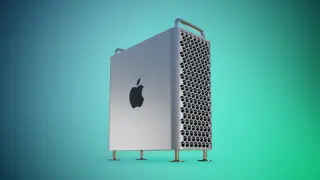
Mark Gurman’s Power On suggests Apple’s upcoming M7 Ultra could support up to 1.5TB of unified memory, potentially matching the top RAM of the 2019 Mac Pro. While this would close a long-running Apple Silicon limit, supply constraints and strategic decisions could affect whether the 1.5TB option ships. Apple’s roadmap reportedly includes an M5 Ultra with up to 768GB, and the high-end RAM upgrade from 128GB would be very expensive (estimates exceed $35,000) if offered.

AMD Strix Halo Brings 120B-Parameter AI to a $1,500 PC
technology3 months ago

AMD Strix Halo Brings 120B-Parameter AI to a $1,500 PC

AMD's Strix Halo Ryzen AI Max Plus enables on-device inference for models up to 120B parameters using up to 128 GB of unified memory in a $1,499 mini PC, offering strong cost efficiency and data control but with real-world memory bandwidth around 122 GB/s and a still-maturing ROCm/Windows ecosystem. It trails NVIDIA in prefill speed and lacks CUDA-level software maturity, though its cost per GB memory (~$25.77) is far cheaper than Apple M3 Ultra’s. A future Gorgon Halo with 192 GB and up to 300B parameters is planned for 2026, signaling AMD's ongoing AI hardware push. For workloads prioritizing local processing and agent workflows, Strix Halo is compelling; for CUDA-heavy or bandwidth-intensive tasks, NVIDIA or Apple may be preferable.

AMD's Ryzen AI MAX 400 Enables 192GB Unified Memory for Local 300B+ LLMs
technology5 months ago

AMD's Ryzen AI MAX 400 Enables 192GB Unified Memory for Local 300B+ LLMs

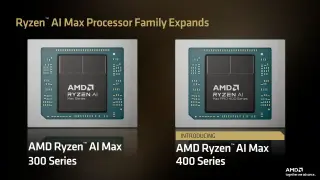
AMD unveils the Ryzen AI MAX 400 family (Gorgon Halo), pairing Zen 5 CPUs, RDNA 3.5 GPUs, and XDNA 2 NPUs with up to 192 GB of unified memory to run 300B+ parameter LLMs locally on a single chip, and up to 160 GB of VRAM. The lineup—MAX+ PRO 495, 490, and 485—offers higher clocks than the MAX 300 series, with launch expected in Q3 2026 through OEMs like ASUS, HP, and Lenovo, targeting professional AI and creator workloads.

AMD Expands Ryzen AI Max 400 Series with 192 GB Memory to Run Big AI Models
technology5 months ago

AMD Expands Ryzen AI Max 400 Series with 192 GB Memory to Run Big AI Models

AMD unveiled the Ryzen AI Max 400 series, a Strix Halo refresh that doubles down on memory: the SoC now supports up to 192 GB of LPDDR5X unified memory (up to 160 GB available to the iGPU), while Zen 5 CPUs boost to 5.20 GHz and RDNA 3.5 GPUs to 3.00 GHz, and the integrated NPU climbs to 55 TOPS. The lineup includes Ryzen AI Max+ PRO 495, Max PRO 490, and PRO 485, with consumer variants planned later. The memory upgrade targets AI workloads and 300B+ parameter LLMs, marking a major memory-focused refresh for Strix Halo.

MacBook Neo Defies 8GB RAM Limits With Surging Demand
gadgets6 months ago

MacBook Neo Defies 8GB RAM Limits With Surging Demand

Apple’s $600 MacBook Neo is proving popular despite its 8GB of unified memory, with two-to-three week online wait times signaling strong demand. Industry chatter points to supply constraints around the A18 Pro chip and RAM, but the unified memory approach helps the device handle typical browsing, streaming, and light tasks. A Neo 2 with more RAM (potentially 12GB) and an A19 Pro chip is rumored, but Apple is expected to keep the Neo’s base price at $600.

MacBook Neo’s 8GB RAM outperforms Windows PCs in real-world RAM tests
technology7 months ago

MacBook Neo’s 8GB RAM outperforms Windows PCs in real-world RAM tests

Tom’s Guide tested the $599 MacBook Neo with 8GB of unified memory against a Windows PC with 128GB RAM, using Chrome with 20 tabs, Apple Music, and Photoshop. The Neo managed total memory of about 7.24 GB versus ~27.1 GB on the Windows machine, with Chrome consuming 1.67 GB on macOS vs 4.76 GB on Windows and similar differences for apps. The article argues that unified memory and macOS RAM compression let the Neo feel lean and responsive despite less RAM, while Windows’ caching can bloat apparent usage. The takeaway: more RAM isn’t always better, though Windows may still win in gaming; the MacBook Neo’s architecture makes 8GB feel much more capable at budget pricing.