Tag

Vela Supercluster

All articles tagged with #vela supercluster

Hidden Giant Behind the Milky Way: Vela Supercluster Rewrites Our Local Gravity
science2 months ago

Hidden Giant Behind the Milky Way: Vela Supercluster Rewrites Our Local Gravity

Astronomers using the CosmicFlows dataset and new redshifts from SALT and MeerKAT have shown the Vela Supercluster, located behind the Milky Way in the Zone of Avoidance, is far larger and more massive than once thought—about 33,800 trillion solar masses across roughly 300 million light-years. Comprising two walls of galaxy clusters moving toward each other, it exerts a gravitational pull rivaling or exceeding the Great Attractor and helps explain local galaxy motions, effectively completing a map of a major gravitational player hidden behind our galaxy.
Hidden Galaxy Giant Behind Our Galaxy: The Vela Supercluster Emerges as a Cosmic Powerhouse
space2 months ago

Hidden Galaxy Giant Behind Our Galaxy: The Vela Supercluster Emerges as a Cosmic Powerhouse

Astronomers mapping the Milky Way’s dust-shrouded Zone of Avoidance have revealed the Vela Supercluster, a vast structure about 300 million light-years across containing roughly 33,800 trillion solar masses, located around 870 million light-years away. Using 65,518 galaxy distance measurements plus 8,283 new redshifts from SALT and MeerKAT, they show Vela is comparable in mass to the Shapley Supercluster and its gravity exceeds that of the Great Attractor, helping explain observed cosmic flows and completing our map of the local universe.

Hidden Giant: Vela Supercluster Maps Vast Structure Beyond Milky Way
science2 months ago

Hidden Giant: Vela Supercluster Maps Vast Structure Beyond Milky Way

Researchers mapped the Vela Supercluster, a colossal assembly of galaxies hidden behind the Milky Way’s dust in the Zone of Avoidance, about 800 million light-years away. It spans roughly 300 million light-years and contains mass equivalent to about 30 quadrillion suns, making it one of the universe’s largest known structures and helping refine cosmological models, with observations from SALT and MeerKAT aiding the map.

Astronomers Map a Hidden Giant: the Vela Supercluster Behind the Milky Way
space2 months ago

Astronomers Map a Hidden Giant: the Vela Supercluster Behind the Milky Way

Researchers have mapped the Vela Supercluster, a massive galaxy assembly hidden behind the Milky Way’s dust in the Zone of Avoidance. Using SALT and the MeerKAT radio telescope, the structure—about 300 million light-years across and roughly 800 million light-years from Earth—contains the mass of ~30 quadrillion suns, making it one of the largest known local-universe structures. The discovery, ten years after its initial identification, helps refine models of cosmology and the distribution of matter in the universe, with future radio telescopes expected to yield even more detailed maps.

Cosmic Giant Vela Supercluster Mapped Behind the Milky Way
space2 months ago

Cosmic Giant Vela Supercluster Mapped Behind the Milky Way

Astronomers have for the first time mapped the Vela Supercluster, a colossal structure roughly 300 million light-years across that houses at least 20 galaxy clusters and contains about 30 quadrillion solar masses. Hidden behind the Milky Way’s Zone of Avoidance, the map was built from 65,000 existing distance measurements and ~8,000 new redshifts (including ~2,000 from the MeerKAT radio telescope), revealing two massive cores moving toward each other and placing Vela among the universe’s largest known structures—larger than Laniakea and rivaling the Shapley Supercluster. This new view could refine models of cosmic structure and dynamics, though parts of the spread will remain obscured by dust and gas.

Astronomers Discover Hundreds of Galaxies Beyond the Zone of Avoidance
science1 year ago

Astronomers Discover Hundreds of Galaxies Beyond the Zone of Avoidance

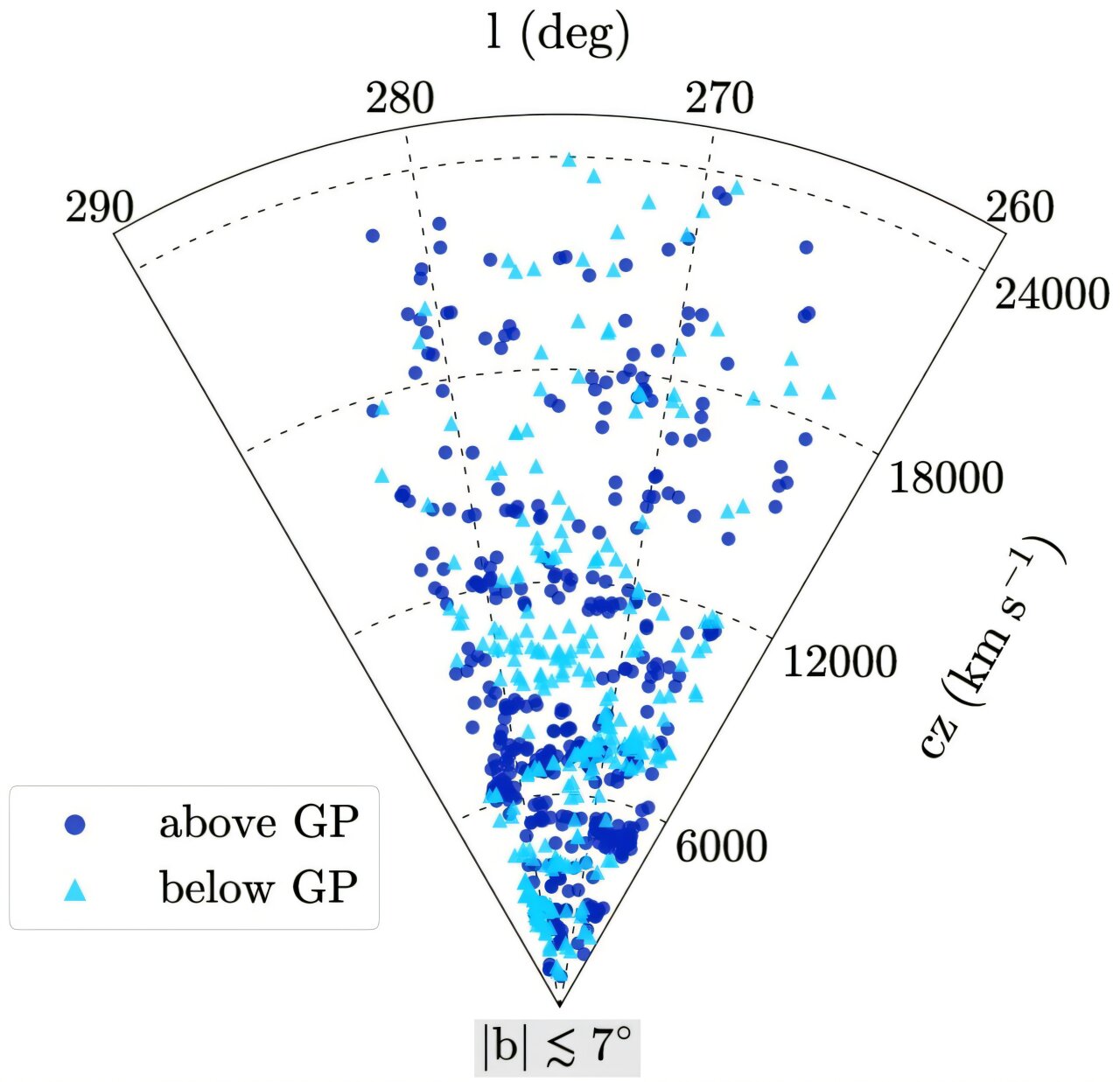
Astronomers have used the MeerKAT radio telescope in South Africa to map the Zone of Avoidance, a region obscured by dust near the galactic center, discovering 719 galaxies within the Vela supercluster. This study highlights the potential of radio astronomy to explore areas previously hidden from optical telescopes, offering new insights into the structure of the universe.