
REM Sleep Reveals a Brain Energy Paradox: Blood Flow Rises While Neuronal ATP Falls
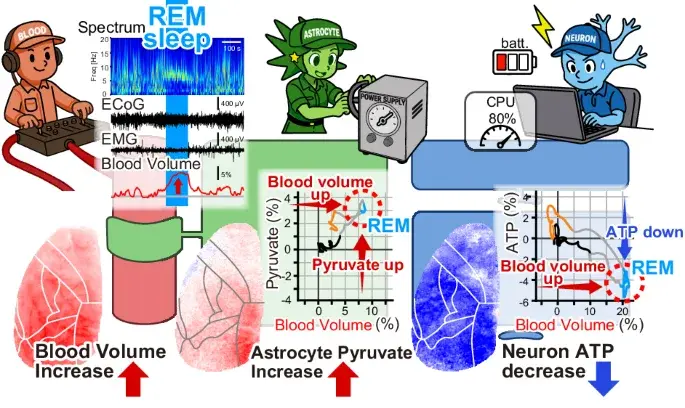
Researchers using live mice found that REM sleep triggers a unique metabolic shift where brain blood volume and astrocytic pyruvate increase, but neuronal ATP levels drop sharply. This contrasts with NREM sleep, where energy supply closely follows neuronal activity. The findings suggest the brain uses distinct energy-allocation strategies to support different computational tasks during sleep.
Key points
- During NREM sleep, theta-band brain activity predicts blood volume changes 4-5 seconds later, indicating tight coupling between neuronal demand and energy supply.
- REM sleep shows a paradox: blood volume and astrocytic pyruvate rise, yet neuronal ATP levels decline significantly, despite high metabolic demand for memory consolidation.
- Blood volume fluctuations in NREM sleep move anterior-to-posterior in about 1 second, while REM sleep features slower, posterior-to-anterior waves taking roughly 15 seconds.
- The study used wide-field fluorescence imaging through intact skulls to monitor blood volume, pyruvate, and ATP simultaneously in live mice without invasive craniotomy.
- Astrocytes and neurons may exhibit a reciprocal energy relationship, where astrocytic pyruvate increases do not always translate to higher neuronal ATP, suggesting complex metabolic trade-offs.
Background
Previous research highlighted that sleep is not rest but active brain processing, with distinct frequency patterns in NREM and REM stages. Earlier studies noted that REM sleep is associated with memory consolidation and synaptic plasticity, which are energy-intensive. This new study builds on those findings by directly measuring metabolic substrates and energy levels in real-time, revealing how the brain balances supply and consumption across different sleep states. It also connects to broader discussions on brain energy efficiency compared to modern computers, as mentioned in the source's introduction.
Why it matters
Understanding how the brain allocates energy during sleep could reveal mechanisms underlying memory consolidation, dream formation, and neurological disorders. The paradox of rising blood flow but falling ATP in REM sleep suggests that the brain may prioritize synaptic reorganization over immediate energy homeostasis, offering insights into how biological brains achieve computational flexibility and efficiency. This could inform future treatments for sleep-related cognitive issues or neurodegenerative diseases.
What to watch
Researchers plan to investigate the specific mechanisms causing the ATP drop in REM sleep, whether it is due to reduced substrate supply, decreased production, or increased consumption. They also aim to explore how these energy dynamics influence synaptic plasticity and memory storage. Future studies may use advanced imaging or genetic tools to test if altering energy allocation affects sleep-related cognitive functions.
Want the full story? Read the original reporting
Read on Nature