Tag

Brain Metabolism

All articles tagged with #brain metabolism

science26 days ago

REM Dreams Hint at a Hidden Brain Energy Paradox

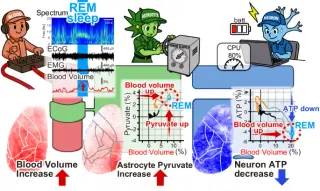
A mouse study from Tohoku University shows that during REM sleep, blood flow and astrocyte-derived fuel rise, but neuronal ATP declines, suggesting energy delivery and usage are temporarily out of sync as dreaming triggers intense brain activity. This energy mismatch means more blood flow doesn’t automatically boost usable energy, and the brain may reorganize energy flow to support internal processing and memory, helping explain why dreaming can feel tiring and how sleep maintains neural efficiency.

REM Sleep Reveals an Energy-Allocation Paradox in Brain Metabolism
neuroscience1 month ago

REM Sleep Reveals an Energy-Allocation Paradox in Brain Metabolism

Using wide-field imaging through the intact mouse skull, the study tracks brain blood volume, astrocytic pyruvate, and neuronal ATP across sleep states and finds that energy delivery and consumption are reorganized by brain state: during NREM, theta activity predicts subsequent BBV with anterior-to-posterior vascular waves, while REM sleep triggers a cortex-wide BBV surge and astrocytic pyruvate rise but a paradoxical drop in neuronal ATP. This dissociation suggests a state-dependent energy reallocation that prioritizes synaptic remodeling and memory-related processing over immediate ATP restoration, revealing a tripartite metabolic network (neurons, astrocytes, vasculature) that flexibly distributes substrates to meet distinct information-processing demands.

Old Diabetes Drug Metformin Shows Brain-Led Control of Metabolism
health5 months ago

Old Diabetes Drug Metformin Shows Brain-Led Control of Metabolism

New preclinical work links metformin’s metabolic effects to the brain, showing it acts in the hypothalamus via the Rap1 pathway to enhance central insulin signaling and reduce liver glucose production in mice. This brain-first mechanism could reshape diabetes and obesity therapies, informing drug combinations and trial endpoints, but human validation is needed and questions remain about dosing, blood–brain barrier crossing, and interactions with AMPK.

Tau hijacks brain energy, linking insomnia to early Alzheimer's
health5 months ago

Tau hijacks brain energy, linking insomnia to early Alzheimer's

A mouse study links early tau tangles to disrupted brain energy use, causing glutamate overproduction that keeps neurons awake and makes sleep hard, which may explain insomnia years before Alzheimer's; drugs that modulate brain metabolism—some used for epilepsy or type 2 diabetes—could improve sleep and potentially slow progression, though human confirmation is needed.

AI maps hidden brain chemistry in Alzheimer's beyond plaques
health-and-medicine6 months ago

AI maps hidden brain chemistry in Alzheimer's beyond plaques

Rice University researchers produced the first label-free molecular atlas of an Alzheimer's brain using hyperspectral Raman imaging paired with machine learning, revealing uneven, brain-wide chemical changes—especially in memory regions—extending beyond amyloid plaques and pointing to broader metabolic disruption (not just a protein problem) that could inform earlier diagnosis and new treatments.

Scent-based cognitive boost: a complex essential oil blend improves memory in a small trial
cognitive-science7 months ago

Scent-based cognitive boost: a complex essential oil blend improves memory in a small trial

A 90-participant double-blind study found inhaling a Genius essential oil blend (patchouli, neroli, grapefruit, cardamom, frankincense, spikenard, rosemary, lemongrass) improved memory and executive-function performance in healthy adults compared with no aroma and sage oil controls, while also increasing brain metabolism during demanding tasks as measured by near-infrared spectroscopy. However, the metabolic increase did not directly explain the performance gains; participants also reported higher alertness and less fatigue. Delivery via a diffuser introduced variability in dosage, and the study assessed only acute, single-session effects. The findings suggest essential-oil aromas can offer small, safe, complementary cognitive benefits but are not a medical treatment; standardizing delivery and testing long-term effects are needed.

"Linking Altered Brain pH and Lactate Levels to Neuropsychiatric Disorders"
health-and-science2 years ago

"Linking Altered Brain pH and Lactate Levels to Neuropsychiatric Disorders"

A global research effort involving 131 scientists from 105 laboratories across seven countries has identified alterations in brain pH and lactate levels as key indicators of metabolic dysfunction in a spectrum of neuropsychiatric and neurodegenerative disorders, including intellectual disability, autism spectrum disorders, schizophrenia, bipolar disorder, depressive disorders, and Alzheimer’s disease. The study, published in eLife, suggests a potential common biological underpinning for these conditions and highlights the impact of both genetic and environmental factors on brain metabolism. The findings could pave the way for new approaches to diagnosing and treating these complex disorders, although further research is needed to understand the exact mechanisms at play in humans.