
Hidden 'Hypersoft' X-ray Sources Reveal Missing Link in Supernova Progenitors
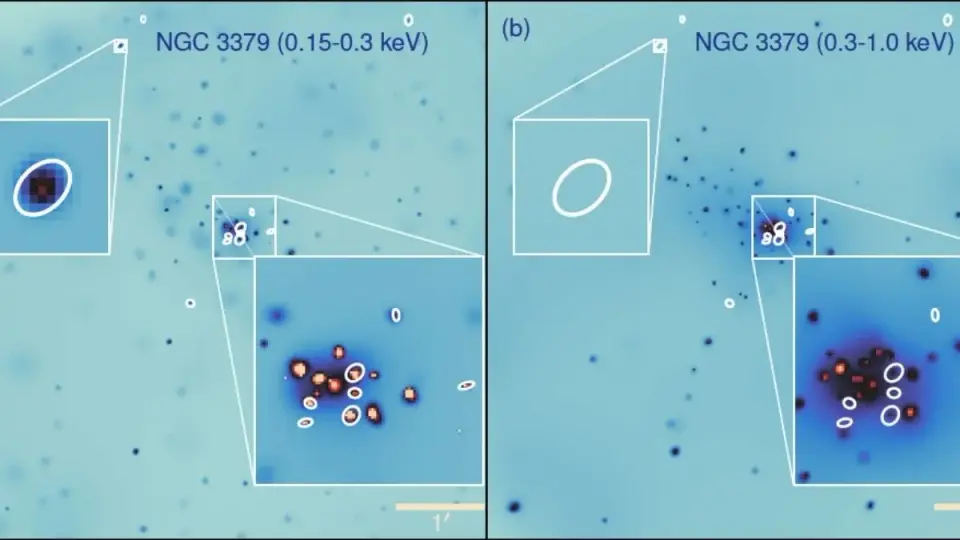
Astronomers have identified 84 previously undetected objects in six nearby galaxies, dubbed 'hypersoft X-ray sources,' which emit low-energy X-rays but likely produce vast amounts of extreme ultraviolet radiation. Hidden by interstellar gas, these objects may include white dwarfs accreting matter, potentially solving the mystery of missing Type Ia supernova progenitors and illuminating how galaxies evolve.
Key points
- Researchers found 84 hypersoft X-ray sources across six galaxies, including Andromeda and M101, using NASA's Chandra X-ray Observatory data.
- These objects emit X-rays at very low energies (0.15-0.3 keV) but are likely much brighter in extreme ultraviolet (EUV) light, which is absorbed by interstellar gas.
- The discovery was made by analyzing existing Chandra archives rather than new observations, revealing a population that had been hidden due to detector limitations and absorption.
- The sources may consist of white dwarfs, neutron stars, or black holes in binary systems, with some potentially being precursors to Type Ia supernovae.
- Identifying these objects could help resolve the 'missing progenitor' problem in supernova studies and explain unaccounted-for ionization in galactic gas.
Background
This discovery follows recent findings of unusual cosmic objects, such as the 'black hole star' MoM-BH*-1 detected by the James Webb Space Telescope in August 2026, which highlighted how dense gas can obscure stellar signatures. Similarly, the September 2026 detection of a lightless micro-object via gravitational lensing demonstrated the existence of hidden mass in the universe. These prior discoveries underscore the ongoing trend of finding unexpected cosmic phenomena that challenge existing models of galaxy evolution and stellar lifecycles.
How outlets are covering it
ScienceAlert and The Economic Times emphasize the potential of these sources to solve the 'missing progenitor' problem for Type Ia supernovae, noting that white dwarfs in these systems might be quietly accreting matter before exploding. Space.com highlights the technical challenge of detecting these objects, pointing out that Chandra's sensitivity drops at low energies and that interstellar gas absorbs the primary EUV emission. freeyork focuses on the specific distribution of these sources, noting that seven were found in the spiral arms of M101, while others appeared in elliptical galaxies, suggesting the phenomenon is not limited to star-forming regions. All sources agree that the 84 detected objects are likely only the brightest members of a much larger, hidden population.
Why it matters
Understanding these hypersoft X-ray sources could bridge a critical gap in astrophysics by identifying the systems that eventually explode as Type Ia supernovae, which are used to measure the expansion of the universe. Additionally, their strong EUV output may account for unexplained ionization in interstellar gas, influencing how galaxies form stars and evolve over time.
What to watch
Astronomers plan to use simultaneous ultraviolet and X-ray observations to determine the exact nature of these objects. Future studies will aim to identify which of these sources are accreting white dwarfs, potentially allowing scientists to predict Type Ia supernovae before they occur. The team also expects to find more of these objects as detector contamination issues are addressed and sensitivity improves.
- Astronomers Detect 84 Mysterious Objects in Nearby Galaxies Unlike Anything They've Seen Before ScienceAlert
- Scientists discover mysterious new X-ray objects 'unlike any they have seen before' Space
- Scientists found 84 strange objects hiding inside six galaxies. Their unusual X-ray emissions could change The Economic Times
- Chandra Reveals Seven Hypersoft X-ray Sources in the Spiraling Arms of M101 freeyork
Want the full story? Read the original reporting
Read on ScienceAlert