
VLT Imaging Confirms Betelgeuse's Elusive Companion, Siwarha
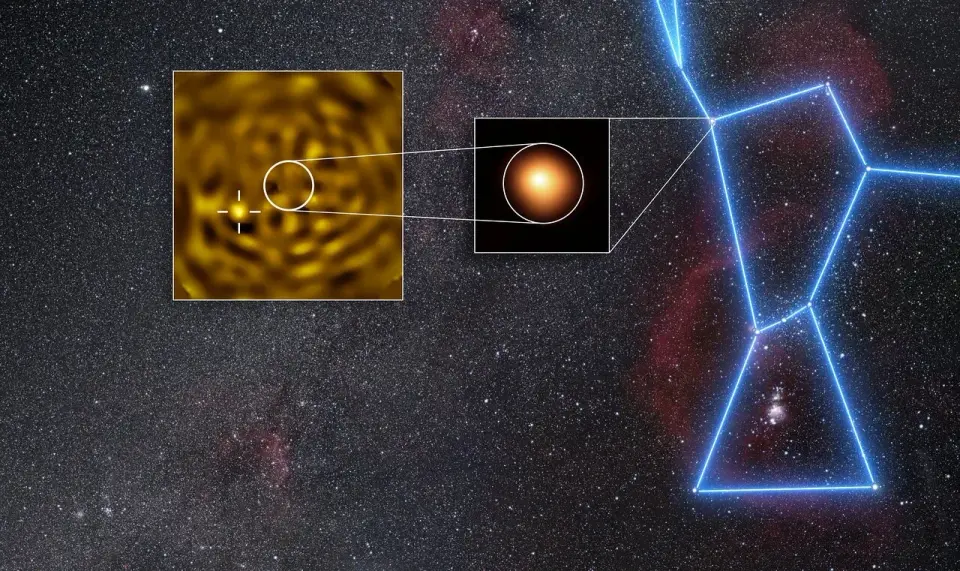
Astronomers have captured the clearest image yet of Betelgeuse B, a companion star to the famous red supergiant. Using the Very Large Telescope in Chile, researchers detected a star with two to three times the mass of the Sun, resolving a century-long debate about the existence of a binary system. While the discovery is strong, scientists plan further observations to confirm the gravitational binding and orbital motion of the pair.
Key points
- The Very Large Telescope (VLT) in Chile captured the first clear image of Betelgeuse B, nicknamed Siwarha, in December 2024.
- The companion star is estimated to have a mass of 2.6 to 3.1 times that of the Sun, significantly more massive than previous predictions of one solar mass.
- The discovery resolves a century-long hypothesis that Betelgeuse's brightness variations were caused by a hidden companion.
- Researchers used the SPHERE instrument and advanced image processing to detect the faint star against the bright background of the red supergiant.
- Further observations are scheduled for late 2027 to confirm the companion's orbital motion and gravitational binding.
Background
Betelgeuse, a red supergiant in the constellation Orion, has been a subject of intense astronomical study for decades. Its variable brightness and pulsations have long obscured potential companions. In 2019, an unexpected dimming event led to theories about dust clouds and starspots, but also renewed interest in a possible binary system. Previous hints of a companion were inconclusive, but recent measurements of Betelgeuse's motion suggested a gravitational tug from another star. The current discovery builds on these earlier suspicions and provides the first direct visual evidence.
How outlets are covering it
Universe Today and Sky & Telescope emphasize the significance of the direct imaging, noting that the companion is more massive than predicted, which explains why it was previously undetected. Science News highlights the use of exoplanet-hunting techniques to detect the star and notes the informal name 'Siwarha.' Space.com, while largely obscured by website code, aligns with the other outlets in confirming the clearest image yet. All sources agree that while the detection is strong, definitive proof requires observing the companion on the opposite side of Betelgeuse in 2027. Some experts, like Andrea Dupree, are already convinced, while others, like Miguel Montargès, remain cautious, calling it a 'candidate' until orbital motion is confirmed.
Why it matters
Confirming Betelgeuse as a binary system changes our understanding of how massive stars evolve and behave. The presence of a companion could influence Betelgeuse's future supernova explosion, potentially altering the outcome of its death. This discovery also improves models of red supergiant stars, which are crucial for understanding how energy and new elements are created and distributed in the universe. It resolves a long-standing debate and provides a clearer picture of one of the most iconic stars in the night sky.
What to watch
Astronomers plan to observe Betelgeuse again in late 2027, when Siwarha is expected to appear on the opposite side of the star. This observation will confirm the orbital motion and gravitational binding of the pair. Further studies will investigate how the companion affects Betelgeuse's evolution and potential supernova. The discovery may also lead to new insights into the formation and behavior of other red supergiant stars.
- It Took a Century, but Astronomers Imaged Betelgeuse's Companion Universe Today
- New Images Confirm: Betelgeuse Has a Companion Sky & Telescope
- New images reveal Betelgeuse’s buddy star Science News
- Betelgeuse, Betelgeuse! Astronomers capture clearest image yet of famous star's elusive companion space.com
- Astronomers observe companion star orbiting stellar giant Betelgeuse Reuters
Want the full story? Read the original reporting
Read on Universe Today