
VLT Confirms Betelgeuse’s Massive Companion, While ALMA Reveals Persistent Surface Hotspots
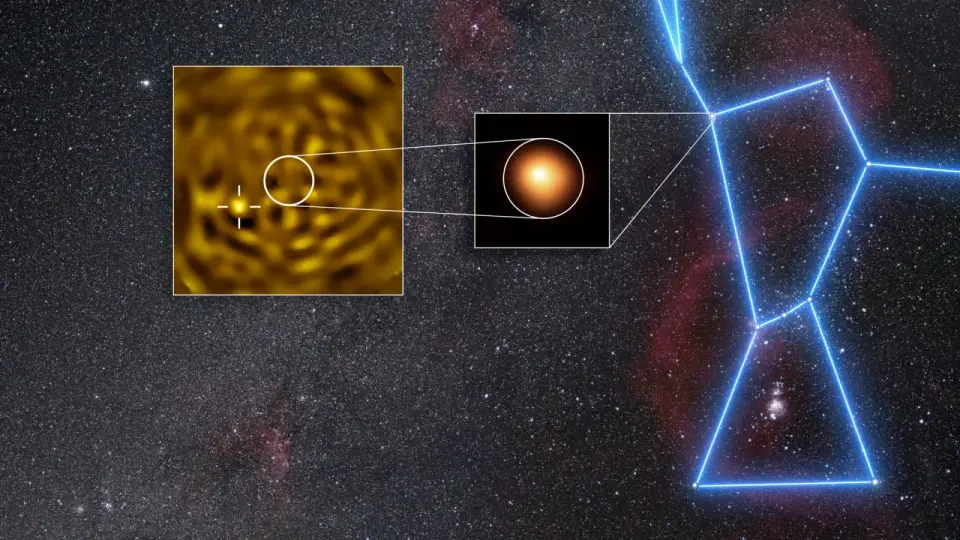
Astronomers have secured the clearest evidence yet that Betelgeuse has a stellar companion, while new ALMA images reveal long-lived hotspots on the star’s surface. The companion, Betelgeuse B, is more massive than previously predicted, and the surface anomalies may influence the star’s eventual supernova.
Key points
- Miguel Montargès and colleagues used ESO’s Very Large Telescope (VLT) to capture the clearest image of Betelgeuse B, a star orbiting the red supergiant.
- Betelgeuse B is estimated to have two to three times the Sun’s mass, exceeding earlier predictions of a solar-mass companion.
- ALMA observations from 2023 show Betelgeuse’s surface has a non-spherical shape with hotspots that have persisted for at least seven years.
- The discovery of the companion and the long-lived surface features may impact models of Betelgeuse’s mass loss and future supernova.
- Further observations are required to confirm the companion’s orbital binding and to understand its relationship with the star’s convective activity.
Background
Betelgeuse, a red supergiant in Orion, has been a subject of intense study for centuries due to its variable brightness and expected supernova fate. Previous archive reports from July and August 2026 highlighted the detection of Betelgeuse B using the VLT’s SPHERE instrument, noting its potential impact on the star’s evolution. The 2022 dimming event was attributed to dust clouds, not a pre-supernova collapse, as reported by Montargès’s team.
How outlets are covering it
ScienceDaily and ESO emphasize the confirmation of Betelgeuse B as a massive companion, highlighting the surprise of its higher mass compared to predictions. Sci.News and the Observatorio ALMA focus on the ALMA findings, stressing the unexpected longevity of hotspots on Betelgeuse’s surface, which challenges current convection models. While ScienceDaily notes the companion’s potential impact on the supernova, ALMA sources suggest the hotspots may be linked to convective motions but do not confirm a direct connection to the companion. All sources agree on the significance of these findings for understanding Betelgeuse’s evolution.
Why it matters
The confirmation of Betelgeuse B and the discovery of long-lived hotspots provide critical insights into the behavior of red supergiants. These findings may reshape models of stellar evolution, mass loss, and the conditions leading to supernovae, offering a clearer picture of one of the most studied stars in the night sky.
What to watch
Astronomers plan to observe Betelgeuse B again in about a year to confirm its orbital binding. Continued ALMA observations will track the persistence of hotspots and their relationship to convection and mass loss. Researchers will also investigate whether the companion influences Betelgeuse’s eventual supernova.
- “I jumped from my chair” – Astronomers spot Betelgeuse’s hidden companion Science Daily
- The bubbling surface of doomed supergiant star Betelgeuse has been revealed like never before Space
- ALMA Reveals Betelgeuse’s Fiery, Long-Lived Hot Spots Sci.News
- ALMA Reveals Long-Lived Hotspots on Betelgeuse’s Bubbling Surface Observatorio ALMA
- Want to see a star in close-up? Astronomers have produced one of the most detailed images of Betelgeuse we've ever seen BBC Sky at Night Magazine
Want the full story? Read the original reporting
Read on Science Daily