Tag

Red Supergiant

All articles tagged with #red supergiant

Radio Data Confirms Betelgeuse’s Fading Linked to Companion Star Siwarha
science24 days ago

Radio Data Confirms Betelgeuse’s Fading Linked to Companion Star Siwarha

New radio observations from ALMA and the VLA confirm that Betelgeuse’s long-term dimming cycle is caused by a companion star, Siwarha, orbiting within its extended atmosphere. The data shows the star’s atmosphere has recovered from the 2019-2020 Great Dimming, while Siwarha’s gravitational wake distorts the star’s shape, explaining its variable brightness.
ALMA Reveals Long-Lived Hotspots on Betelgeuse’s Bubbling Surface
astronomy3 months ago

ALMA Reveals Long-Lived Hotspots on Betelgeuse’s Bubbling Surface

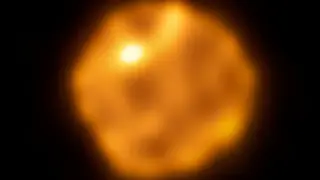
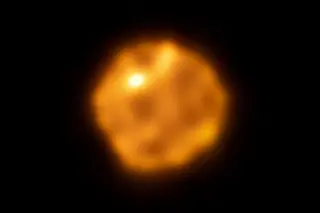
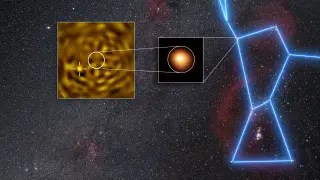
Astronomers using the Atacama Large Millimeter/submillimeter Array (ALMA) have captured the most detailed image of the red supergiant Betelgeuse, revealing an uneven, bumpy surface with persistent hotspots. The 2023 observations show that a bright hotspot in the star’s northeast has remained in the same location for at least seven years, challenging current models of stellar convection. This new data highlights the complex, non-spherical structure of Betelgeuse as it approaches its eventual supernova.

ALMA Imaging Reveals Persistent Hotspots and Irregular Surface on Betelgeuse
astronomy3 months ago

ALMA Imaging Reveals Persistent Hotspots and Irregular Surface on Betelgeuse

Astronomers using the Atacama Large Millimeter/submillimeter Array (ALMA) have captured the most detailed view yet of Betelgeuse's surface, revealing persistent hotspots and a non-spherical, corrugated atmosphere. The 2023 observations show that a bright northeastern hotspot has remained in the same location for at least seven years, challenging current models of stellar convection. These findings provide new insights into the turbulent dynamics of the red supergiant before its eventual supernova.

VLT captures definitive image of Betelgeuse's elusive companion star
astronomy4 months ago

VLT captures definitive image of Betelgeuse's elusive companion star

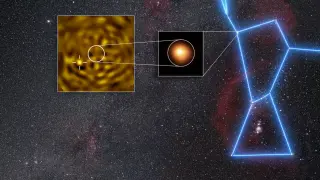
Astronomers have captured the clearest image yet of Betelgeuse's companion star, confirming a century-old hypothesis that the famous red supergiant is part of a binary system. Using the Very Large Telescope in Chile, researchers detected the fainter star, named Siwarha, which is significantly more massive than previously estimated. This discovery resolves long-standing debates about the star's brightness variations and may influence its future supernova evolution.

Giant Star WOH G64 Flashes Signs of Impending Explosion
science6 months ago

Giant Star WOH G64 Flashes Signs of Impending Explosion

Astronomers studying WOH G64, among the universe's largest stars in the Large Magellanic Cloud, report dramatic, rapid changes over decades: its surface temperature has climbed more than 1,000°C and its color shifted from red to yellow, with unusual dimming episodes in 2011 and 2025. Such behavior is unprecedented for a star of this size and may mark the final stages of its life, offering a rare, real-time glimpse into how massive stars end their lives and seed the cosmos with heavy elements.

Giant Star WOH G64 Shifts Hue, Hinting at Impending Supernova
space-and-astronomy7 months ago

Giant Star WOH G64 Shifts Hue, Hinting at Impending Supernova

Astronomers say the star WOH G64 in the Large Magellanic Cloud has transformed from a red supergiant into a yellow hypergiant (a change tied to observations starting in 2014), is shedding its outer layers, and is heating up—signs that it may be nearing its explosive end. At about 1,500 solar radii, it remains one of the universe’s largest stars, is younger than 5 million years, and new research in Nature Astronomy argues the star could be heading toward a supernova in its relatively short life arc.

Giant Star WOH G64 Shifts to Yellow Hypergiant, Foreshadowing a Supernova
science7 months ago

Giant Star WOH G64 Shifts to Yellow Hypergiant, Foreshadowing a Supernova

Astronomers report that the star WOH G64 in the Large Magellanic Cloud has transitioned from a red supergiant to a yellow hypergiant, with ongoing mass loss and heating—a potential sign it is nearing a supernova. The change may result from interactions with a companion or a pre-supernova wind, representing a short-lived but crucial phase in the evolution of a very massive star.

Giant Star Turns Yellow, Hinting at a Possible Supernova
science8 months ago

Giant Star Turns Yellow, Hinting at a Possible Supernova

Astronomers monitoring the red supergiant WOH G64 in the Large Magellanic Cloud report a rapid evolution into a yellow hypergiant, with a temperature rise of about 1,000 C and significant shrinking. This rare color and size change may signal an impending supernova, though researchers offer two possible explanations—binary interaction with a companion or a prior eruptive episode—and the star’s exact fate remains uncertain.

Gigantic Star WOH G64 Poised for Cosmic Catastrophe
science9 months ago

Gigantic Star WOH G64 Poised for Cosmic Catastrophe

Astronomers say WOH G64, a red supergiant in the Large Magellanic Cloud about 165,000 light-years away and roughly 30 solar masses with a radius over 1,500 suns, is likely transitioning toward a yellow hypergiant after shedding outer layers; this may lead to a spectacular end in a supernova or direct collapse into a black hole, with the fate expected to unfold over hundreds to thousands of years in cosmic time.

Astronomers watch a 1,540-solar-radius star flip from red to yellow, hinting at a possible supernova
astronomy9 months ago

Astronomers watch a 1,540-solar-radius star flip from red to yellow, hinting at a possible supernova

Astronomers tracking the star WOH G64 in the Large Magellanic Cloud have observed it change from a red supergiant into a rare yellow hypergiant, a dramatic and unusually slow transformation that could mark the star’s evolution toward a core-collapse supernova or direct black-hole formation. The object, about 28 solar masses and roughly 1,540 times the Sun’s size, may be part of a binary system, with interactions potentially influencing its path to death. While this hints at a possible explosive finale, the final fate remains uncertain and would likely occur on timescales of hundreds to thousands of years rather than within our lifetime; the findings were reported in Nature.

Webb Unmasks Progenitor of Nearby Supernova in NGC 1637
science9 months ago

Webb Unmasks Progenitor of Nearby Supernova in NGC 1637

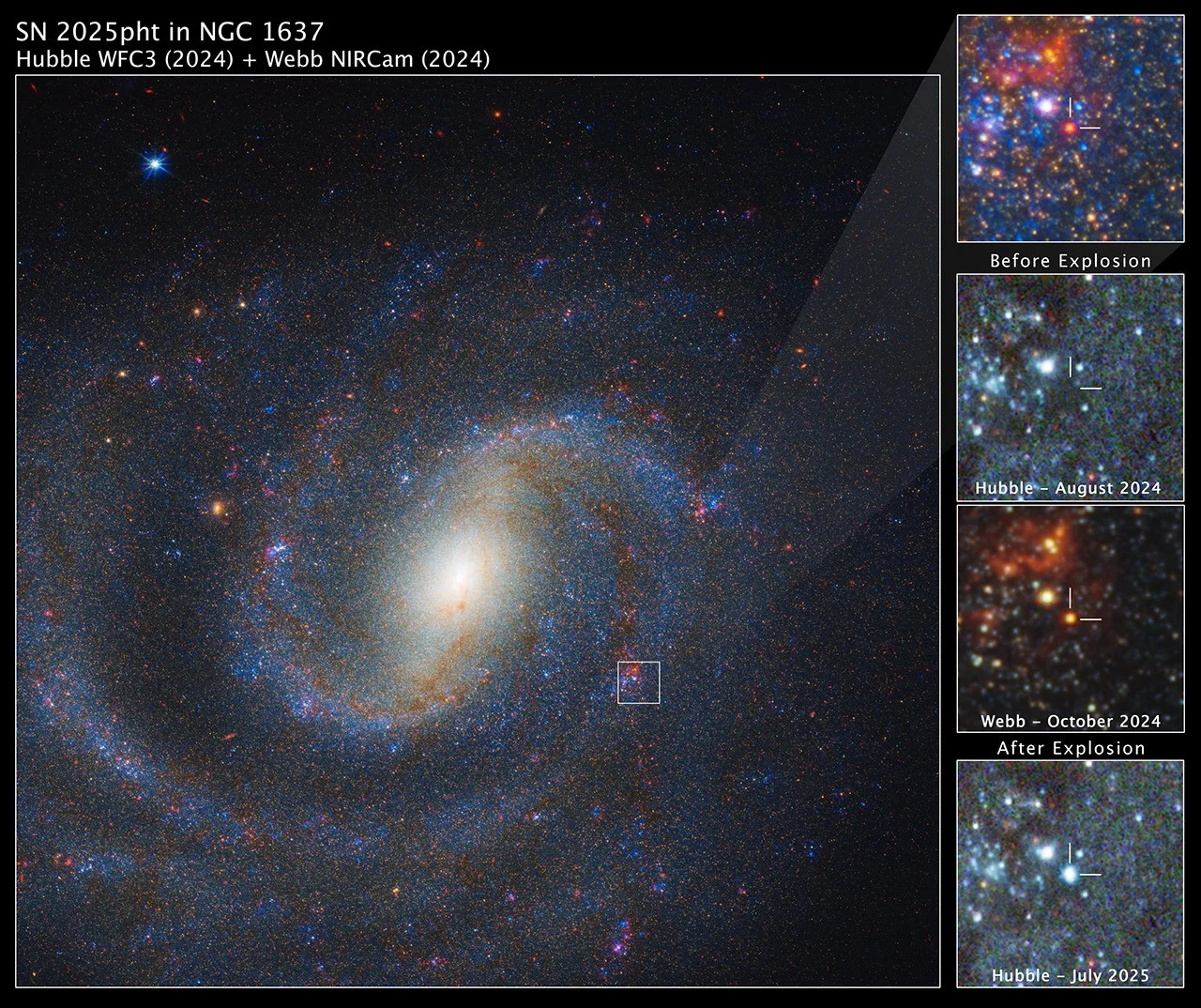
NASA’s James Webb Space Telescope, combined with archival Hubble data, identified the red supergiant star that exploded as supernova SN 2025pht in the galaxy NGC 1637—Webb’s first published detection of a supernova progenitor. The progenitor appeared unusually red due to surrounding dust, supporting ideas that dusty, massive stars can be missed in pre-explosion imaging. The dust is likely carbon-rich, prompting future searches for similar progenitors, including with the upcoming Roman Space Telescope.

Giant Red Star Defies Death, Hints at Hidden Companion
space9 months ago

Giant Red Star Defies Death, Hints at Hidden Companion

New SALT spectroscopy of the star WOH G64 in the Large Magellanic Cloud shows it is still a red supergiant, not dying to become a yellow hypergiant as previously thought. Titanium oxide in its atmosphere contradicts earlier interpretations based on dimming and dust, and a possible close companion could be distorting the star’s atmosphere and cocoon, reshaping ideas about its evolution.

Astronomers spot a red supergiant's rapid changes hinting at a secret stellar companion
science9 months ago

Astronomers spot a red supergiant's rapid changes hinting at a secret stellar companion

Astronomers monitoring WOH G64, a red supergiant in the Large Magellanic Cloud, report real-time changes: the star has dimmed and appears warmer, while its surroundings show more dust and ionized gas. New SALT observations hint at a hotter, smaller companion heating gas near the star and influencing its wind, suggesting binary interaction. If this relationship persists, the star’s visible characteristics could continue to shift, offering a rare live view of the final stages in a massive star’s life.