
VLT captures definitive image of Betelgeuse's elusive companion star
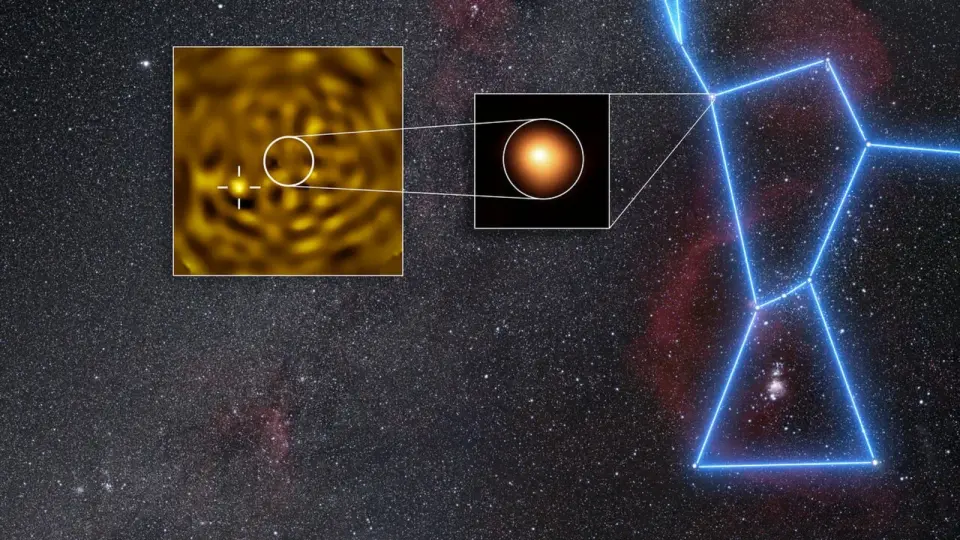
Astronomers have captured the clearest image yet of Betelgeuse's companion star, confirming a century-old hypothesis that the famous red supergiant is part of a binary system. Using the Very Large Telescope in Chile, researchers detected the fainter star, named Siwarha, which is significantly more massive than previously estimated. This discovery resolves long-standing debates about the star's brightness variations and may influence its future supernova evolution.
Key points
- The Very Large Telescope (VLT) in Chile produced the first clear direct image of Betelgeuse's companion, designated Betelgeuse B or Siwarha.
- The companion star is estimated to be 2.6 to 3.1 times the mass of the Sun, significantly more massive than earlier predictions suggested.
- Observations were conducted in December 2024 when the companion was predicted to be at its farthest point from Betelgeuse, maximizing visibility.
- The discovery confirms that Betelgeuse is a binary system, resolving a century-long debate about the cause of its complex brightness variations.
- Researchers plan to observe the companion again in late 2027 to confirm its orbital position and solidify the discovery.
Background
Betelgeuse, a red supergiant in Orion, has been a subject of intense study for over a century due to its variable brightness. In 2024, two studies linked a six-year brightness cycle to the presence of a companion star. Prior to this, a dramatic dimming event in 2019-2020 was attributed to dust clouds rather than a pre-supernova collapse. The current discovery builds on these earlier findings, providing the first direct visual evidence of the companion star, which had previously been detected only through indirect methods or inconclusive observations.
How outlets are covering it
Space.com and EarthSky emphasize the clarity of the new image as the strongest evidence yet, highlighting the team's excitement and the use of exoplanet-hunting techniques. Science News adds the formal name 'Siwarha' and notes the discrepancy between the companion's actual mass and previous estimates, which explains why it was detectable. All sources agree on the need for further observation in 2027 to confirm the companion's orbital path, with Science News noting that some astronomers are already convinced while the lead researcher remains cautious.
Why it matters
Confirming Betelgeuse as a binary system resolves a century-old astronomical mystery and provides new data on the star's evolution. The companion's mass and orbit may influence Betelgeuse's future supernova explosion, offering insights into the life cycles of massive stars. This discovery also demonstrates the effectiveness of advanced imaging techniques originally developed for exoplanet detection in studying evolved stars.
What to watch
Astronomers plan to observe Betelgeuse again in late 2027 when the companion is expected to appear on the opposite side of the star. This observation will provide definitive confirmation of the companion's orbital path and solidify the discovery. Further studies will investigate how the companion affects Betelgeuse's evolution and potential supernova.
- Betelgeuse, Betelgeuse! Astronomers capture clearest image yet of famous star's elusive companion Space
- After centuries of study, Betelgeuse is revealed to be two stars The Times
- New images reveal Betelgeuse’s buddy star Science News
- Astronomers find strongest evidence yet that Betelgeuse has a companion Phys.org
- Companion for Betelgeuse update! A new image EarthSky
Want the full story? Read the original reporting
Read on Space