
Chemical fingerprints reveal Earth and Mars built via opposite planetary recipes
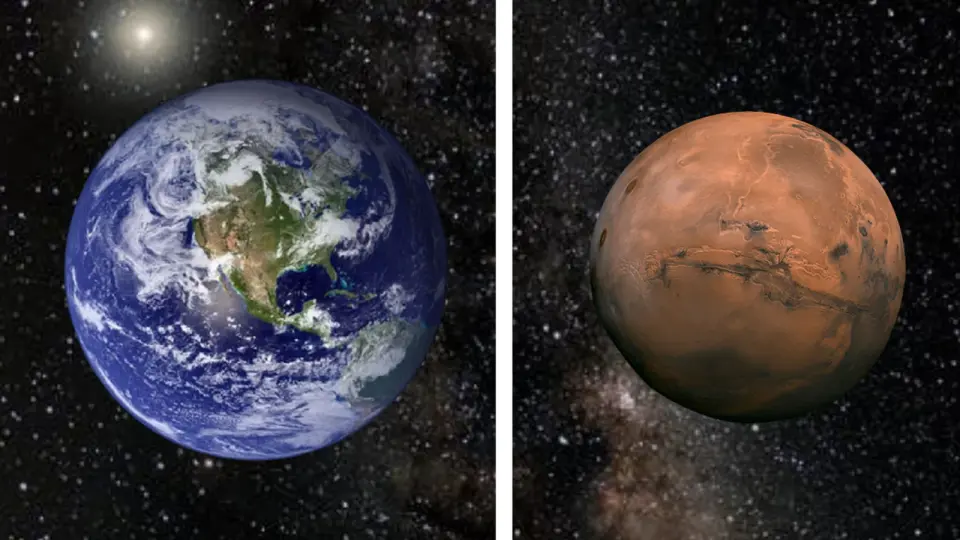
A new study in Nature Astronomy reveals that Earth and Mars, despite forming side-by-side in the same solar system, developed through fundamentally different processes. Earth’s mass is primarily derived from pebble accretion, while Mars’s is dominated by planetesimal collisions. Researchers analyzed volatile elements in planetary mantles to determine these distinct formation histories.
Key points
- Earth’s bulk mass is at least 75% from protoplanets that grew via pebble accretion, with up to 25% from planetesimals.
- Mars’s mass is roughly 73% from planetesimals, with only about 27% from pebble accretion.
- The study uses the depletion of volatile elements like sodium, zinc, and potassium as a chemical fingerprint of formation history.
- The research supports a hybrid model of planet formation but shows the two processes contributed in vastly different proportions for each planet.
- The findings were published in Nature Astronomy on September 25, 2026, by researchers from the University of Copenhagen.
Background
Previous discussions in our archive highlighted the physical scale differences between Earth and Mars, noting that Mars’s surface area is comparable to Earth’s dry land due to Earth’s extensive oceans. This new research shifts the focus from current physical dimensions to the ancient processes that created these bodies 4.5 billion years ago, addressing long-standing debates about how rocky planets assemble from gas and dust disks.
How outlets are covering it
Space.com and The Economic Times provide a high-level overview, emphasizing the surprise that neighboring planets formed differently. SciTechDaily highlights the specific percentages, noting Earth’s 75/25 split versus Mars’s 73/27 split. StudyFinds offers the most technical detail, explaining that 'devolatilization' during pebble accretion strips volatile elements, and that Mars’s formation may have been hindered by gravitational stirring from other protoplanets. While all sources agree on the core finding, StudyFinds notes that the exact percentages may vary if unobserved planetesimal types are considered, whereas SciTechDaily emphasizes the robustness of the chemical 'imprint' in the mantles.
Why it matters
Understanding the distinct formation paths of Earth and Mars helps scientists predict the composition and habitability of exoplanets. The retention of volatile elements, which are crucial for life, is directly linked to how a planet assembled. This research provides a new method to analyze rocky worlds beyond our solar system, potentially identifying which planets are most likely to retain water and other life-supporting substances.
What to watch
Researchers plan to apply this volatile-depletion fingerprint to spectroscopic studies of polluted white dwarf stars and other exoplanets to determine if the hybrid accretion model is universal. Further simulations will refine the assumptions regarding volatile loss during the disk phase, aiming to better understand the transitional stages of planetary growth.
- Earth and Mars may be neighboring rocky worlds but they were built in different ways Space
- Earth and Mars Were Formed in Fundamentally Different Ways, Study Finds SciTechDaily
- Earth and Mars: Built from different cosmic recipes Phys.org
- Earth, Mars born from same cloud of gas and dust, yet formed differently: Study The Economic Times
- Earth and Mars Were Born From the Same Dust but Grew Up Completely Different StudyFinds
Want the full story? Read the original reporting
Read on Space