
Accidental Telescope Test Reveals Stellar Debris Shattering in the Helix Nebula
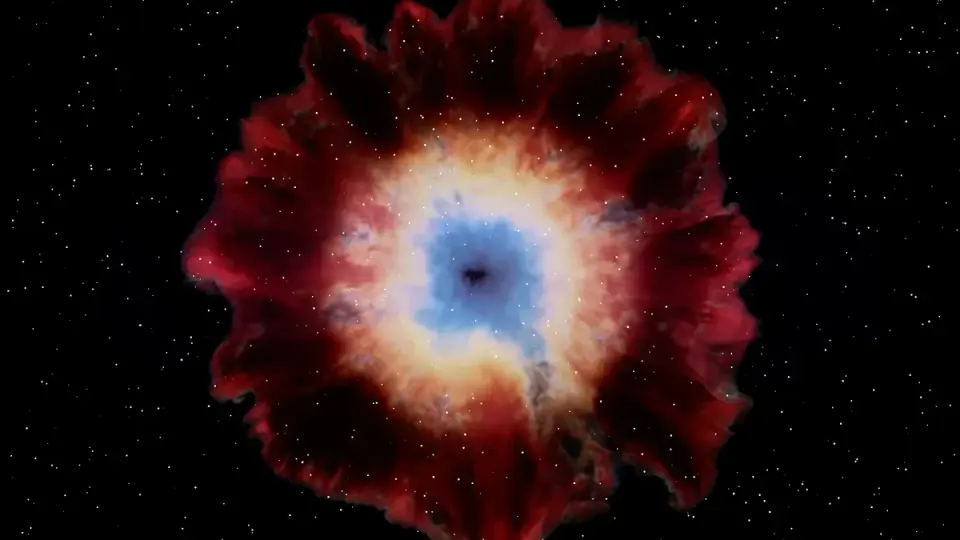
Astronomers accidentally discovered that dying stars release material as fragmented 'shrapnel' rather than smooth gas, using the new MOTHRA telescope to capture 22 bow shocks in the Helix Nebula.
Key points
- Researchers Pieter van Dokkum and Roberto Abraham discovered the phenomenon while testing the MOTHRA telescope in Chile in November 2025.
- The study, published in Nature, identifies 22 bow shocks in the outer regions of the Helix Nebula, located 650 light-years from Earth.
- These shocks mark where dense clumps of stellar debris collide with interstellar gas, shedding elements like carbon and oxygen.
- The debris fragments survive for approximately 10,000 years before fully dispersing into the interstellar medium.
- MOTHRA uses 1,140 telephoto lenses to detect faint emissions, allowing observation of nebula outskirts missed by traditional mirrors.
Background
Previous coverage of the James Webb Space Telescope highlighted its ability to image the Helix Nebula with high clarity, but focused on the bright inner structures. This new discovery extends understanding to the faint, outer halo where material disperses, complementing earlier findings on cosmic cycles such as black hole feeding mechanisms.
How outlets are covering it
Scientific American emphasizes the serendipitous nature of the discovery, noting that van Dokkum and Abraham were merely calibrating the instrument. Bioengineer.org provides a more technical breakdown, detailing how the bow shocks change shape with distance from the central white dwarf, indicating progressive erosion. Both sources agree on the 10,000-year dispersal timeline but differ in emphasis: Scientific American highlights the emotional impact on the researchers, while Bioengineer.org focuses on the physical mechanics of the shock waves and the instrument's wide-field capabilities.
Why it matters
This finding clarifies the mechanism of cosmic recycling, showing that stellar material does not flow smoothly but breaks apart violently. This process enriches the interstellar medium with elements necessary for future star and planet formation, directly impacting our understanding of the origin of life's building blocks.
What to watch
The team plans to use the fully operational MOTHRA telescope to observe similar processes in other stars, including predicting the future fate of our Sun. They aim to build better theoretical frameworks for how elements cycle through the galaxy over millions of years.
- Stunning new images reveal cosmic cycle of death and rebirth Scientific American
- Tests of a New Telescope Captured the Faint Aftermath of a Star’s Death The New York Times
- A dying star offers a rare glimpse of how the universe recycles its raw materials Phys.org
- The Helix Nebula is Hurling Clumps of Gas through Space skyandtelescope.org
- Astronomers Observe a Cosmic Recycling System in Action Bioengineer.org
Want the full story? Read the original reporting
Read on Scientific American