
JWST Detects First Triple Black Hole System in Galaxy 12.5 Billion Light-Years Away
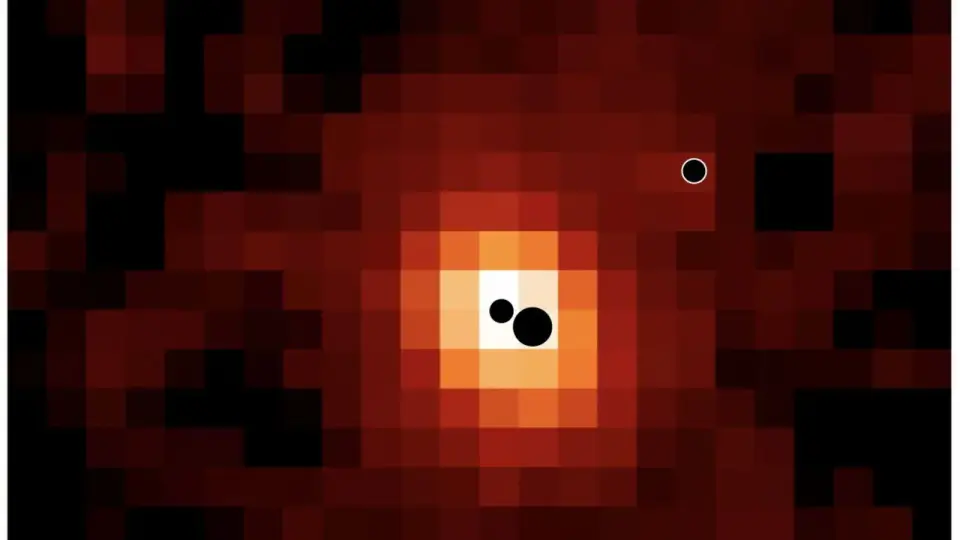
Astronomers using the James Webb Space Telescope (JWST) have identified the first known galaxy containing three actively accreting supermassive black holes. Located in the distant galaxy J0148-4214, which existed less than 1.3 billion years after the Big Bang, the system features two black holes separated by just 620 light-years and a third located 5,500 light-years away. The discovery, published in Astronomy & Astrophysics, suggests that mergers played a critical role in the rapid growth of supermassive black holes in the early universe. The central pair is expected to merge within 700 million years, while the third may eventually join them, offering a snapshot of the chaotic assembly processes that built modern galactic cores.
Key points
- JWST’s NIRSpec instrument detected three distinct broad-line regions in galaxy J0148-4214, confirming three separate black holes rather than a single system.
- The two central black holes have masses of 80 million and 0.6 million solar masses, while the third has a mass of 2 million solar masses.
- The central pair is separated by approximately 620 light-years (190 parsecs) and is predicted to merge within 550 to 700 million years.
- The third black hole is located 5,500 light-years from the center and may have been ejected by a previous interaction or is currently sinking inward via a minor merger.
- The smaller central black hole appears to be accreting matter at a rate exceeding the theoretical Eddington limit, challenging standard growth models.
Background
This discovery builds on recent JWST findings regarding the 'little red dots' and compact red objects in the early universe, which have challenged standard coevolution theories of black hole growth. Previous observations, including a 2024 study by the same lead author, identified dual black hole systems in galaxies seen just 740 million years after the Big Bang. Additionally, recent reports of 'wandering' black holes and filament recycling mechanisms have highlighted the complex dynamics of black hole accretion and migration, providing a broader context for understanding how supermassive black holes achieve their immense sizes so quickly.
How outlets are covering it
Space.com and Universe Today emphasize the significance of the discovery as the first evidence of three active black holes in a single distant galaxy, highlighting the role of mergers in early universe growth. Smithsonian Magazine focuses on the timeline, noting the light took 12.5 billion years to reach Earth, and questions how such massive objects formed so early. ZME Science provides a more skeptical perspective, noting that while the evidence is strong, the researchers stop short of calling the case definitive, and highlights the anomaly of the smaller black hole accreting faster than theoretically predicted. All sources agree on the masses and separations but differ in emphasis: Space.com and Universe Today focus on the merger timeline, while ZME Science and Smithsonian focus on the implications for black hole growth theories and the uncertainty surrounding the third black hole's origin.
Why it matters
This discovery provides direct evidence that supermassive black holes grew rapidly in the early universe through mergers, not just accretion. It challenges existing models of black hole growth and offers a potential target for future gravitational wave observatories like LISA, which may detect the mergers of such systems. Understanding how black holes assembled so quickly helps explain the presence of massive black holes in galaxies that formed less than a billion years after the Big Bang.
What to watch
Astronomers plan to use higher spatial and spectral resolution to study the gas kinematics around the black holes, which may clarify whether the third black hole is sinking inward or was ejected. Future observations by LISA may detect the gravitational waves from the merger of the central pair, which is expected to occur within 700 million years. Additionally, further studies will aim to determine if the smaller black hole is indeed accreting above the Eddington limit, which would require revising theoretical models of black hole growth.
- Scientists find 3 supermassive black holes on the verge of collision inside a distant galaxy Space
- In a First, Astronomers May Have Spotted a Galaxy in the Early Universe With Three Behemoth Black Holes Smithsonian Magazine
- Telescope Spots Two Black Holes on the Cusp of Merging The New York Times
- Another First for the JWST: It Detects Three Supermassive Black Holes in the Same Galaxy Universe Today
- Astronomers Baffled by 3 Feeding Supermassive Black Holes Packed Into Early Galaxy When the Universe Was Barely a Billion Years Old ZME Science
Want the full story? Read the original reporting
Read on Space