
Heavy seeds ignite rapid growth, linking JWST's little red dots to overmassive black holes
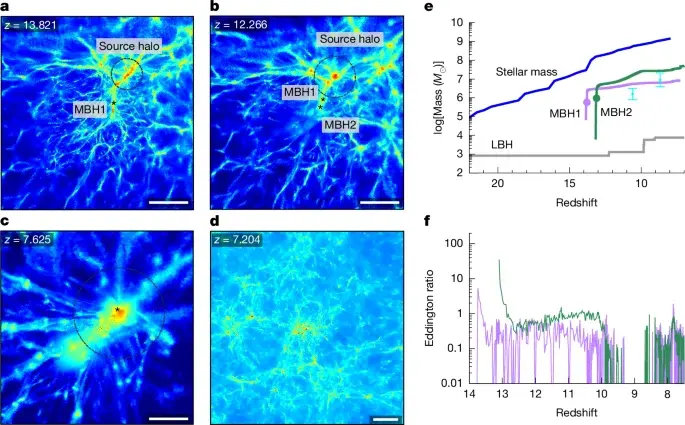
Cosmological radiation‑hydrodynamic simulations show that ~10^6 solar‑mass heavy seeds can form in overdense protocluster regions under intense FUV radiation, quickly growing via brief super‑Eddington accretion to ~3×10^7 M⊙ by z ≈ 8. This unifies the high‑redshift little red dots observed by JWST with the overmassive black holes, as dense circum‑BH disks produce Balmer features and Hα emission without a traditional broad‑line region, while light‑seed remnants fail to grow similarly. The study also predicts X‑ray obscuration during early growth and potential LISA detections from BH mergers. Results are robust to changes in LW flux and higher resolution tests, offering a cohesive pathway from heavy‑seed formation to overmassive high‑z quasars.
- Overmassive black holes and little red dots naturally form in simulations Nature
- Massive Black Holes May Have Started as Little Red Dots The New York Times
- Black Holes or Black Hole Stars? Astronomers Spar Over Webb Telescope’s ‘Little Red Dots.’ Quanta Magazine
- New study links mysterious 'little red dots' to early black hole formation qz.com
- Japans Supercomputer Deciphers Webbs Red Dots Mirage News
Want the full story? Read the original reporting
Read on Nature