
JWST Captures Ancient Supernova from 1.15 Billion Years After Big Bang
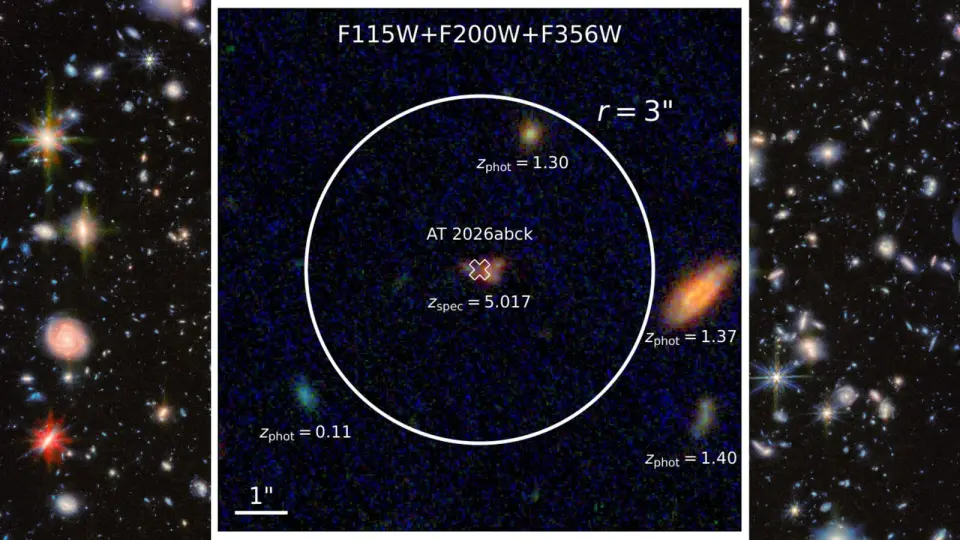
The James Webb Space Telescope has identified a supernova that erupted just 1.15 billion years after the Big Bang, offering a rare glimpse into the universe’s infancy. This event, designated AT 2026abck, occurred when the universe was less than one-tenth of its current age. The discovery provides critical data on the brightness and expansion of early stellar explosions, which were significantly more luminous than modern counterparts.
Key points
- The supernova AT 2026abck dates to approximately 1.15 billion years after the Big Bang, making it one of the most distant ever observed.
- At its peak, the explosion was 8 billion times brighter than the Sun, rivaling the total luminosity of the Milky Way.
- The event occurred in the host galaxy ID101411, which contains 6.3 billion solar masses and forms stars at a rate ten times faster than the Milky Way.
- The supernova’s ejected material expanded to a radius of 46 astronomical units, reaching temperatures exceeding 16,000 degrees Celsius.
- The host galaxy is metal-poor, indicating insufficient time for heavy elements to form, consistent with the early universe’s composition.
Background
This discovery follows recent JWST milestones, including the identification of MoM-z14 as the most distant galaxy at 280 million years after the Big Bang and the confirmation of the record-breaking fast radio burst FRB 20240304B from 10.6 billion years ago. These findings collectively challenge existing models of the cosmic dawn, suggesting that early galaxies were more active and chemically distinct than previously assumed.
Why it matters
Observing such an ancient supernova allows astronomers to study the conditions of the early universe, including star formation rates and chemical evolution. The extreme brightness and rapid expansion of AT 2026abck provide insights into how massive stars behaved in the universe’s first billion years, helping refine models of cosmic evolution and the origins of heavy elements.
What to watch
The findings, published as a preprint on arXiv on September 29, await peer review. Future observations may confirm the supernova’s details and reveal more about the metal-poor environment of ID101411, potentially reshaping understanding of early galaxy formation and stellar lifecycles.
Want the full story? Read the original reporting
Read on Live Science