
Chemical Analysis Suggests Uranus and Neptune Have Distinct Origins
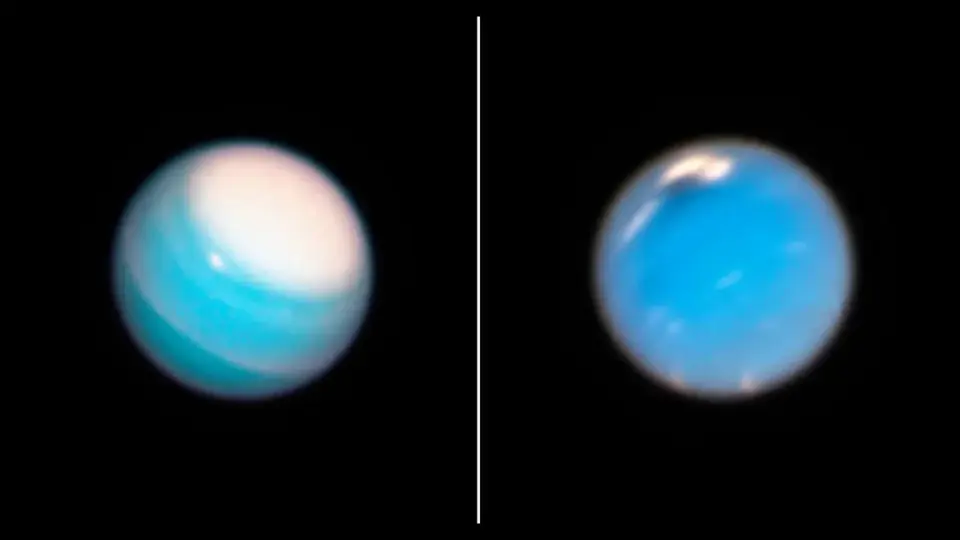
A new study in Astronomy & Astrophysics suggests that Uranus and Neptune, despite their visual similarities, likely formed from different regions of the protoplanetary disk. By analyzing carbon monoxide levels, researchers found that Neptune has significantly more oxygen than Uranus, indicating distinct chemical histories rather than a shared origin.
Key points
- Researchers used carbon monoxide measurements to infer the oxygen-to-hydrogen ratios in the deep atmospheres of Uranus and Neptune.
- Neptune’s atmosphere contains roughly two orders of magnitude more carbon monoxide than Uranus, suggesting a higher oxygen content.
- The study indicates that Neptune’s building blocks likely formed closer to the Sun, near the water ice line, while Uranus’s materials may have originated further out.
- The findings challenge the long-held view that the two ice giants are evolutionary twins, describing them instead as 'cousins' with different histories.
- The results have implications for understanding exoplanets, as Uranus and Neptune serve as key benchmarks for planetary formation models.
Background
Previous research, such as a September 2026 study, confirmed the existence of superionic ice in planetary interiors, refining models of ice giant composition. However, direct atmospheric measurements remain limited due to the planets' distance and thick cloud cover. This new study builds on those models by using remote sensing data to probe deeper atmospheric chemistry.
How outlets are covering it
Gizmodo and Sci.News both highlight the 'cousin' analogy used by lead author Olivier Mousis to describe the planets' distinct histories. Labroots emphasizes the use of ALMA data and computer models to simulate the protoplanetary disk. While all sources agree on the chemical divergence, Gizmodo notes the limitation of lacking in-situ measurements, whereas Labroots focuses on the broader implications for exoplanet research, noting that Neptune-like planets make up two-thirds of confirmed exoplanets.
Why it matters
Understanding the distinct formation pathways of Uranus and Neptune helps refine models of how planets form and evolve in other star systems. Since similar-sized planets are common around other stars, accurate local benchmarks are crucial for interpreting exoplanet data and future missions like NASA’s planned Uranus Orbiter and Probe.
What to watch
Future missions, such as NASA’s Uranus Orbiter and Probe, are expected to launch in the next decade to provide direct atmospheric samples. These missions will test the current models and confirm whether the chemical differences observed from Earth truly reflect distinct origins in the protoplanetary disk.
- Uranus and Neptune Look Like Twins. Scientists Now Think It’s a Coincidence Gizmodo
- Planetary 'twins' Uranus and Neptune may have different origin stories Phys.org
- Neptune and Uranus Had Very Different Origins Labroots
- Uranus and Neptune May Have Taken Different Paths to Becoming Ice Giants Sci.News
- Neptune and Uranus appear to have significantly different chemical origins The Brighter Side of News
Want the full story? Read the original reporting
Read on Gizmodo