
JWST Reveals N159: A Low-Metallicity Star Nursery in the Large Magellanic Cloud
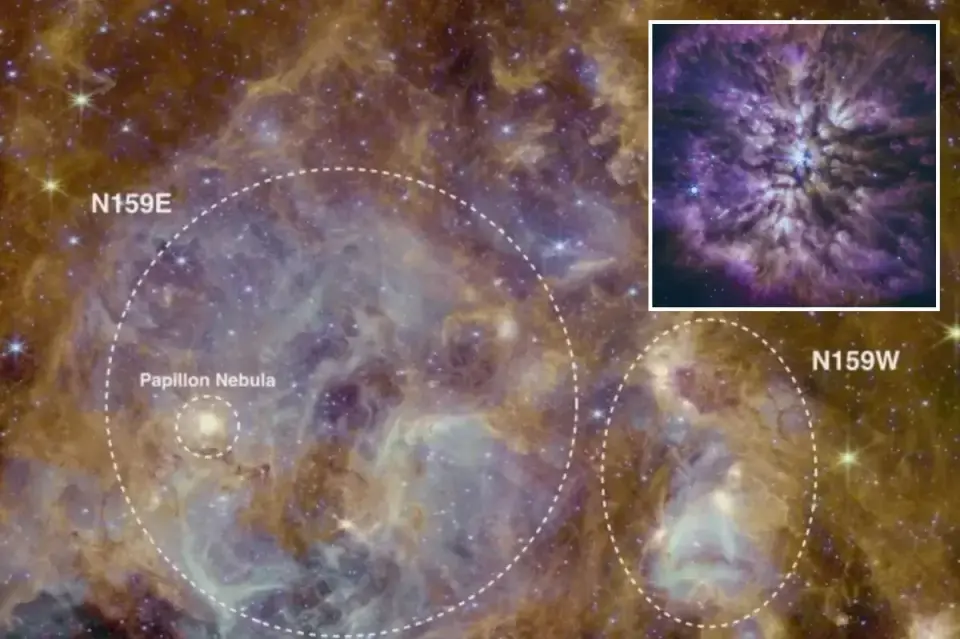
NASA’s James Webb Space Telescope (JWST) has released a new image of the N159 star-forming region, located 161,000 light-years away in the Large Magellanic Cloud. Selected as the Picture of the Month for October 2026, the image captures a turbulent 'cauldron' of gas where new stars are forming. The region features a lower metallicity than the Milky Way, offering astronomers a unique opportunity to study conditions similar to those in the early universe. The image highlights distinct chemical signatures, including polycyclic aromatic hydrocarbons and ionized hydrogen, revealing the complex chemistry of stellar nurseries.
Key points
- JWST captured N159, a star-forming region 161,000 light-years away in the Large Magellanic Cloud, a satellite galaxy of the Milky Way.
- The image was released on October 22, 2026, and selected as NASA’s Picture of the Month for October.
- N159 has a lower metallicity (proportion of elements heavier than hydrogen and helium) than the Milky Way, resembling early universe conditions.
- The region is estimated to be less than 3 million years old, making it one of the youngest star-forming areas in the Large Magellanic Cloud.
- The image reveals chemical components: orange areas indicate polycyclic aromatic hydrocarbons, blue clouds show ionized hydrogen (H II), and dark red filaments represent cool molecular hydrogen.
- The observation allows astronomers to study pre-main-sequence stars and compare stellar evolution stages in a low-metallicity environment.
Background
This release follows recent JWST observations of other star-forming regions, such as IC 348 in the Perseus constellation, which helped identify ultra-light brown dwarfs. The N159 observation complements broader efforts to understand star formation in environments with varying metallicity, providing a window into the early universe's conditions as noted in recent cosmological simulations like Lumina.
How outlets are covering it
NASA and ESA emphasized the scientific value of N159’s low metallicity for understanding early universe star formation, while Space.com highlighted the visual beauty and the specific chemical composition revealed by JWST’s filters. The New York Post focused on the 'spooky' Halloween-themed aesthetic of the image, describing it as a 'cosmic cauldron,' whereas The Elkhart Truth provided minimal additional detail beyond the core announcement. All sources agreed on the location (161,000 light-years away) and the significance of the low metallicity, but differed in emphasis: NASA/ESA on scientific utility, Space.com on chemical breakdown, and the New York Post on public engagement through seasonal imagery.
Why it matters
The N159 image provides critical data for understanding how stars form in environments with lower metal content, which mirrors conditions in the early universe. This helps refine models of stellar evolution and the role of metallicity in star formation. Additionally, the detailed chemical mapping of the region advances knowledge of molecular processes in stellar nurseries, contributing to broader astrophysical research.
What to watch
Astronomers will continue analyzing JWST data from N159 to study pre-main-sequence stars and the dynamics of gas clumps. Future observations may compare N159 with other low-metallicity regions to further understand the impact of metallicity on star formation. The image may also inform simulations of early universe conditions, such as those developed in projects like Lumina.
- James Webb Telescope captured spooky new image thousands of light-years away New York Post
- Webb Sees Turbulent Star Nursery NASA (.gov)
- Something spooky is brewing in this eerie corner of the universe FOX Weather
- Glowing 'cauldron' of new stars photo of the day for Oct. 26, 2026 Space
- James Webb spots stars brewing in Halloween-like cosmic cauldron The Elkhart Truth
Want the full story? Read the original reporting
Read on New York Post