
JWST Data Reveals Planet Formation as a Race Against Protoplanetary Disk Decay
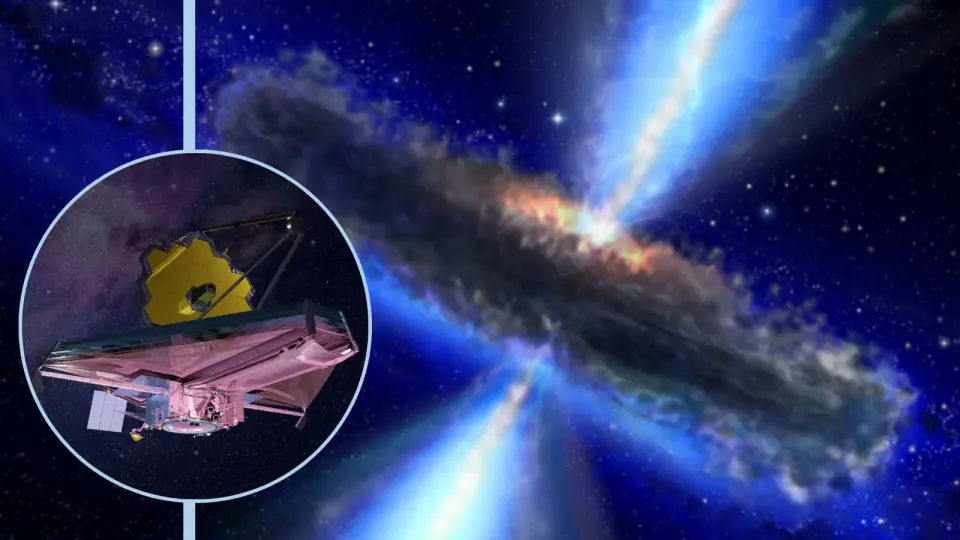
Astronomers used the James Webb Space Telescope to analyze 72 young, sun-like stars, revealing that planet formation is a time-sensitive process dictated by the rapid loss of material from protoplanetary disks. By tracking molecular hydrogen, the study shows that gas giants must assemble their atmospheres before stellar winds and radiation strip the disk of its raw ingredients.
Key points
- JWST’s Mid-Infrared Instrument (MIRI) was used to observe 72 young stars at various stages of development.
- The study tracks the escape of molecular hydrogen, a primary building block for planets, from swirling disks of gas and dust.
- Early disk evolution is dominated by magnetic jets and winds, while later stages are driven by photoevaporation from stellar radiation.
- Gas giants like Jupiter must form quickly while the disk is still substantial, as the window for accretion closes as material is lost to space.
- The research provides a 'movie' of planetary system evolution, helping explain why our solar system has its current configuration.
Background
This finding builds on recent JWST discoveries regarding star and galaxy formation, such as the identification of faint stars in early galaxies and the detailed imaging of the Carina Nebula. While previous studies focused on the birth of stars and the mass of early galaxies, this research specifically addresses the subsequent phase: how the remaining material in a disk is consumed or lost to form planets.
How outlets are covering it
Space.com and UA.News present a consistent view of the findings, both highlighting the work of Naman Bajaj and the use of MIRI to track molecular hydrogen. Space.com emphasizes the 'race against time' metaphor, focusing on the urgency for gas giants to assemble their atmospheres. UA.News provides a more technical breakdown of the mechanisms, detailing the shift from magnetic jets to photoevaporation as the disk thins. Both outlets agree that the loss of gas effectively ends the opportunity to form gas-rich planets once the disk disperses.
Why it matters
Understanding the timeline and mechanisms of material loss in protoplanetary disks is crucial for modeling how solar systems form. It explains why certain types of planets, particularly gas giants, are found in specific locations and why the formation process is not a static event but a dynamic competition between accretion and dispersal.
What to watch
The research team plans to quantify the exact amount of material removed by different mechanisms and determine the specific regions of the disks where these processes operate. The findings have been published in The Astronomical Journal.
- James Webb Space Telescope observes 72 stars and finds planet formation is a race against time Space
- JWST reveals a race against time for forming planets Phys.org
- U of A scientists play crucial roles in Nancy Grace Roman Space Telescope science, eagerly await Sunday's launch The University of Arizona
- JWST reveals how young solar systems may lose the gas needed to build planets The Brighter Side of News
- James Webb Telescope showed how gas loss limits planet formation UA.NEWS
Want the full story? Read the original reporting
Read on Space