
New Study Reveals Black Hole Winds Extend 300,000 Light-Years Beyond Galaxies
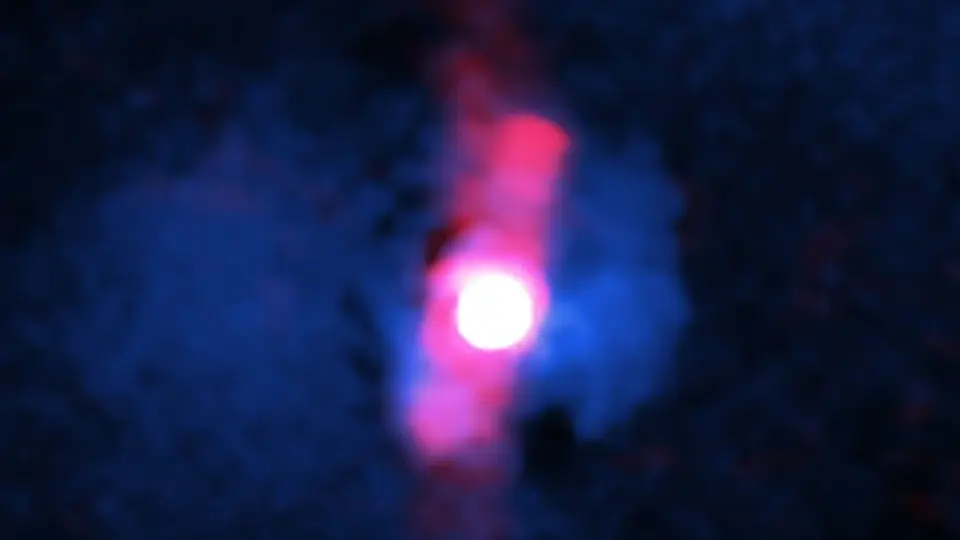
A study led by Satoshi Yamada of Tohoku University indicates that supermassive black holes eject energy far beyond their host galaxies. Observations of the quasar H1821+643, located 3.4 billion light-years away, show outflows extending 300,000 light-years, three times the size of the Milky Way. These winds are estimated to be 100 times more powerful than previously thought, injecting energy equivalent to billions of supernovae into the surrounding space.
Key points
- Researchers found that winds from actively feeding supermassive black holes are approximately 100 times more powerful than earlier estimates suggested.
- The outflows from the quasar H1821+643 extend roughly 300,000 light-years, far exceeding the boundaries of its host galaxy.
- The energy injected by these outflows is comparable to several billion supernova explosions, driving turbulence in hot gas across vast distances.
- The host galaxy of H1821+643 sits at the center of a dense galaxy cluster and contains a black hole estimated at three to four billion solar masses.
- This finding challenges the previous assumption that such winds were contained within the galaxy, revealing a much more extensive impact on the surrounding environment.
Background
Recent archival coverage has highlighted various behaviors of supermassive black holes, including runaway objects leaving star-forming wakes and dormant black holes reawakening to produce jets. These studies, often utilizing the James Webb Space Telescope, have helped clarify how black holes interact with their environments over long timescales. The current finding adds to this understanding by demonstrating the extreme reach of energy outflows from active quasars, suggesting that black holes influence their surroundings far more significantly than previously modeled.
Why it matters
Understanding the scale and power of black hole outflows is crucial for modeling galaxy evolution and the distribution of energy in the universe. If these winds extend hundreds of thousands of light-years, they can significantly affect the formation of stars and the structure of galaxy clusters. This research provides new insights into the feedback mechanisms between supermassive black holes and their host environments, potentially reshaping our understanding of cosmic dynamics and the role of black holes in shaping the large-scale structure of the universe.
What to watch
Future observations may focus on measuring the extent and power of outflows in other quasars to determine if this phenomenon is common. Researchers will likely use advanced telescopes to map the turbulence and energy distribution in the hot gas surrounding these black holes. Additionally, studies may explore how these powerful winds impact the growth of galaxies and the distribution of matter in galaxy clusters, providing a clearer picture of the interplay between black holes and their cosmic environments.
Want the full story? Read the original reporting
Read on Space