
SN 2026ahvu: Astronomers Track a Nearby Type Ia Supernova Approaching Peak Brightness
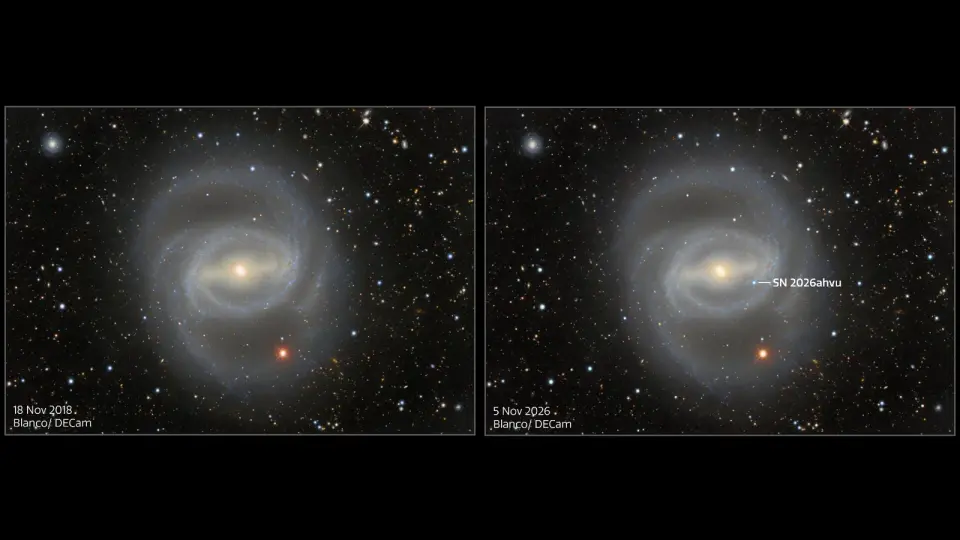
A Type Ia supernova designated SN 2026ahvu was detected on November 2, 2026, in the spiral galaxy NGC 1433, located approximately 50 million light-years away. Discovered by the ATLAS survey, the event is currently brightening and is expected to reach peak magnitude between November 18 and 23. NOIRLab is coordinating observations using the Dark Energy Camera and Gemini South telescope to study the explosion's early stages, while amateur astronomers are encouraged to observe the event from southern hemispheres.
Key points
- SN 2026ahvu was discovered on November 2, 2026, by the Asteroid Terrestrial-impact Last Alert System (ATLAS).
- The supernova is a Type Ia event involving the thermonuclear explosion of a white dwarf in a binary system.
- It is located in the galaxy NGC 1433, roughly 50 million light-years from Earth, making it one of the closest such events since 2011.
- The event was captured early in its evolution, allowing scientists to observe it before it reached maximum brightness.
- Peak brightness is predicted between November 18 and 23, with magnitudes ranging from 10.5 to 12.1.
- NOIRLab is coordinating observations using the Dark Energy Camera (DECam) and Gemini South telescope.
Background
Type Ia supernovae are critical 'standard candles' used to measure cosmic distances, but the exact mechanisms triggering their explosions remain debated. Previous nearby events, such as SN 2011fe in 2011, have provided data, but SN 2026ahvu offers a rare opportunity to observe the early phases of the explosion in detail. The Dark Energy Survey, which provided pre-explosion images of NGC 1433, helps scientists compare the galaxy's state before and after the event.
How outlets are covering it
Space.com and NOIRLab emphasize the rarity of capturing the supernova early in its brightening phase, highlighting the value of pre-explosion images from the Dark Energy Survey. IFLScience focuses on the accessibility of the event for amateur astronomers and the global call for observations. Universe Space Tech highlights a scientific debate regarding the explosion's trigger, noting that a lack of pre-explosion X-ray emission in archival Chandra data may suggest a merger of two white dwarfs rather than accretion from a companion star, though this conclusion is not yet definitive due to distance uncertainties.
Why it matters
Observing SN 2026ahvu from its early stages allows scientists to refine models of Type Ia supernovae, which are essential for measuring the expansion of the universe. Understanding the specific mechanism behind this explosion, whether it involved a single white dwarf or a merger, helps resolve ongoing debates in astrophysics and improves the accuracy of cosmic distance measurements.
What to watch
Astronomers expect SN 2026ahvu to reach peak brightness between November 18 and 23. NOIRLab is coordinating follow-up observations with the SOAR Telescope and inviting other observatories to contribute data across various wavelengths. Amateur astronomers are encouraged to observe the event to help track its evolution and fade.
- Supernova explodes before astronomers' eyes photo of the day for Nov. 18, 2026 Space
- Gemini and DECam showcase a young Type Ia supernova Phys.org
- A Nearby Exploding Supernova Will Peak Within Days, And You Can Help Scientists With Their Observations IFLScience
- NSF NOIRLab-operated Facilities Capture Brightening Nearby Supernova NOIRLab
- Astronomers observe a nearby supernova from the very first days of the explosion Universe Space Tech
Want the full story? Read the original reporting
Read on Space