
White Dwarf HS 0209+0832 Feeds on Planet Formed from Stellar Ashes
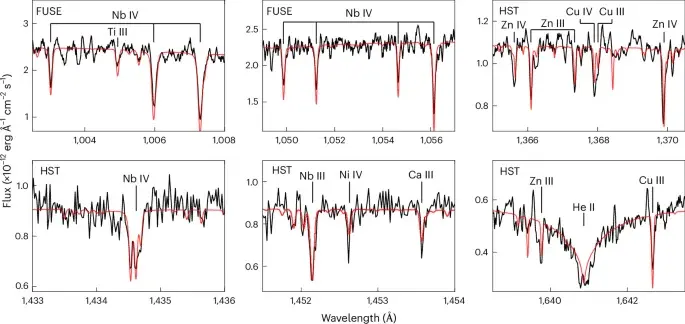
Astronomers have identified a white dwarf, HS 0209+0832, that is accreting material from a 'second-generation' planet. This planet likely formed from the ejected envelope of the star's progenitor after it died, rather than from the original protoplanetary disk. The discovery, published in Nature, marks the first evidence of such post-stellar planetary formation around a white dwarf.
Key points
- HS 0209+0832 is a hot, young white dwarf with an effective temperature of approximately 35,800 K and a cooling age of about 5 million years.
- The star's atmosphere shows strong enrichment in trans-iron elements like zinc, copper, and niobium, but is depleted in rock-forming elements such as silicon and iron.
- The chemical composition suggests the accreted material originated from a planet formed from the wind-driven mass loss of an asymptotic giant branch (AGB) star, not from the original protoplanetary disk.
- TESS data reveals a sinusoidal photometric period of 4.399 days, attributed to thermal emission from a phase-locked giant planet or a transiting cometary tail.
- The planet is likely undergoing photo-evaporation due to the white dwarf's intense radiation, causing its atmosphere to escape and accrete onto the star.
Background
This discovery builds on previous findings that white dwarfs often accrete debris from disrupted planetary bodies, which typically resemble Solar System objects. While second-generation planets around pulsars have been theorized, this is the first identification of such a system around a white dwarf. The concept of second-generation planets was proposed over 15 years ago, but this is the first observational evidence. The white dwarf's unusual helium abundance and lack of typical rock-forming elements distinguish it from standard accretion events involving rocky debris or icy bodies.
How outlets are covering it
Nature provides the primary scientific analysis, detailing the spectroscopic data from Hubble, FUSE, and VLT that confirm the unusual elemental abundances. Science News frames the discovery as a 'phoenix' planet, emphasizing the novelty of a planet forming from a dead star's ashes. CNN highlights the detection of a possible planet born from a dead star's ashes, focusing on the broader implication that planetary systems can have second beginnings. All sources agree on the core finding but differ in emphasis: Nature focuses on the chemical evidence and formation mechanism, while Science News and CNN highlight the conceptual breakthrough of post-stellar planet formation.
Why it matters
This discovery demonstrates that close-in planets can form around white dwarfs after the main sequence phase, challenging the traditional view that all planets form from the original protoplanetary disk. It opens a new window for studying second-generation planet formation and the chemical processing of stellar ejecta. Identifying more such systems could provide insights into the dynamics of post-AGB binaries and the formation of giant planets in extreme environments.
What to watch
Researchers plan to observe more hot white dwarfs for high carbon abundances and s-process element enhancements to identify additional second-generation planet candidates. Establishing a larger sample of these systems will help confirm the formation mechanism and understand the prevalence of post-stellar planetary formation. Further detailed atmospheric modeling of second-generation planets is needed to determine likely atmospheric abundances and refine the evaporation rates.
- Discovery of a second-generation planet candidate accreting onto a white dwarf Nature
- ‘Phoenix planet’ may have formed from a dead star’s ashes CNN
- The phoenix planet: Astronomers find a world reborn from its star's ashes Phys.org
- Suspected Second-generation Planet Solves NASA Hubble Cold Case NASA Science (.gov)
- A ‘phoenix’ planet was born from the ashes of its dead star Science News
Want the full story? Read the original reporting
Read on Nature