
Genomic Analysis Links All Complex Life to Ancient Asgard Archaea
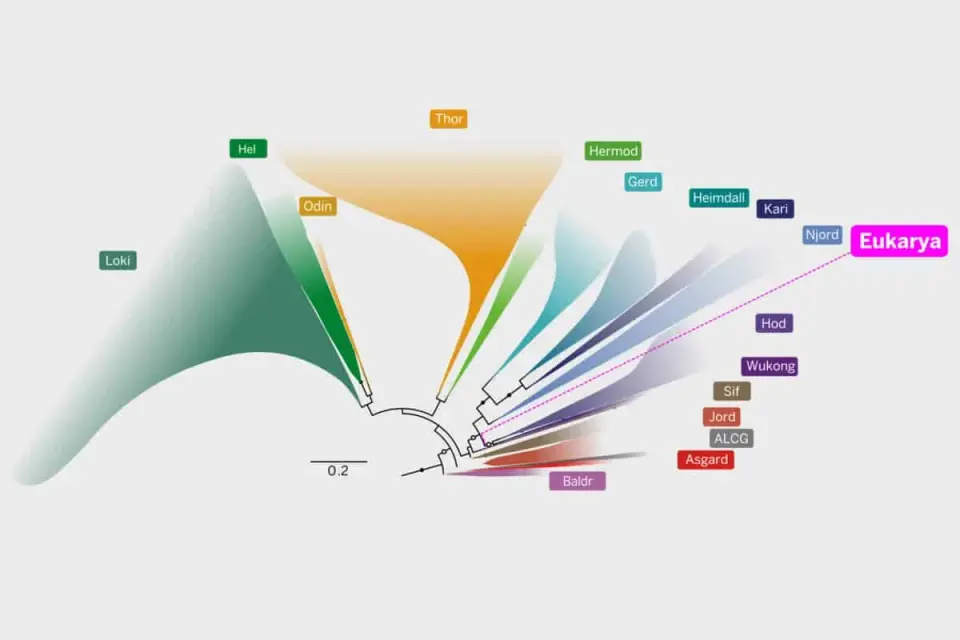
Researchers led by Thijs Ettema at Wageningen University have identified a common ancestor for all eukaryotes within the Asgard archaea group. By analyzing hundreds of microbial genomes, the team found that complex life forms, including humans and plants, trace their lineage to a specific order called Hodarchaeales. While earlier studies suggested this connection, recent broader sampling has complicated the exact evolutionary placement, though the fundamental link remains supported by genetic data.
Key points
- Thijs Ettema’s team analyzed hundreds of archaea genomes to trace the origins of eukaryotes, organisms with defined nuclei.
- The study identifies the Hodarchaeales order as the closest microbial relative to all complex life forms.
- Asgard archaea, discovered in 2015, are microorganisms that carry clear evolutionary links to the archaeal lineage from which eukaryotes emerged.
- The findings were originally published in Nature in 2023 but have been updated following a correction regarding redundant genetic markers.
- Cultivation of these microbes remains difficult due to slow growth and metabolic dependencies on partner organisms.
Background
This discovery builds on the broader understanding of life's origins, such as the 2026 analysis placing the Last Universal Common Ancestor (LUCA) at 4.2 billion years ago. While LUCA represents the root of all life, the Asgard archaea findings specifically address the divergence of complex, nucleus-containing eukaryotes from simpler prokaryotic ancestors.
Why it matters
Understanding the common ancestor of all complex life provides a foundational framework for evolutionary biology. It clarifies how modern organisms, from humans to plants, evolved from ancient microbial lineages, offering insights into the metabolic and cellular machinery that enabled the transition from prokaryotes to eukaryotes over two billion years ago.
What to watch
The scientific community continues to debate the exact placement of eukaryotes within the Asgard family tree. While the 2026 correction by the original authors maintained the Hodarchaeales connection, other large-scale analyses suggest eukaryotes may branch beside Heimdallarchaeia. Future studies will likely refine the metabolic and environmental conditions of this ancient ancestor.
Want the full story? Read the original reporting
Read on ZME Science