
Malva platform enables real-time, reference-free search across 74 million single-cell transcriptomic profiles
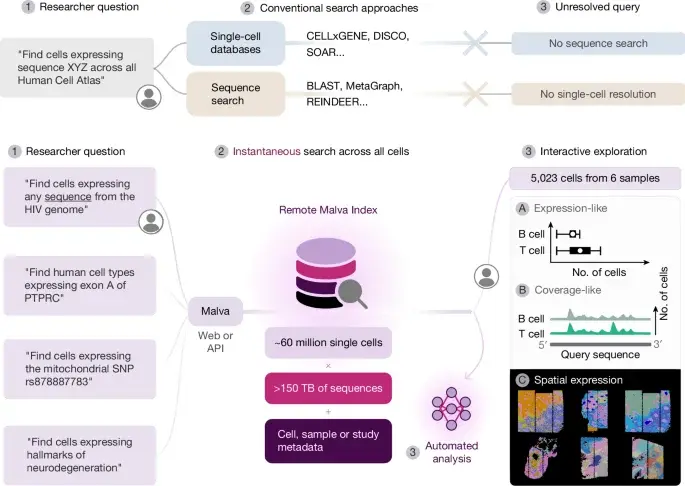
Researchers have introduced Malva, a computational platform that allows ultrafast, reference-free sequence searches across massive single-cell and spatial transcriptomics datasets. By indexing approximately 74 million cells from thousands of experiments, Malva enables users to query for specific nucleotide sequences, mutations, splice junctions, or pathogens in seconds without downloading raw data or aligning reads to a reference genome. The system uses k-mer indexing to achieve low memory usage and high speed, transforming static gene count tables into dynamic, sequence-resolved resources. This capability facilitates the discovery of novel isoforms, viral contaminants, and somatic mutations in cancer, bridging the gap between raw sequence data and biological insight at atlas scale.
Key points
- Malva indexes over 140 TB of public single-cell and spatial transcriptomics data, covering approximately 74 million cells from 592 human studies and additional mouse samples.
- The platform uses a k-mer indexing algorithm that avoids reference alignment, achieving indexing speeds 4 to 25 times faster than traditional methods with a peak memory footprint of only 8 GB.
- Query latency is minimal: 70 milliseconds for a single k-mer, 0.9 seconds for a 1 kb transcript, and approximately one minute for 1,000 transcripts on a single CPU core.
- Malva enables reference-free cell-type clustering and de novo assembly, allowing researchers to identify cell types and predict similarity directly from sequence composition without predefined gene annotations.
- The system successfully detects somatic mutations across 16 cancer types, identifies viral contaminants like Mycoplasma, and maps isoform usage patterns such as CD45RA in B cells, all without reprocessing raw files.
Background
Previous coverage highlighted Malva’s potential to accelerate cancer and infection research by enabling rapid sequence-based queries, though noted limitations regarding exact 24-nucleotide matches. This new detailed publication confirms the platform’s technical performance, validating its accuracy against reference-based pipelines and demonstrating its utility in detecting germline variation, isoform switches, and spatial expression patterns in mouse embryogenesis. It addresses the longstanding challenge that standard single-cell pipelines discard sequence information, retaining only gene counts, which obscures critical data on mutations, pathogens, and non-reference transcripts.
Why it matters
Malva transforms single-cell atlases from static gene count tables into dynamic, sequence-resolved resources, enabling researchers to interrogate raw sequence data at petabyte scale without prohibitive computational costs. This capability is critical for discovering disease-associated sequences, novel RNAs, and pathogen presence that are invisible to standard alignment-based methods, potentially accelerating the development of targeted therapies and improving the accuracy of cellular profiling in health and disease contexts.
What to watch
The Malva Index is continuously expanding, currently covering approximately 80% of the Human Cell Atlas and 20% of human single-cell runs from the NCBI Sequence Read Archive. Future developments will likely focus on integrating Malva with state-of-the-art neural networks for automated analyses and expanding coverage to non-model organisms and biodiversity studies where reference genomes are sparse or incomplete.
Want the full story? Read the original reporting
Read on Nature