
Petermann Glacier Loses Manhattan-Sized Ice Island in Largest Arctic Calving Since 2020
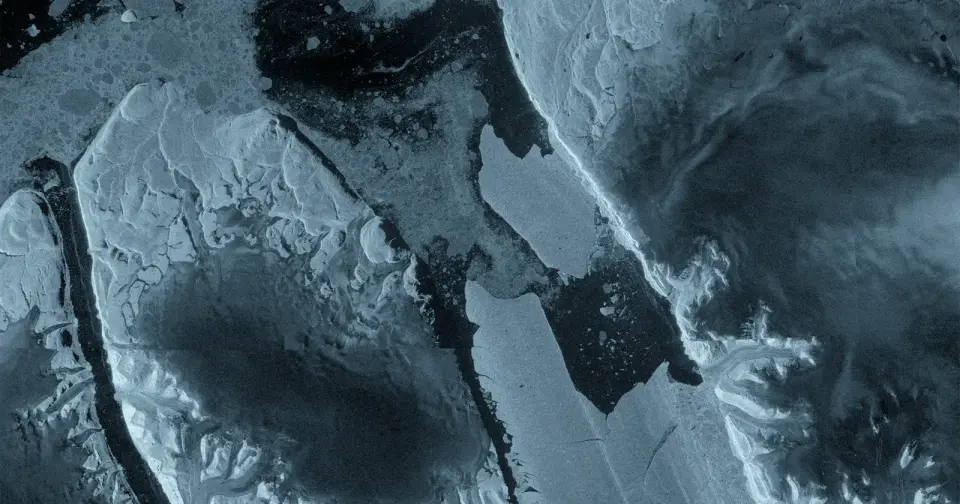
On August 4, 2026, a 76.4-square-kilometer ice island detached from Petermann Glacier in northwest Greenland, marking the largest floating ice loss in the Arctic since 2020. The tabular iceberg, comparable in size to Manhattan and up to 150 meters thick, was identified via ESA’s Copernicus Sentinel-1 satellite data. Scientists anticipate two further major calving events, potentially removing 22% of the glacier’s remaining ice tongue, while monitoring the drifting mass for hazards to Arctic shipping routes.
Key points
- The calving event occurred on August 4, 2026, involving a 76.4-square-kilometer section of Petermann Glacier’s floating ice tongue.
- The resulting ice island is estimated to be up to 150 meters (492 feet) thick and is the largest Arctic calving event since 2020.
- Researchers from the University of Ottawa, University of Stirling, and Environment and Climate Change Canada are tracking the iceberg’s drift and fragmentation.
- Two additional ice islands, estimated at 94 and 84 square kilometers, are expected to detach as existing fractures propagate.
- The loss of the ice tongue removes a natural barrier that slowed glacier flow, potentially accelerating ice discharge into the ocean.
Background
Petermann Glacier has been a focal point for glaciological research since 2019, with satellite monitoring revealing progressive fractures in its floating ice tongue. Previous major calving events at this location occurred in 2012, after which the ice tongue remained relatively stable for over a decade. This event follows a broader trend of accelerating ice loss in the Arctic, where rising ocean temperatures and changing precipitation patterns have altered the balance between snow accumulation and ice discharge.
How outlets are covering it
While PetaPixel and Space.com emphasize the visual scale of the event and its significance as the largest loss since 2012, ScienceDaily highlights the collaborative research effort and the specific threat to marine safety. Universe Today focuses on the mechanical implications, noting that the loss of the ice tongue removes a 'plug' that slowed glacier flow, thereby accelerating ice loss. All sources agree on the rarity of such large tabular icebergs in the Arctic compared to Antarctica, but they differ in emphasis: PetaPixel and Space.com frame it as a climate change indicator, while ScienceDaily and Universe Today stress the immediate logistical and scientific monitoring challenges.
Why it matters
The calving of such a massive ice island signals a shift in the stability of Greenland’s ice sheet, potentially accelerating sea-level rise contributions from glacier discharge. The drifting ice island poses direct risks to Arctic shipping lanes and offshore infrastructure, requiring enhanced monitoring by Environment and Climate Change Canada. Furthermore, the event provides a rare opportunity to study the dynamics of large Arctic ice masses, offering insights that can be applied to understanding ice loss in other polar regions.
What to watch
Scientists expect two additional large calving events in the near future as existing fractures propagate. The primary ice island will be tracked for years as it drifts, potentially running aground before fracturing into smaller, harder-to-track pieces. Researchers will continue using satellite imagery and aerial observations to monitor the iceberg’s movement and assess its impact on glacier dynamics and ocean environments.
- Satellite Images Show Manhattan-Sized Ice Island Breaking Away From Greenland Glacier PetaPixel
- Manhattan-sized ice island breaks off Greenland’s Petermann Glacier ScienceDaily
- A Greenland Glacier Loses Another Chunk of Ice Universe Today
- Huge iceberg breaks apart from Greenland's Petermann Glacier The Weather Channel
- Satellite sees Greenland's most significant floating ice loss in over a decade photo of the day for Aug. 24, 2026 Space
Want the full story? Read the original reporting
Read on PetaPixel