
Drone Pilot Warns California Fisherman of Approaching Great White Shark
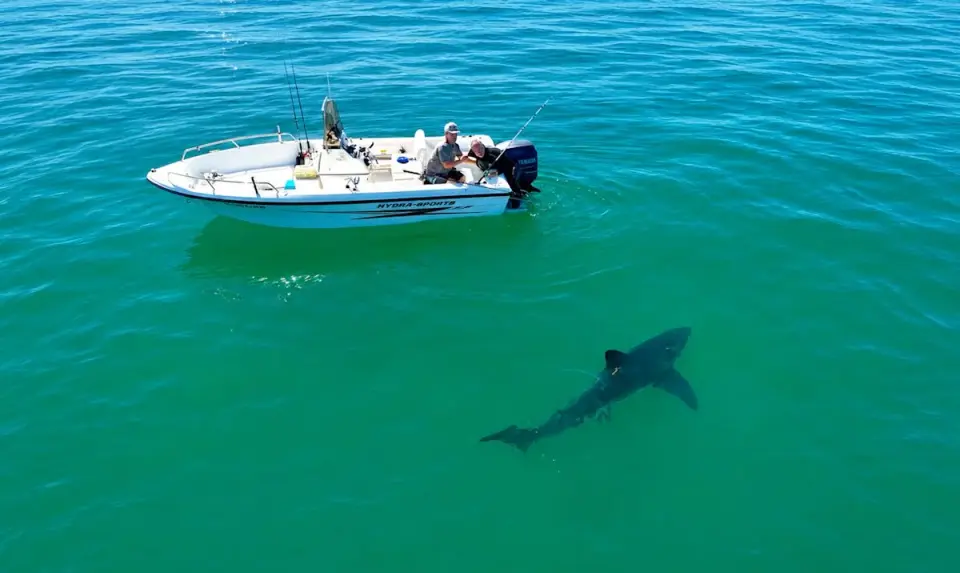
A drone operator in Southern California used aerial footage to alert a fisherman swimming near his boat about a large great white shark approaching the vessel. The fisherman, who had live catch hanging from the side of the boat, returned to the boat after the warning. Experts note that while sharks may investigate prey-like movements, humans generally do not trigger predatory attacks unless specific conditions are present.
Key points
- Carlos Gauna, a drone filmmaker known as The Malibu Artist, spotted a 10- to 11-foot great white shark approaching a boat off Southern California while filming from a beach nearly two miles away.
- The fisherman was swimming beside his boat with two live fish hanging from the hull, which Gauna identified as a potential trigger for the shark's interest due to the movement of prey.
- Gauna used his drone to signal the fisherman, prompting him to climb back aboard the vessel.
- Dr. Chris Lowe, director of Cal State Long Beach's Shark Lab, noted that humans do not typically resemble prey to sharks, but fresh catch or struggling prey can alter shark behavior.
- The incident highlights the importance of situational awareness in the ocean, particularly when live bait or catch is present near swimmers.
Background
This incident follows a recent release by Carlos Gauna of a 13-minute silent compilation of great white shark footage along the California coast, aimed at shifting public perception about shark-human interactions. It also occurs amid recent coastal disruptions in Southern California, where 18-foot waves and dual storm systems triggered flooding warnings and coastal closures in mid-November 2026.
Why it matters
The incident underscores the value of remote monitoring and situational awareness in marine environments, particularly when humans are near potential predators. It also illustrates the nuanced relationship between shark behavior and human activities, such as fishing, which can inadvertently attract attention. While the risk of attack in this specific case was likely low, the warning prevented a potentially dangerous situation and highlights the need for caution when handling live catch near swimmers.
What to watch
Gauna may continue to share footage from his drone compilations to educate the public about shark behavior and ocean safety. Marine biologists may use such incidents to further study shark interactions with humans and prey-like stimuli. No immediate regulatory changes are expected, but the incident may reinforce existing safety guidelines for swimmers and fishermen in coastal areas.
Want the full story? Read the original reporting
Read on Yahoo